

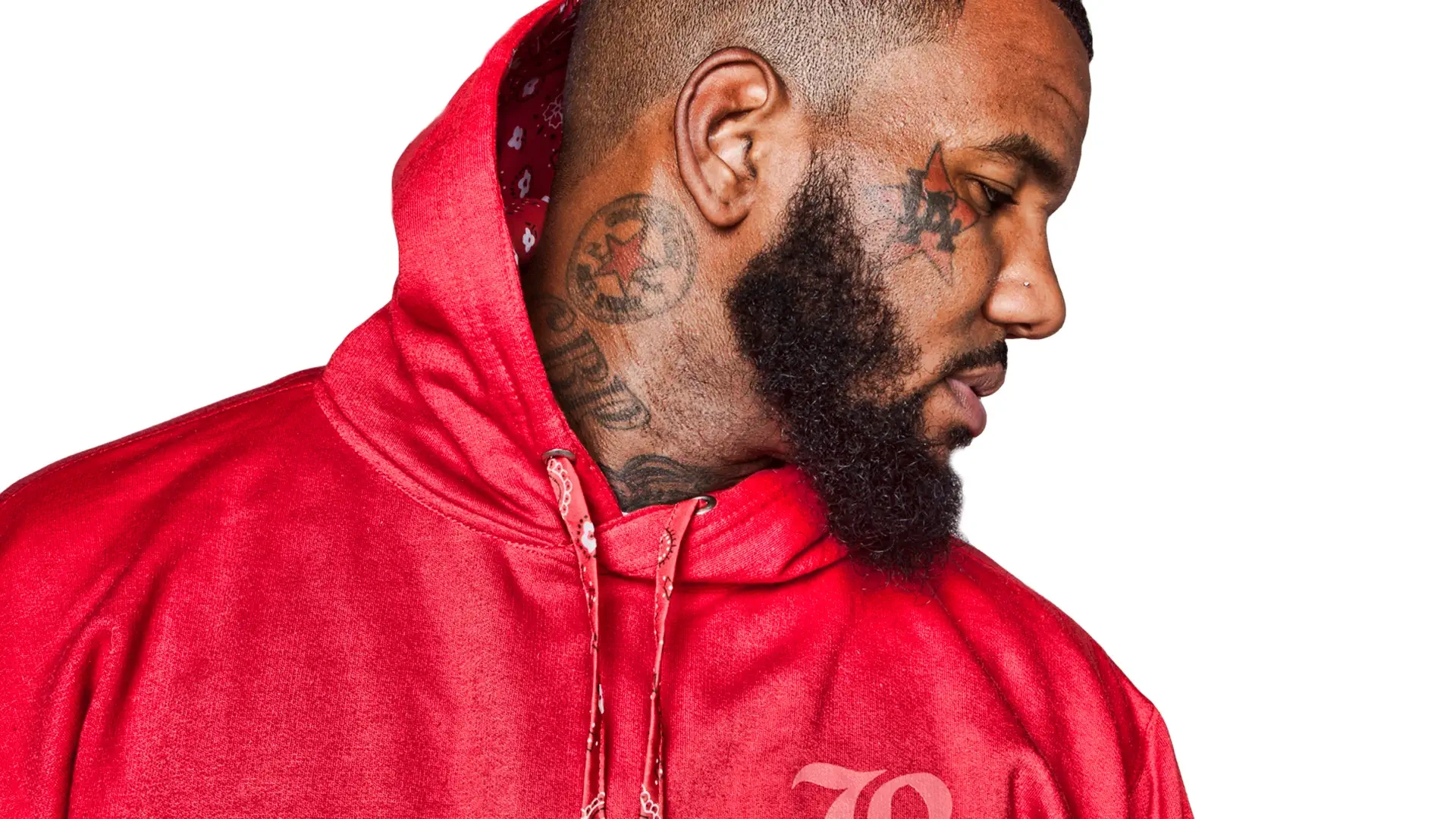
In the summer of 2022, The Game and Big Sean shot a video for "Stupid," one of the singles built to carry Drillmatic: Heart vs. Mind into the world. According to a lawsuit filed Wednesday (Sept 30), a substantial share of that production bill landed on The Game's own label and has never been repaid. That label, 100 Entertainment, is now suing Universal Music Group and its distribution arm, Virgin Music Group, for breach of contract in California Superior Court.
The complaint says UMG and Virgin promised a $500,000 marketing and promotion fund for the album and spent $179,274.79 of it. Of the $125,000 set aside for radio, the filing says, none was spent at all. 100 Entertainment is asking for at least $500,000 in damages along with attorneys' fees and court costs.
Michael Trauben, the attorney representing 100 Entertainment, compressed the label's theory of harm into one sentence of the complaint:
"Deprived of nearly two-thirds of its bargained-for promotional support during the critical release cycle, the album did not perform as it would have had Defendants administered the marketing and promotion fund as the parties approved."
The breakdown behind "nearly two-thirds" is easy to verify: subtracting the $179,274.79 spent from the pledged $500,000 leaves $320,725.21 unspent, about 64 cents on every promised dollar. Music videos swallowed the biggest slice of actual funds ($87,947.58), but even that came in at roughly half of its planned $170,000 budget.
The lawsuit singles out radio promotion as the rollout's biggest failure, claiming none of the $125,000 allocated for airplay was ever spent. Without that push, the two-decade veteran was forced to rely strictly on streaming placement, social media, and independent funding. For an artist whose career was built on urban radio, an unspent airplay budget is a concrete, easily audited allegation.
Drillmatic arrived on Friday, Aug 12, 2022. It sold about 25,000 units in its first week and debuted at No. 12 on the Billboard 200, then spent two weeks on the chart before falling off. Those are respectable numbers for an independent release in a crowded August, and they are also the numbers 100 Entertainment now argues were capped by a rollout that never ran at full volume.
Trauben's complaint spells out what the label believes that cap cost:
"Plaintiff thereby lost royalties, streaming and sales revenues, and related income that the album would have generated with the promised marketing support, in an amount to be proven at trial."
While accounting ledgers and invoices can easily prove whether money was withheld, quantifying lost revenue asks a court to calculate the earnings of a release campaign that never actually occurred.
100 Entertainment had an exclusive distribution deal with Virgin for Drillmatic, not a traditional artist contract with a major label. In arrangements of that kind, the independent label usually keeps its masters and its creative direction. The distributor gets the music onto platforms and supplies services and funding, which are typically advanced against the label's share of revenue. Under that structure, a promised marketing and promotion fund is part of what the label bargained for when it signed, and the complaint says it arrived at about a third of the agreed size.
The complaint adds a second category of grievance on top of the unspent fund. 100 Entertainment says it covered a substantial portion of the production costs for the "Stupid" video to keep the rollout on schedule, and that UMG has not reimbursed those costs. The filing also says UMG and Virgin denied any breach of contract in earlier letters to 100 Entertainment. The lawsuit arrives at the end of that correspondence, not at the start of it.
Neither UMG nor Virgin had issued a public statement on the case as of Monday (Oct 5).
The suit lands a little more than four years after Drillmatic came out. It also arrives six weeks after The Game finally released The Documentary 3 on Aug 21, roughly 19 months after its original January 2025 date. That album, his 11th studio record, was the first new full-length he had put out since Drillmatic, so the dispute over one rollout is now running alongside the promotion of the next.
The Game's history with Universal reaches back to the start of his career. The Documentary, his 2005 debut, came out through Dr. Dre's Aftermath, G-Unit and Interscope, a label inside the Universal system, and it made him one of the most visible new rappers in the country that year. Two decades later, the sequel to that record is out and his own company is in court with the same parent company over the album that came right before it.
It is also the second time in a matter of months that a veteran with real catalog leverage has taken a major-label money dispute to court. Jermaine Dupri's $18 million royalty suit against Sony Music was filed in July and settled in August on undisclosed terms. Both cases turn on paper, on what a contract promised and what an accounting shows, and both put a major company in the position of explaining its own numbers.
The narrower question in the 100 Entertainment case is whether the budget the complaint describes was a binding commitment or a plan that could flex once the record was out. The complaint describes the fund as one "the parties approved," language that suggests a specific, signed-off allocation rather than a loose target, and the radio line is the cleanest test of it. Either $125,000 was promised for radio and nothing was spent, or the paperwork will show a different deal than the one 100 Entertainment describes.
For artists running their own labels through major distribution, the marketing schedule in a deal deserves the same scrutiny as the royalty split. Independent labels negotiating with a major distributor can ask for an itemized marketing plan and written spend reports at fixed points in the release cycle. They can also ask for a clause that says what happens to any money left unspent. A distribution deal that names a dollar figure for promotion is only as useful as the reporting that shows where each dollar went. 100 Entertainment's complaint is built almost entirely on that reporting: $500,000 promised, $179,274.79 spent, $87,947.58 on video, and nothing on radio.
UMG and Virgin will have their own chance to answer those numbers once they respond in court.
Comments (0)
No comments yet — be the first to share your thoughts.
Leave a comment