

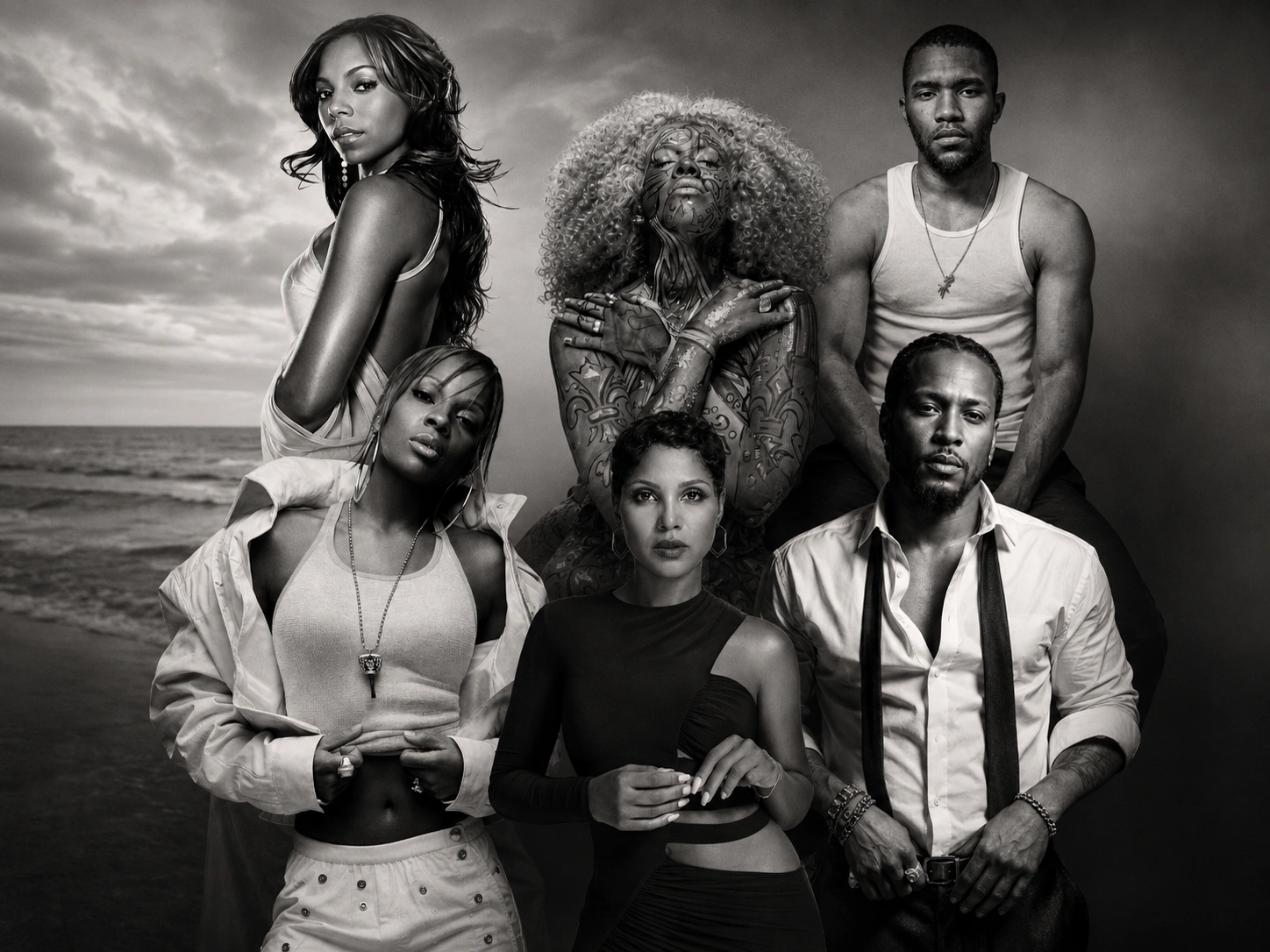
They sold millions of records. Some of them still ended up broke, or silenced, or locked out of their own catalog for decades. Here is how the paperwork did what no rival ever could.
The music industry has always run on an uncomfortable arithmetic: the artist takes the risk of being seen, and the label takes the risk of being paid back first. For most of R&B's history, that second part of the equation was written by lawyers the artist never had, into contracts the artist rarely understood, at an age when the artist was in no position to argue. The fifteen stories below span seven decades, and nearly all of them share the same architecture. Someone made a fortune. It was rarely the person singing.
The Original Sin: Doo-Wop and the Birth of the Bad Deal
Frankie Lymon & The Teenagers
Before there was a modern R&B industry to exploit anyone, Frankie Lymon and the Teenagers were already being exploited by the one that existed. "Why Do Fools Fall in Love" was a massive 1956 hit, co-written by Lymon while he was still a teenager, and the group saw only a sliver of the money it generated for adults around them. Publishing credits were reassigned, royalties were skimmed, and Lymon, who had helped invent a genre's commercial template before he could legally sign his own contracts, died in 1968 addicted to heroin and functionally broke. Every predatory deal that follows in this list has a direct ancestor here.
Little Richard
Little Richard spent decades saying plainly, and loudly, that Specialty Records paid him a fraction of what his hits earned the label, and that the standard contracts of the era were built to keep a Black rock and roll pioneer from ever seeing the scale of his own success. He eventually negotiated a settlement, but the imbalance he described, one of the most influential catalogs in American music history generating comparatively little for the man who made it, became the founding case study for why artists of his generation grew permanently suspicious of the paperwork.
The Nineties Girl Group Bankruptcies
TLC
This is the single most quoted bad record deal in R&B history, and the numbers still stagger on repetition. TLC signed with LaFace Records and manager Perri "Pebbles" Reid's Pebbitone in 1991, a contract that gave the trio roughly fifty-six cents per album sold, split three ways, before recoupable costs. By 1995, on the strength of two multi-platinum albums, the group filed for Chapter 11 bankruptcy, citing $3.5 million in debt. Chilli's line at the 1996 Grammys, delivered moments after winning Best R&B Album, became the era's defining quote: "We've sold 10 million albums worldwide. We're as broke as broke can be." The group sued, eventually renegotiated directly with LaFace, and had to buy back the rights to their own name.
Toni Braxton
Toni Braxton's contract routed her royalties through LaFace as part of a group agreement with her sisters, and the recoupable-expense structure common to the label left her filing for bankruptcy in 1998 despite Toni Braxton and Secrets selling a combined tens of millions of copies worldwide. She filed again in 2010. Braxton has spoken candidly since about renegotiating her deals from a position of hard-won leverage rather than trust, a lesson she says she learned only after watching a fortune she had earned disappear into contractual structure before it ever reached her.
The Uptown and Bad Boy Ecosystem
Mary J. Blige
Mary J. Blige's debut, What's the 411?, made her the reigning voice of hip-hop soul at just twenty years old, signed to Andre Harrell's Uptown Records. She has said in interviews since that the financial terms of that early deal did not reflect the scale of what she was generating for the label, and that renegotiating her contracts after leaving Uptown for MCA was a defining act of self-advocacy in an industry that had initially undervalued her. The gap between her cultural impact in the early 1990s and her actual earnings from that period remains one of the more quietly cited cautionary tales among the artists who came up around her.
Jodeci and K-Ci & JoJo
Jodeci helped define the sound of 1990s R&B for Uptown and MCA, but internal accounts from members over the years have described a contract structure that left the group frustrated with their earnings relative to their sales. K-Ci and JoJo eventually split off to record as a duo, a move that in interviews they have framed partly as a search for cleaner financial terms after years of feeling shortchanged inside the group's original arrangement.
The Production Deal Problem
En Vogue
En Vogue's four voices made producers Denzil Foster and Thomas McElroy's vision for a modern girl group into a genuine commercial force, but the group's own accounts of their early contracts describe a structure where the writing and production credits, and the publishing rights attached to them, sat with Foster and McElroy rather than the singers performing the songs. Internal lineup changes over the following decade were driven in part by exactly this kind of financial frustration, a recurring pattern in girl groups built around an outside production team rather than the artists' own compositions.
The Publishing Trap
Kelis
Kelis has said plainly, in multiple interviews, that she was promised an even three-way split of publishing royalties with producers The Neptunes on her first two albums, a verbal arrangement she says was never honored on paper. "I was told we were going to split the whole thing 33/33/33, which we didn't do," she told The Guardian in 2020, adding that she saw no money from either Kaleidoscope or Wanderland. The dispute became public again in 2022 when Beyonce's "Energy" interpolated "Milkshake" and credited only Pharrell Williams and Chad Hugo, not Kelis, who is not a credited songwriter on her own signature single under the terms of that original deal. The sample was quietly removed from later versions of the track, but Kelis's underlying royalty dispute with The Neptunes was never resolved by that gesture.
The Silenced and the Shelved
D'Angelo
D'Angelo's Voodoo made him one of the defining voices in neo-soul, but the "Untitled (How Does It Feel)" video also boxed him into a sex-symbol image he later said he found suffocating, and the industry pressure to keep repeating it, layered onto genuine label friction over direction and control, contributed to a fourteen-year gap before Black Messiah finally arrived in 2014. It stands as one of R&B's starkest examples of a major label's commercial expectations actively working against an artist's own sense of what his career should be.
Frank Ocean
Frank Ocean's relationship with Def Jam grew contentious enough that he has described feeling boxed out of his own release timeline, ultimately delivering the visual album Endless in 2016 largely to satisfy his contractual obligation to the label at minimal cost and effort, before independently self-releasing Blonde, widely considered his true artistic statement, just one day later outside the label system entirely. The maneuver is now cited in the industry as one of the cleaner examples of an artist using the letter of a bad contract to escape its spirit.
The Catalog Held Hostage
Aaliyah
Aaliyah's catalog sat almost entirely off major streaming platforms for nearly two decades after her death in 2001, not due to any lack of demand but because of a prolonged dispute between her estate and Blackground Records, the label founded by her uncle Barry Hankerson. Fans built entire online movements around the absence, and when her albums finally began arriving on streaming starting in 2021, the story became less about a comeback than about what two decades of a locked catalog actually costs an artist's legacy, in an industry where Black music's dominance of the streaming era has become one of the defining stories of the last several years, dominance her own catalog was excluded from for most of that time.
The Management and Ownership Fights
New Edition
New Edition's original success under manager Maurice Starr came with a contract the group has said left all five teenagers earning a small fraction of what their records generated. The group eventually sued Starr and won a settlement, but not before watching an outside adult profit from a phenomenon built entirely on their own faces and voices, a formative injustice several members have referenced for decades as the reason they insisted on tighter control over every deal that followed.
Blackstreet
Teddy Riley built Blackstreet into one of the defining New Jack Swing acts of the 1990s, but the group's lineup churned repeatedly across its run, changes that members and industry accounts alike have tied at least partly to disputes over money and credit inside a structure where Riley held outsized creative and financial control as the group's founder and primary producer.
Dru Hill
Dru Hill's run of hits in the late 1990s masked a genuinely turbulent internal business relationship, with members later describing frustration over how the group's earnings were managed and distributed. Sisqo's break into a hugely successful solo career with "Thong Song" only sharpened the contrast, a reminder of how unevenly a group's commercial value can end up divided once the contracts and management fees are actually totaled.
Ashanti
Ashanti's run of hits for Murder Inc. in the early 2000s made her one of the best-selling R&B acts of the decade, but her relationship with the label and its founder Irv Gotti soured over royalties she said she was owed, culminating in a lawsuit years later over unpaid compensation from that era. The dispute became one of the more prominent examples of a chart-topping artist having to take her own label to court simply to collect money tied to music that had already made everyone involved a great deal of it.
The Pattern Underneath the Paperwork
Read all fifteen together and the through-line is not fraud in the cartoonish sense. It is structural leverage. A teenager signs what an adult puts in front of her. A label recoups its costs before an artist sees a cent. A production team credited as songwriters keeps the publishing money long after the song stops being new. None of it requires anyone to break the law. It only requires one side to understand the contract and the other side to trust the person holding the pen. The royalty dispute stories in this piece span from 1956 to the 2020s because the mechanism never actually went away, it just got better lawyers on one side of the table and, slowly, over decades of artists like TLC and Kelis and Aaliyah's estate speaking publicly about exactly what happened to them, slightly better ones on the other.


Comments (0)
No comments yet — be the first to share your thoughts.
Leave a comment