

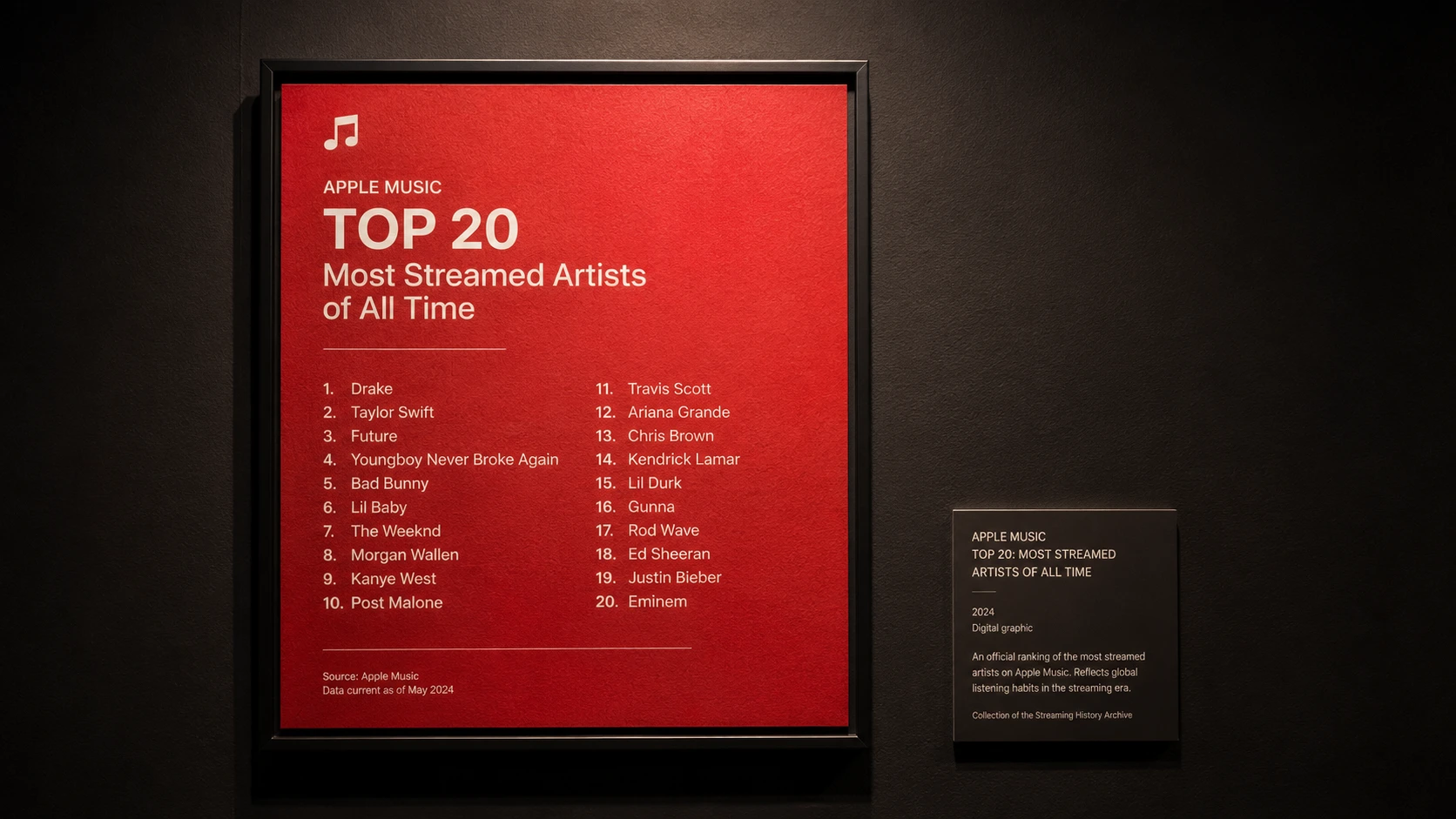
Apple Music just published its 20 most-streamed artists of all time. Read it correctly and it stops being a leaderboard. It becomes the receipt for a century-long takeover, dropped right in the middle of Black Music Month.
You have seen it by now. The red square, the Apple logo at the bottom, twenty names stacked in two tidy columns, Drake sitting at the top like he was placed there by gravity. It went around the timeline the way these things do, screenshotted and reposted and argued over for a day. Most people read it as a popularity contest and scrolled on. That is the wrong way to read it. What Apple Music and Chart Data released on June 18 is not a popularity contest. It is a property record, and the property in question is the sound of the modern world.
Here is the direct answer for anyone who only wants the headline: Drake is officially the most-streamed artist in Apple Music history, topping a list that spans the platform's entire eleven years. But the headline is the least interesting thing on the page. Look at the other nineteen names. Fourteen of the twenty work primarily in hip-hop or R&B. The genres that built this list were invented, refined, and exported by Black America. And the list dropped, with no apparent sense of occasion, during the exact month the country set aside to acknowledge that fact.
For most of recorded-music history, Black music was treated as a feeder system. It was the place the mainstream went shopping. Rock and roll was built on it, pop borrowed its cadences, and the official charts were engineered, for decades, to keep the borrowing quiet and the credit elsewhere. The genius was acknowledged. The ownership of the center was not.
Streaming detonated that arrangement, because streaming does not care what radio programmers or award committees think is respectable. It counts. It is a brutally honest machine, and when you let an honest machine tally eleven years of what people on earth actually chose to press play on, this is the list you get. Not a list where Black music is well-represented. A list where Black music is the representation, and everything else is visiting. Drake, Future, YoungBoy Never Broke Again, Lil Baby, The Weeknd, Kanye West, Travis Scott, Chris Brown, Kendrick Lamar, Lil Durk, Gunna, Rod Wave. The spine of the all-time chart is the spine of the culture.
And the entries that are not hip-hop or R&B mostly prove the same point from a different angle. Listen to where modern pop keeps its rhythm and its phrasing, where its melodic runs and its drum programming come from, and you are listening to choices Black music made first. Even the pop on this list is fluent in a language it did not invent. That is not an insult to anyone on it. It is the water the entire industry swims in.
It is tempting, in rap's endless greatest-of-all-time arguments, to flatten what Drake's number-one spot actually represents. Forget the rankings debate for a second. He holds 27 songs in Apple Music's all-time top 500, more than any artist alive or dead, and his 2026 alone produced a record-breaking simultaneous album drop that briefly made him the platform's most-streamed artist in a single day. We broke down that triple-album maneuver and what it signaled in our coverage of the Iceman, Habibti, and Maid of Honour release, and the streaming milestone is the long tail of exactly that kind of move.
But the deeper reason he sits at the top is the thing that gets lost. Drake is a one-man demonstration of Black music's reach, because his entire method is absorption and amplification of the diaspora. Afrobeats, UK drill, dancehall, Caribbean production, Memphis cadences, Atlanta trap, all of it pulled into the center and broadcast to rooms that had never heard it. We traced that whole machinery in our deep dive on how he globalized the genre. The man at number one got there by being a conduit for everything the list underneath him represents. That is not a coincidence. That is the thesis with a face on it.
Pull the camera back far enough and the red graphic stops looking like a 2026 story at all. It looks like the last frame of a much older one. Every name on it is standing on a foundation poured by people who never saw a streaming dollar. The blues singers who got songwriting credit stolen in real time. The Motown architects who built the template for crossover and watched the institutions keep the equity. The early hip-hop pioneers in the Bronx who invented an entire art form out of two turntables and a neighborhood that the city had written off, and who, for the most part, are not wealthy men today.
The reason Black Music Month exists, since President Carter first proclaimed it in 1979, is precisely because the contribution kept being separated from the credit. So when an honest counting machine finally puts the numbers on a red square and the numbers say what the culture always knew, the right response is not only celebration. It is recognition. This list is a monument, and like most monuments it is standing on graves that do not have their names on it. Honoring the moment means saying both things at once.
Here is where the victory lap has to slow down, because there are two charts and Apple Music only published one of them. There is the streams chart, the one we are all admiring. And then there is the ownership chart, the one nobody screenshots, and the two do not match. Dominating the first is not the same as owning the second, and the gap between them is the oldest story in this business.
Streams are rented attention. They generate fractions of pennies, routed first to whoever controls the masters and the publishing, and only then, often after the recoupment math has had its way, to the artist. An act can sit near the top of a chart like this one and still not own the songs that put them there. We laid out that exact disconnect in our piece on why millions of plays still do not pay most artists' bills, and that disconnect is the unfinished business this graphic quietly raises. The culture has, beyond any argument now, won the streaming era on sound. Winning it on equity is a separate fight, and it is the one still in progress.
That is not a reason to dim the moment. It is the reason the moment matters. The generation on this list grew up watching their elders make the world's music and miss the world's money, and a meaningful share of them have responded by obsessing over masters, building their own labels, and treating ownership as the actual prize. The number-one streaming spot is the trophy. The deed is what they are really after.
So put the red square back in context one more time. It is not a leaderboard for fans to bicker about. It is documentary evidence, filed by the most unsentimental witness in the building, that Black music is not a category within global pop. It is the load-bearing wall. Hip-hop and R&B did not get a seat at the table. They became the table, and everyone else is eating off it.
That is worth saying plainly during the one month built for saying it. The sound already won. It won so completely that even a corporation's automated stream-counter cannot help but announce it. The work that remains, the part Black Music Month should actually point us toward, is making sure the people who keep building that sound finally get to own the floor they are holding up. Until then, screenshot the red graphic. Just read it for what it is. A receipt, and a reminder of the balance still owed.
Comments (0)
No comments yet — be the first to share your thoughts.
Leave a comment