

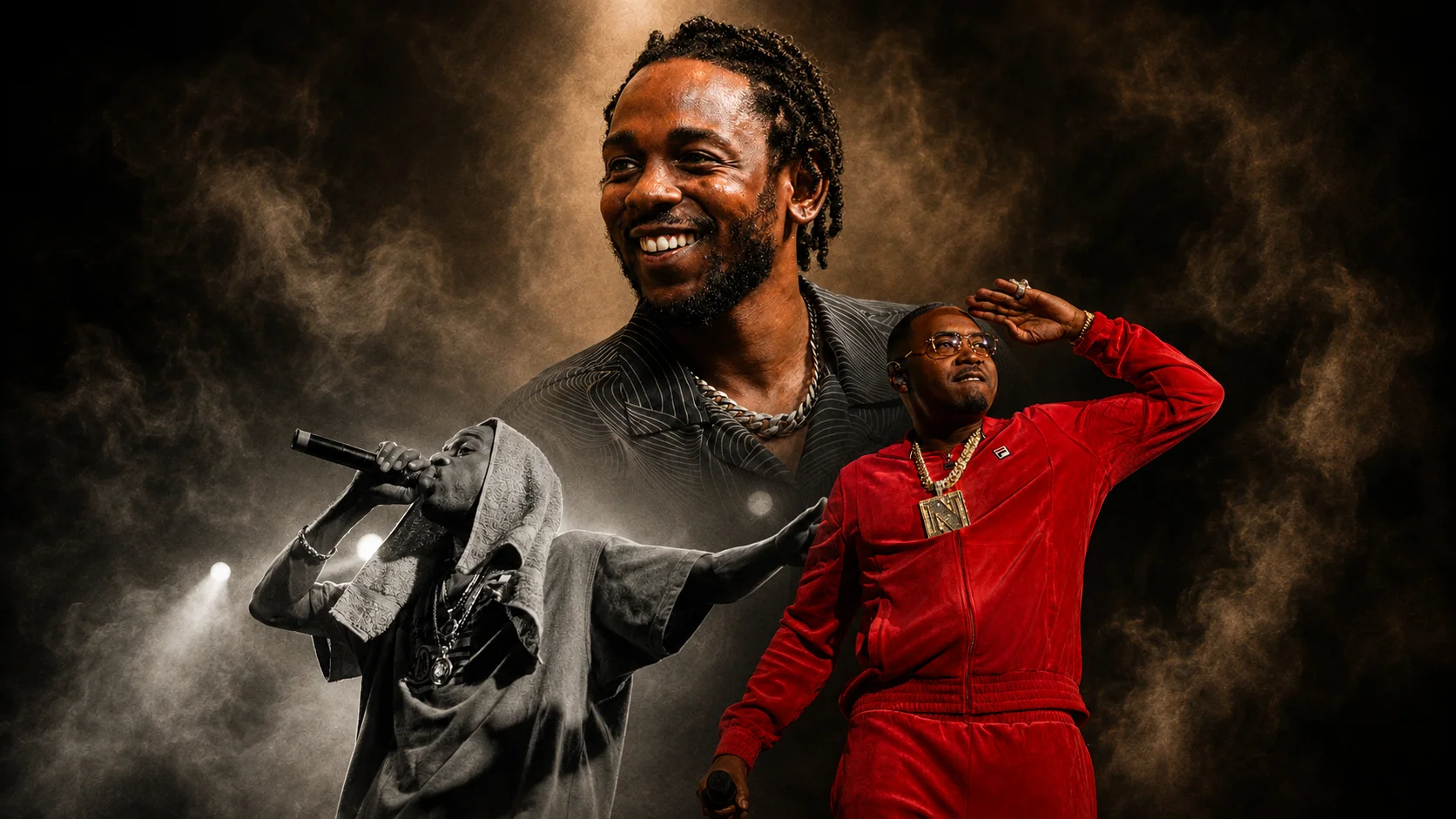
The title always arrives late. In 1987, Rakim was a teenager from Wyandanch, New York, who talked over an Eric B. record instead of shouting across it. It took years for the culture to understand that he had changed where a rhyme was allowed to sit inside a bar. Nas was twenty when Illmatic arrived in April 1994, then spent much of the next decade being told he had wasted the gift. Kendrick Lamar was a Compton kid with a mixtape and a Dr. Dre cosign before he became a Pulitzer winner. Nobody in that line was crowned on release day. The crowns came later, once the rest of the room caught up.
That is why the search for the next great lyricist is almost always conducted badly. It gets reduced to a freestyle bracket, a punchline audit or a streaming tally, producing the same six names every year. But the line from Rakim to Nas to Kendrick is not a leaderboard of who raps hardest. It is a record of three artists who arrived when the music had drifted away from writing and pulled it back by force.
Look closely at what each of them did to the art form, and the criteria become clear. Rakim took the shout out of rap. He moved the rhyme inside the line, let syllables land away from the drum and delivered it all at conversational volume. The words themselves had to carry the weight. Nas turned the verse into first-person reporting. He wrote with a camera, in the present tense, from a specific set of windows in Queensbridge, and the detail became the argument. Kendrick made the album, rather than the song, the primary unit of meaning. He turned his own voice into a cast rather than a signature, allowing a record to hold a position, contradict it and prosecute that contradiction across an hour.
Three things, then: a technique that changes what the form can do, a perspective the form did not previously have and a body of work rather than a moment. Hip-hop lyricism at this level is measured in decades, reinventions and reversals, not one hot verse.
What is not being measured: freestyle clips, bar-for-bar Genius annotations, first-week numbers or how loudly the internet insists somebody snapped. Glorification is slow, and it is almost always retroactive. Jay-Z's debut took thirty years to become permanent, and it was not the consensus album of its own summer. Anyone claiming they can name the winner today is probably selling something.
Here are five artists with a legitimate case, argued honestly, with the counterargument included.
JID has the hands. He still owes us the thesis.
Nobody currently working has more control over the mechanics. JID can compress more syllables into a bar without sacrificing diction than almost anyone since Andre 3000. Unlike most technicians, he never sounds as though he is completing an assignment. The Forever Story, released in 2022, was the proof of concept: a family narrative with recurring characters, a real ending and a structural discipline that most rappers with his hand speed never bother to develop. God Does Like Ugly arrived on August 8, 2025, pushing further into the competitive and spiritually restless register he has circled since the Dreamville years.
So what is missing? Rakim, Nas and Kendrick each had a position, something they were arguing for that could survive being written down as a sentence. JID has moods, virtuosity, an exceptional ear for collaborators and an unwillingness to standing still long enough to be pinned down. In February 2026, he remixed the Frosted Flakes "Hey Tony" jingle for Kellogg's, debuting it at a branded seven-on-seven football event featuring the marching band from his former high school in Stone Mountain, Georgia.
That is not a scandal. Rappers have always taken the check, and there is something genuinely warm about bringing the Stephenson band along for it. But it also says something about where his attention goes when he is not in an album cycle. At the equivalent point in their careers, the three men in this lineage were almost unbearably fixated on a central idea.
What has to happen is simple to describe and difficult to execute: one record where the technique serves the thesis instead of the other way around. He is capable of making it. He has not made it yet.
Doechii has the perspective. She still owes us the album.
Doechii is the only artist on this list whose case rests on something the lineage genuinely lacks. Rakim, Nas and Kendrick wrote from fixed vantage points and made them universal. Doechii writes from inside a mind that refuses to hold still, and she has developed a technical vocabulary for that instability: register shifts in the middle of a verse, sudden self-interruptions and the ability to move from shredding double-time into a spoken aside without showing the seams.
Alligator Bites Never Heal, released August 30, 2024, was a mixtape by her own designation. It won Best Rap Album at the Grammys in February 2025, making her the third woman to win the category. She followed it by turning "Anxiety," a song she first uploaded to YouTube in 2019, into her first top-ten hit on the Billboard Hot 100.
The problem is the two-year silence where the debut studio album should be. At the 2026 Grammys, where she received five nominations and won Best Music Video, she said a new record was coming and that her headspace had changed. As of this writing, it has not arrived.
That is not a character indictment. Perfectionism is real, and the pressure surrounding a first album after that kind of breakthrough can deform the work before it is finished. But the lineage against which she is being measured consists of artists who delivered under pressure, then returned and did it again.
There is another, more interesting risk. Her strongest commercial instincts pull toward pop, and the industry will pay her enormously to follow them. Lauryn Hill remains both the cautionary tale and the proof of concept: one nearly perfect record, an unbreakable ceiling and then a silence nobody could successfully argue against. Doechii has the pen to avoid that outcome. She has to publish.
Rylo Rodriguez built an entire language and never asked for the crown
This is the choice that will annoy people, and it is the one this publication feels most strongly about. Rylo Rodriguez came out of the Roger Williams Housing Projects in Mobile, Alabama, and was raised by his grandfather and signed to Lil Baby's label in 2020. Since then, he has developed the most inventive free-associative writing in Southern rap.
His metaphors arrive sideways. Setups and payoffs land two bars apart, sometimes in what feels like the wrong order. The emotional register can slide from grief into a store-brand joke inside a single breath. Nobody else writes quite like him. Lil Wayne at his peak is the closest ancestor, and Wayne is a reasonable person to be compared with in any serious conversation about the pen.
S.K.A.T.E. landed on July 3, 2026, his first project in three years. The title stands for Silence Keeps All Targets Exposed, as clean a statement of worldview as anybody in this piece has offered. The album is also twenty-three songs long.
That number is the counterargument. The lineage rewards editing. Illmatic is ten tracks. Rylo works in abundance, and abundance is often how great writers get filed under regional favorite rather than a canonical figure. He also shows no visible interest in the crown, which is either disqualifying or exactly why he might deserve it, depending on how romantic you are about these things.
What would change the argument? A short, ruthlessly sequenced record made with somebody in the room who is willing to tell him no.
Little Simz is already doing the job, from the wrong passport
Here is the uncomfortable possibility: the next person to hold this position is not American. The sentence deserves to be said plainly rather than filed away under international coverage.
Little Simz, born Simbiatu Ajikawo in Islington, has been writing at this level for the better part of a decade. She won the Mercury Prize in 2022 for Sometimes I Might Be Introvert, an album that accomplishes structurally what Kendrick's best records do. It builds an argument across a full project, then stages it through orchestration, interludes and character. She is six albums deep. She acts. She has completed the long apprenticeship this lineage supposedly rewards.
What makes her case urgent in 2026 rather than 2021 is Lotus, released June 6, 2025. The album was made in the wreckage of her split from producer Inflo, whom she had known since childhood and sued in January 2025 over an unpaid loan of 1.7 million pounds. She has said she started and abandoned four albums before completing this one, and described losing her sense of purpose during that period.
The record that emerged is thirteen songs, self-directed and unsentimental about betrayal. It is the sound of a rapper writing her way through the worst professional year of her life without flinching and without wallowing. That is a rarer skill than rapping fast.
The counterargument is real, but it is structural rather than artistic. This lineage has always belonged to a specifically American conversation, and the audience that confers the title has never fully extended the privilege across the Atlantic. Simz may already be doing the job while being denied the name. That is a problem with the voters, not the candidate.
Baby Keem is closest to the throne, which proves nothing
Baby Keem is on this list because the case is genuinely strong and because it is the case most likely to be made lazily. He is Kendrick's cousin, a PGLang principal, a co-architect of some of the most restless rap records of the past five years and a Grammy winner for "Family Ties."
Ca$ino arrived on February 20, 2026, with twelve tracks, more than four years after The Melodic Blue. It confirmed what "Family Ties" had suggested: Keem hears song structure the way most rappers hear a beat. He builds records that change shape twice before the second verse.
But proximity is not succession, and structure is not the pen. Keem's gift is architectural. He writes toward feeling and momentum rather than argument, and the moments on Ca$ino when he reaches for something declarative are the moments when he sounds least like himself.
The Rakim-to-Nas-to-Kendrick line is a line of writers whose words can be lifted out of context and still land. That is not currently what Keem is optimizing for.
The path exists. It requires him to decide that he is a writer who produces rather than a producer who raps. There is no evidence yet that he wants to make that trade.
Who got left out, and why
A few omissions are worth defending. The veterans still doing extraordinary work, billy woods, Roc Marciano and AZ among them, are not candidates for a title whose operative word is next. It is faintly insulting to keep describing fifty-year-old masters as emerging.
J. Cole named his own exit with The Fall-Off in February 2026, which is its own form of authorship. Vince Staples remains one of the sharpest minds in the music, but he is currently building outward into punk, television and everything else. That is a career, not a bid for this particular throne.
Denzel Curry, Saba, Rapsody and Kenny Mason all have live cases that could look obvious three years from now. Meanwhile, many of the names dominating the online best rappers of 2026 conversation are built for the clip economy, which rewards nearly the opposite of what this list is measuring.
Why the argument matters more than the answer
There is a commercial subtext here that nobody in the comments section is likely to raise. Hip-hop remains the largest genre in American streaming, but its share has been contracting as Latin and country close the gap. Part of the mechanism behind that decline is a thinning superstar pipeline.
Genres do not survive on volume alone. They survive on people the culture will argue about for thirty years, and those people have historically been writers.
That is why this exercise deserves to be taken seriously rather than treated as another comment-bait ranking. The pen is the part of the music that does not scale. A model can approximate a flow, a cadence, a beat and, increasingly, a voice. What it cannot do is spend fifteen years accumulating a particular set of windows through which to look at the world.
That remains true far beyond music, in every field where the work that resists automation is built on judgment nobody can shortcut.
The honest answer is that we will not know for another decade. The artist who inherits the line may be somebody whose name does not appear in this piece, working right now in a bedroom in a city none of us are watching. That is how it happened the last three times.
What we can do is define the standard, name the five artists with the strongest active claims and refuse to hand the title to whoever trended hardest this week. Rakim did not trend. He simply wrote in a way nobody had before, then waited for the rest of us to catch up.
Comments (0)
No comments yet — be the first to share your thoughts.
Leave a comment