

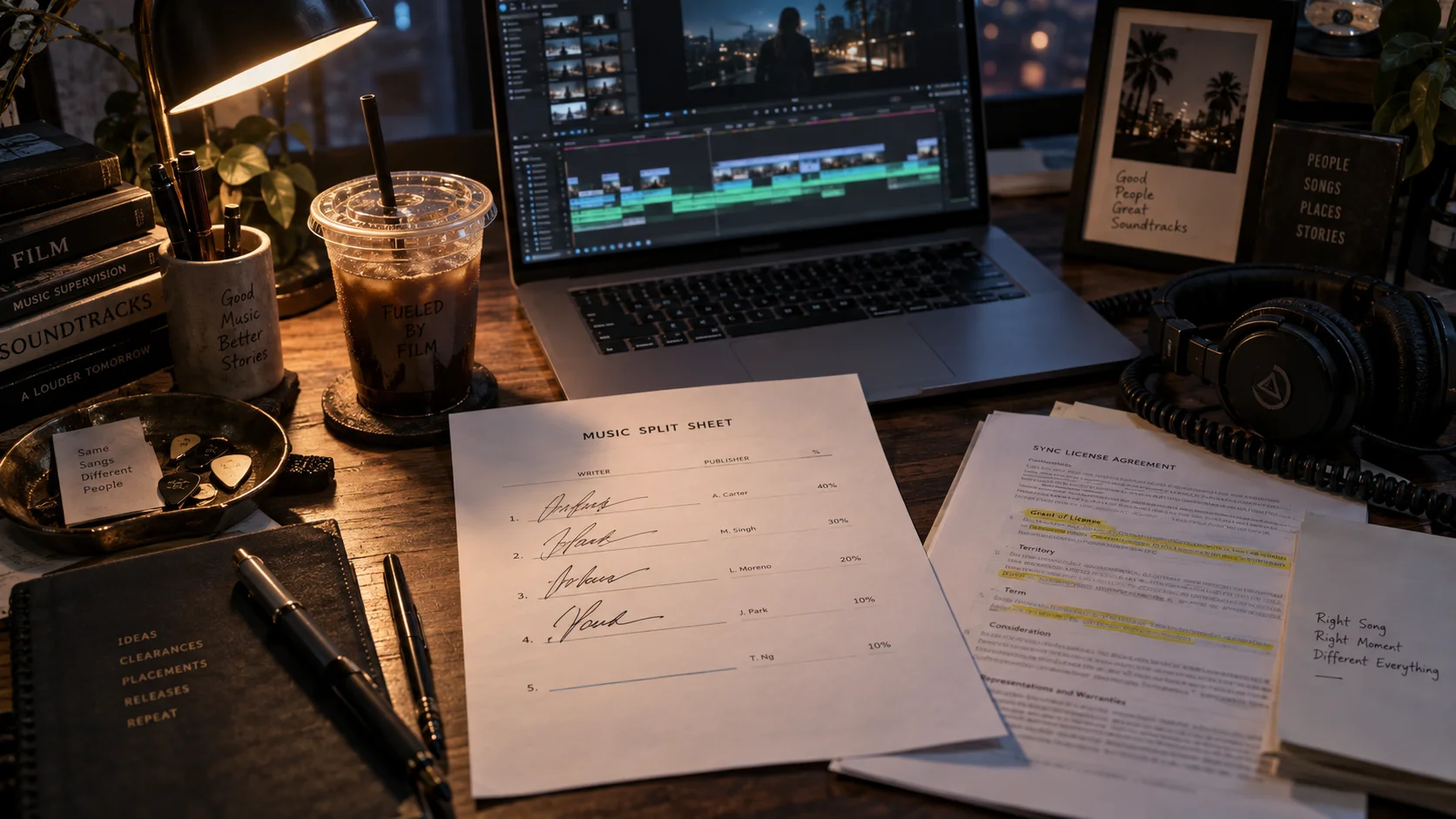
Synchronization licensing starts with a simple request: a scene description, a runtime and a Friday deadline. Even when a music supervisor knows the exact track she wants, she still has to identify everyone authorized to approve it. A clean rights file may take two calls. A messy one can take 11. The difference is rarely the music itself. It is the paperwork.
Synchronization licensing was the fastest-growing line in the U.S. music business during the first half of 2026. Revenue reached $232 million, up 18.2 percent, while paid subscriptions, which generate much of rap and R&B income, rose 6.4 percent, according to our reading of the RIAA mid-year report.
Winning sync opportunities is not simply about pitching harder or sending more emails. Every placement needs two separate permissions: a synchronization license for the composition and a master-use license for the recording. Artists and rights holders can improve their odds by keeping ownership records current, naming a responsive contact and confirming that both sides can approve a deal. In short, the artist who makes clearance easy is the one who gets the call.
Two Copyrights, Two Signatures
The U.S. Copyright Office states the underlying structure without decoration in Circular 56A, which holds that "sound recordings and musical compositions are considered two separate works for copyright purposes." One song you wrote and one recording of it are two pieces of property, and they can be owned by different people who have never spoken.
Steven Winogradsky and Amy E. Mitchell put the practical consequence plainly in their entertainment law institute chapter on music licensing: "When copyrighted music is included in an audiovisual production, there are potentially two separate copyrights involved that need to be licensed: (1) the musical composition, typically owned by the music publisher; and (2) the specific recording of that composition, typically owned by the artist's record company." The first document is the synchronization license, granted by whoever controls the publishing. The second is the master use license, granted by whoever owns the recording.
Worth knowing before a lawyer corrects you in a meeting: there is no synchronization right written into the statute. The exclusive rights at 17 U.S.C. 106 begin with the right "to reproduce the copyrighted work in copies or phonorecords," and sync is an industry term for licensing that reproduction right against moving picture. The name is trade custom; the leverage is statutory.
This is where leased beats quietly disqualify a catalog. An artist who bought a track for thirty dollars under a non-exclusive lease does not own the instrumental composition and frequently cannot grant the master rights a supervisor needs, a gap we mapped in detail earlier this month. The song can be a hit and still be unlicensable.
One Stop, or No Callback
Mark Frieser, who chairs Sync Summit, defines the term supervisors use for the records they can actually move on: "a 'one stop' is a track that has all assigned rights cleared, and a 'one-stop shop' is a library, publisher, label or other rights owner, creator or holder authorized to represent all assignable rights to a particular track or set of tracks for sync licensing." He does not leave room for partial credit. "Publishing and master rights must be 100% pre-cleared," he writes. "Not half, not some, but all your rights better be airtight."
The reason is occupational rather than aesthetic. A supervisor who delivers an uncleared song to a network has put her own name on a legal exposure that outlives the episode, so she reaches for the record she can close by Friday. Dom Jones, a specialist for Sony SyncShop, told Berklee what that looks like from the other side of the inbox: "Nobody wants to go back and forth with you while you figure out your splits. If they love the song, make it easily clearable for the person that you're pitching."
A split sheet signed in the room, a registered work, an identified publisher and a master owner who answers email are not administrative hygiene in this business. They are the product.
What the Money Actually Looks Like
No trade body publishes a verified rate card for sync, and any artist told otherwise is being sold something. The most defensible public figures come from Ari Herstand, who reports typical upfront fees for independent artists running roughly $500 to $20,000 for television, $10,000 to $80,000 for films and trailers, $2,000 to $10,000 for video games, and anywhere from $20,000 into the high six figures for commercial campaigns. Herstand also notes that a $10,000 placement for an emerging artist on a Netflix show is not unusual. Those are practitioner estimates rather than audited data, and they should be quoted that way.
At the other end of the range, the guide Terrorbird Media general manager Josh Briggs contributed to The Creative Independent describes a music supervisor offering $250 for an independent film alongside a scenario in which a Netflix series quotes $5,000 all in for worldwide rights in perpetuity. Michael Jurasits, creative director and music supervisor at Human Worldwide, described the negotiation itself to Berklee: "There's a lot of, like, 'Who's gonna say a number first? What's your fee for this song or for a year license? Well, how much do you have?' That back-and-forth happens a lot. But there's a baseline for what you should feel your song is worth."
Two different clauses travel under the name most favored nations, and conflating them costs money. Synchtank describes the vertical version, in which "the master side and the publishing side must be paid equally for the use of the track." Briggs describes the horizontal version: "In sync licensing, if you 'quote MFN,' it essentially means that if any other artist gets a better deal than you in the same film/episode/video game (maybe a shorter term, more limited territories, or a higher fee), you will get the same deal as them."
Allegra Willis Knerr, executive vice president of global sync licensing at BMG Rights Management, named the term artists surrender most often without noticing. "If they're building a whole trailer out of it, that's a separate deal that should not be wrapped up in the in-film or in-episode fees," she told Berklee. "So if you're asked for that, cross it out. Tell them no, you get in-context only."
The Check After the Check
The upfront fee is one revenue event, and for a placement that broadcasts it is often the smaller one. ASCAP is explicit about the document that triggers the rest: "A cue sheet is a schedule of the music contained in a film or television program and is the essential document for ASCAP to distribute royalties for musical performances in audio-visual media." The production company prepares it, the society matches it against broadcast logs, and payment arrives roughly six months after the performance.
Miss the paperwork upstream and the money does not arrive late, it does not arrive. BMI's royalty policy manual is unusually blunt for a compliance document: "you must affiliate with BMI prior to the time of the performance of your music in order to receive royalties. Late affiliations will cause royalties not to be paid." An artist who signs a sync deal in October and joins a performing rights organization in December has licensed the song and forfeited the cue sheet income behind it.
Where Rap Keeps Losing the Clearance
No public dataset breaks sync placements down by genre, and anyone quoting a hip-hop share figure is guessing, so the honest version of this argument is mechanical rather than statistical. Three specific frictions sit on rap and R&B records more heavily than on other catalogs, and each one is a clearance problem rather than a taste problem.
Symphonic states the rule without hedging: "If your music contains copyrighted samples, you cannot license it for sync without permission from the sample's label and publisher." The second is the clean version, which television requires and which many independent releases never commission. The third is the co-writer count, because a record with six names on it needs six signatures, and the supervisor with a Friday deadline needs one.
The Creative Independent puts third-party licensing agent commissions at 20 to 30 percent and warns that the number should never exceed half. Production music libraries typically split sync and master fees with the composer 50/50 while the writer keeps the writer's share of performance income, according to SonicScoop's breakdown of library deals. Songtradr states on its own support pages that "all licenses on Songtradr are non-exclusive," which matters when a competing offer asks for exclusivity on a catalog an artist has not yet monetized.
Jones flagged the arrangement artists sign by mistake. "There are some publishing companies who will masquerade as a sync rep, but a sync rep is only supposed to take commission when they get you an opportunity," he said. "A publishing deal takes some of your publishing. If you're talking to a sync rep and they try to take some of your publishing, that's a red flag."
Dominic Bastyra, who founded Wake The Town and Theodore Music, told Resident Advisor that a strong agency's hit rate on sync jobs "is probably going to be 30 to 40 percent." Kristoffer Roggemann, a creative producer and partner at Mophonics, has watched artists forfeit the attempt entirely: "I've seen independent artists lose deals, sadly, because they were so attached to a song and really were trying to, like, squeeze blood from a stone and cash in on their first sync." The $232 million that moved through this business in six months went to records a supervisor could clear before the deadline, which is a standard any independent artist can meet on a laptop in an afternoon.

Comments (0)
No comments yet — be the first to share your thoughts.
Leave a comment