

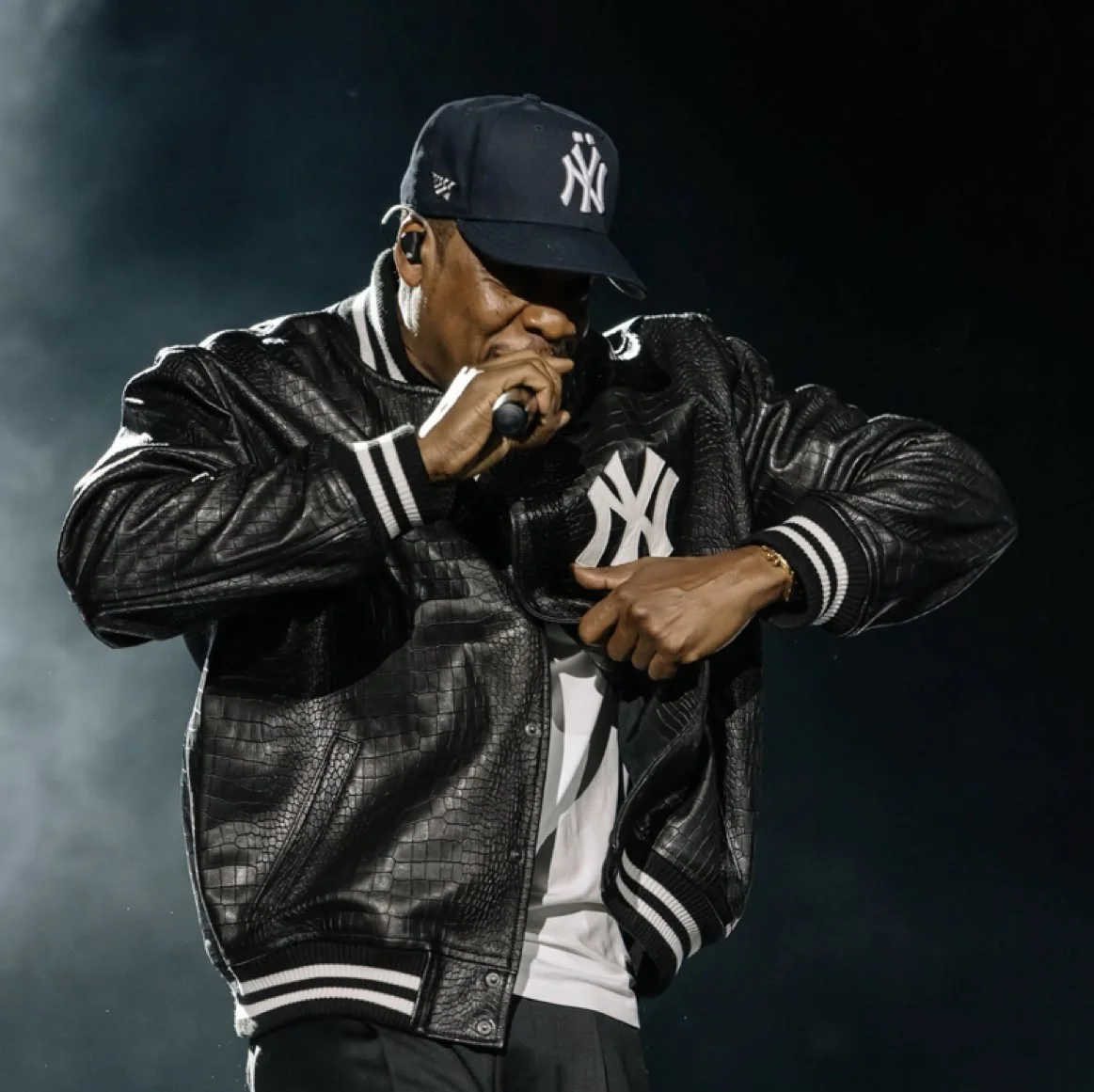
A 30th anniversary is supposed to be easy. Cue the classics, roll the archival footage, let nostalgia do its polite work. But Jay-Z's Yankee Stadium performance on July 10, night one of a three-show run at the stadium, with Beyoncé handling Mary J. Blige's hook on "Can't Knock the Hustle," Nas trading verses on "Dead Presidents," and Blue Ivy Carter at the piano for "Feelin' It," suggested something more consequential than a hometown victory lap. It was a public ceremony for a record that has crossed a rare threshold. Reasonable Doubt no longer belongs only to the artist who made it.
That does not mean Shawn Carter has surrendered authorship. It means the album has become cultural property, a living document whose language, posture, and worldview have been absorbed by generations who were not alive when it arrived in 1996. Fans argue over its best verse as if debating constitutional law. Rappers cite it as a business manual, critics return to it as a moral drama, and entrepreneurs find their own reflections in its mixture of hunger and calculation.
It Was Not Born a Blockbuster
The mythology around Reasonable Doubt can make its original stakes easy to forget. Jay-Z was not yet the obvious superstar, the boardroom fixture, the man whose name would become shorthand for rap's highest commercial ceiling. He was a 26-year-old Brooklyn rapper betting on himself after traditional label pathways had not delivered a clear opening.
Released June 25, 1996, on his own Roc-A-Fella Records and distributed through Priority Records, the album arrived with an unusually adult sense of its own risk. It was polished but not soft, lavish but never carefree. Jay rapped about drug money, social mobility, paranoia, and high-end taste with the calm precision of someone who understood that a suit can be both armor and evidence.
Commercially, it was respected before it was revered. The album opened at number 23 on the Billboard 200 with roughly 43,000 copies sold in its first week, a modest number for a record now treated as scripture. Its long afterlife was built through word of mouth, critical reassessment, and the slow accumulation of listeners who recognized a deeper internal architecture than a collection of street tales. Each return revealed a new contradiction. Jay-Z could sound proud of the life he described and exhausted by its costs, seduced by luxury and alert to its traps.
That complexity is why claims that it is the best Jay-Z album have never felt like simple fan service. The debate includes later work such as The Blueprint and 4:44, but the debut has a singular charge. It captures an artist before the empire, when the possibility of escape still carried the scent of the block.
What Yankee Stadium Changed, and What It Confirmed
A Jay-Z stadium show is inevitably a spectacle of scale, and HitsCulture's full recap of the three-night run covers the guest list and the production in detail. But night one mattered because the songs resisted being reduced to victory lap material. Jay-Z told the sold-out crowd that the album which moved roughly 43,000 units its first week had just put close to that same number of people in the stands, closing the thought with a callback to culture always winning. Thirty years collapsed into a single arithmetic joke, and the joke was the whole argument: the audience the record could not find in 1996 eventually found it anyway, then bought tickets to prove it.
Take "Can I Live," the album's grand argument for autonomy. Its narrator does not ask to be admired; he asks to be understood on his own terms. Three decades later, the song can land differently depending on who is listening. For some, it remains an anthem of self-determination. For others, it is a reminder that the American language of individual freedom can become a convenient alibi for damage done in pursuit of success.
That tension is central to the record's hip-hop canon status. It has endured not because it offers clean answers, but because it refuses to clean up its questions. Jay-Z's narrator is charismatic enough to make a dangerous life sound elegant, then sufficiently haunted to reveal the bill beneath the tablecloth. Nowhere is that more direct than "D'Evils," where the narrator swaps out prayer to God for allegiance to a mob boss entirely, a substitution so blunt it functions less like a lyric and more like a thesis statement about what money can promise and what it can hollow out.
The Album's Real Subject Is Ownership
It is tempting to read Reasonable Doubt only as a record about the drug economy. It is more accurately a record about ownership and control, about who gets to own a future, a name, a product, a neighborhood, a narrative. Jay-Z's early entrepreneurial posture was not a decorative subplot. It was the frame around the art.
His formation of Roc-A-Fella with Damon Dash and Kareem "Biggs" Burke created a template endlessly imitated, often simplified into the slogan that artists should own their masters. The actual lesson was more demanding. Ownership requires leverage, patience, relationships, capital, distribution, and the willingness to make decisions that can isolate you. Independence is not a mood board.
That distinction matters in an era when an artist can upload a song from a phone, watch it travel across TikTok, and still discover that visibility is not the same as control. The modern Jay-Z business empire, spanning music, entertainment, and investment, can make his ascent look inevitable in retrospect. Reasonable Doubt restores the uncertainty. It captures ownership before it became branding, when it was a necessity born from a closed door.
For independent rappers, the album remains useful not because it tells them to duplicate Jay-Z's life, which would be absurd, but because it insists that art and infrastructure are connected. The strongest verse in the world cannot negotiate a contract. A great record needs a route into the culture, and a creator needs some say over where that route leads.
Why the Moral Ambiguity Has Aged So Well
Rap has always been asked to justify itself in ways other American art forms rarely are. The debate around Reasonable Doubt often circles the same question: does describing a criminal economy glorify it? The record's answer is neither a sermon nor an acquittal.
Jay-Z's brilliance was writing from inside a consciousness where ambition and harm are tangled. Songs such as "Dead Presidents II," "Friend or Foe," and "Regrets" do not flatten their narrator into a hero or a villain. They understand that a person can be resourceful, ruthless, frightened, vain, and loving in the same verse. That is not moral ambiguity as evasion. It is narrative accuracy.
The record also challenged the narrow idea that realism must sound drab. Its champagne, Italian tailoring, and luxury car references were not merely aspirational props. They represented the desire to leave scarcity behind, while exposing how quickly a new appetite can become another cage. The album's luxury was always threaded with dread.
That is why it remains foundational. It gave rap an urbane crime novel's psychological detail without sacrificing the music's wit, rhythm, or pleasure. Jay-Z did not make struggle sound noble. He made its bargains sound expensive.
When an Album Enters the Permanent Archive
There is no official ceremony when a record becomes public culture. No committee meets to announce that an album has moved beyond fandom and into collective memory. The transition happens gradually, through arguments, references, samples, songs passed from older siblings to younger ones, and performances that let a new audience inhabit an old work together.
By that measure, Reasonable Doubt has long since reached the permanent archive. It is not frozen in a museum case, though. Its meaning changes with the listeners who inherit it. A young artist may hear a lesson in self-belief. A veteran may hear an elegy for choices that cannot be reversed. A business-minded listener may hear the beginnings of a blueprint. A critic may hear an unsettled account of capitalism, masculinity, and American aspiration.
The Yankee Stadium night affirmed that the record is now bigger than the moment that birthed it. But it also made its original intimacy feel newly valuable. In a culture that rewards instant victory, Reasonable Doubt is proof that a work can build its authority slowly, begin as a cult object, survive the churn, and eventually become a language people use to explain themselves. What started as one man's hustler mythology now belongs to whoever needs it next.
At 30, Jay-Z's debut is still asking its old question: what are you willing to risk for the life you say you want? The difference is that the question now belongs to everyone listening.


Comments (0)
No comments yet — be the first to share your thoughts.
Leave a comment