

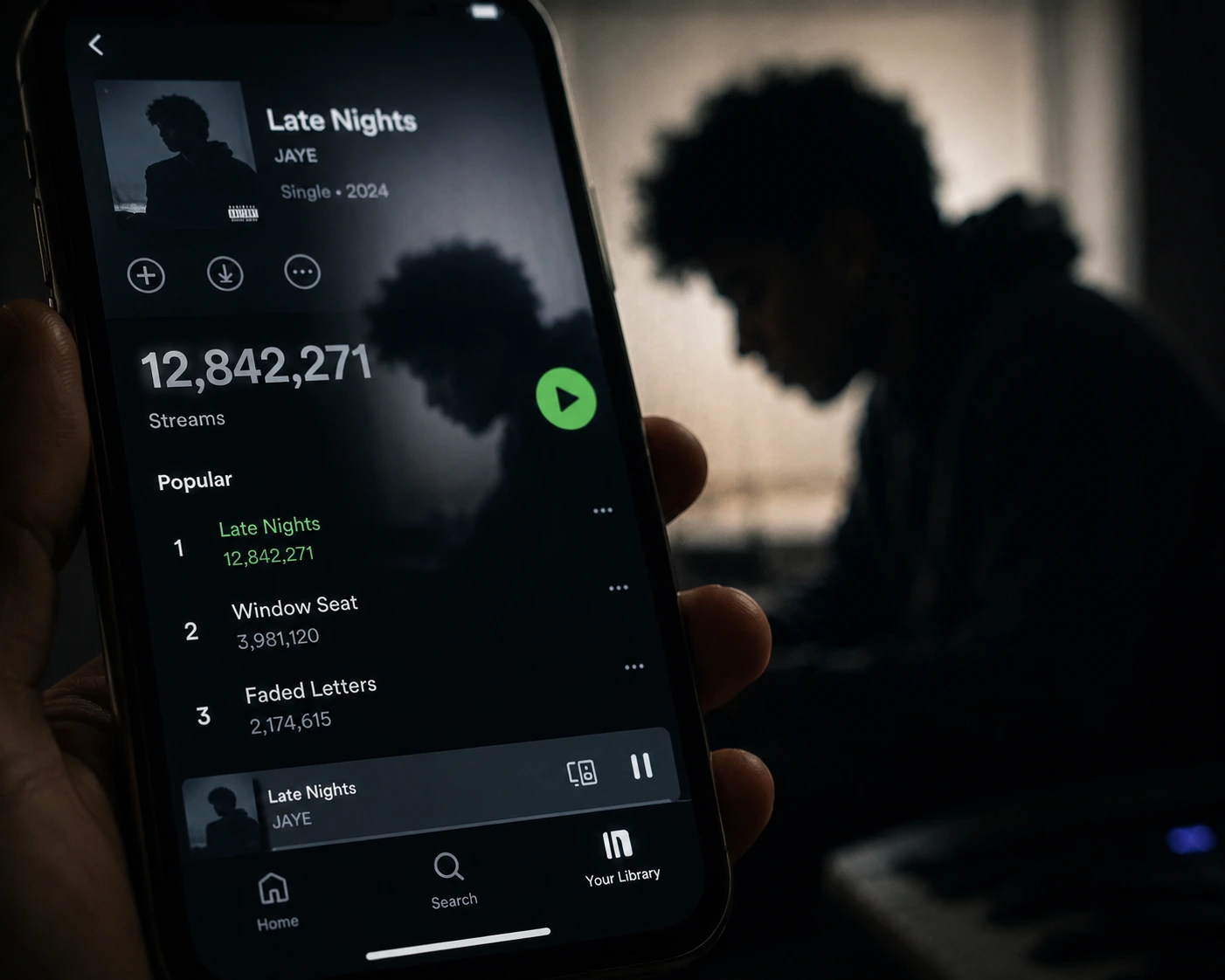
A few years ago, hitting a million streams felt like a milestone worth celebrating. Artists posted the screenshots. Fans shared the news. Labels took notice. The number carried cultural weight, the kind of weight that used to be attached to gold records and radio spins. But somewhere between the celebration and the direct deposit, a lot of artists started asking the same quiet question: where is the money?
The answer is complicated, uncomfortable, and something the streaming industry has never been particularly eager to make simple. A million streams sounds like success. In practice, for most artists, it translates to somewhere between $3,000 and $5,000 before managers, lawyers, distributors, and labels take their cuts. For an independent artist who spent $10,000 recording and mixing a project, that math does not work. For a signed artist whose label is recouping advances, it works even less.
This is the streaming trap. And millions of artists are living inside it right now.
The first thing to understand is that streaming royalties are not paid per play the way radio royalties were paid per spin. Each platform operates on what is called a pro-rata model. Every month, a streaming service takes its total royalty pool, which is a percentage of subscription and advertising revenue, and divides it proportionally based on how many total streams occurred on the platform and what share of those streams your music accounted for.
Spotify's average per-stream payout sits somewhere between $0.003 and $0.005. Apple Music pays slightly higher, closer to $0.007 to $0.01 per stream. YouTube Music and Amazon Music fall somewhere in between depending on the listener's subscription tier. Tidal has historically claimed a higher per-stream rate, though the actual figures depend heavily on how total royalty pools are calculated in a given month.
From SoundCloud to Streaming Giant: The Playbook Modern Artists Use to Build Without a Label
What that means in practice is this: if your song gets one million streams on Spotify, you are looking at roughly $3,000 to $5,000 in gross royalties before anyone else touches the money. If you are on a label that is recouping a $50,000 advance, you will not see a dollar of that until the label has recovered its investment. If you are independent and using a distributor, the distributor takes a percentage or an annual fee off the top. If you have a manager taking 15 to 20 percent, that comes next. By the time the money reaches the artist, a million streams can feel like a very small deposit.
"A million streams sounds amazing until you realize what it actually pays," said Russ, who famously built his independent career by releasing music at high volume before mainstream recognition. "That's why I never stopped treating the business like a business. The streams are marketing. The money has to come from somewhere else too."
For signed artists, the royalty structure carries an additional layer of complexity that most fans never see. A major label deal typically grants the label anywhere from 50 to 85 percent of streaming revenue, depending on the contract structure and how far along the artist is in recouping their advance. The artist receives what is called a royalty rate, often expressed as a percentage of the label's net receipts rather than the gross royalties paid by the platform.
That distinction matters enormously. If Spotify pays $4,000 in royalties for a million streams and the label's net receipts after its own costs are $3,200, an artist with a 20 percent royalty rate receives $640. Not $4,000. Not $800. $640. From a million streams.
"Most artists don't read their contracts carefully enough to understand that distinction," said music attorney Joi Chitty, who has represented independent and major label artists throughout her career. "The royalty rate sounds like a percentage of what the platform pays. It is actually a percentage of what the label decides to call its net. Those are two very different numbers."
This is not a new problem. It is a problem that predates streaming entirely, rooted in recording contract structures that were designed during the era of physical sales and adapted, largely in the label's favor, into the digital age.
A common assumption in the current conversation around independent music is that staying off a major label automatically solves the streaming royalty problem. It does not. Independent artists keep a larger percentage of their royalties, which is real and meaningful. But they are also working with smaller total stream counts in most cases, which means the larger percentage is applied to a smaller number.
An independent artist generating 500,000 streams a month keeping 85 percent of their royalties is still earning roughly $1,275 to $2,125 before distributor fees. That is not a living wage in most American cities, let alone a sustainable business. The structural issue is not just about what percentage you keep. It is about the platform payout rate itself, which is set by the platforms in negotiation with major labels, not with independent artists.
"The rates were negotiated by the majors for the majors," said songwriter and independent artist advocate Damon Lawson. "Independent artists benefit from those negotiations only indirectly, and usually at a lower effective rate because of how distribution tiers work. The system was not built with us in mind."
The artists navigating this landscape most effectively in 2026 are the ones who have stopped treating streaming as a primary revenue source and started treating it as a discovery and marketing engine. The streams are how new listeners find the music. The money comes from everywhere else.
Merchandise has become one of the most significant revenue streams for independent artists at every level. Limited drops tied to album cycles, exclusive colorways for dedicated fans, and direct-to-consumer sales through artist-owned storefronts all generate margins that streaming cannot match. An artist selling 500 units of a $40 hoodie generates $20,000 in gross revenue. That same artist would need roughly five to six million streams to generate equivalent streaming income.
Rod Wave, whose emotional catalog has generated billions of streams across platforms, has paired his DSP presence with consistent touring revenue and merchandise operations that run independently of his label arrangements. The streaming numbers drive awareness. The business infrastructure around those numbers is where the real income lives.
"People see the stream count and think that's the bag," Rod Wave said in a 2023 interview. "The bag is the show. The bag is the merch. The streams just tell people who you are."
Sync licensing is the process of placing music in film, television, commercials, video games, and other visual media. It is also one of the most consistently underutilized revenue opportunities available to independent artists. A single sync placement in a popular television series can generate anywhere from $5,000 to $50,000 or more depending on the project, the scene, and how the song is used. A placement in a national commercial can exceed six figures.
Unlike streaming royalties, sync fees are typically negotiated as flat payments rather than fractional per-play rates. They also generate downstream performance royalties every time the licensed content airs, creating a recurring income stream from a single placement.
Artists like Lucky Daye have spoken openly about the role sync opportunities played in sustaining their careers during periods when streaming numbers alone would not have covered the cost of their operations. "A sync check changes the math completely," Daye noted in a 2024 conversation about independent revenue strategy. "One placement can fund six months of creative work."
Every honest conversation about artist income eventually arrives at the same place. Live performance revenue is the most direct and predictable income source available to artists at every level of the industry. A ticket sold is a dollar collected. The margin depends on venue deals, production costs, and routing efficiency, but the fundamental transaction is clean in a way that streaming payouts are not.
Beyonce's Renaissance World Tour in 2023 generated over $580 million in gross revenue, making it one of the highest-grossing tours in history. That figure dwarfs what any streaming catalog, regardless of size, could generate in the same period. At the independent level, an artist selling out 300-capacity venues at $25 a ticket across a 30-city tour generates $225,000 in gross ticket revenue before costs. That same artist would need approximately 50 to 75 million streams to match that figure through Spotify alone.
"Touring is where I pay my bills," said rising independent artist Amindi, whose streaming presence has grown significantly over the past two years. "The streams are real and I'm grateful for every one. But nothing replaces being in a room with people who paid to be there."
A growing number of artists are supplementing their streaming presence with direct-to-fan revenue models that bypass platform intermediaries entirely. Platforms like Bandcamp, Patreon, and Substack allow artists to sell music, offer subscription tiers, and communicate directly with their most committed supporters without giving a significant percentage to a streaming platform or a label.
Bandcamp's model, for example, allows artists to keep approximately 85 percent of revenue from music sales after the platform takes its fee. On a $10 album purchase, the artist receives roughly $8.50. On Spotify, generating equivalent income from that same listener would require that person to stream the album thousands of times across years of repeated listening.
The direct-to-fan model also builds a quality of relationship that streaming numbers cannot measure. A fan who pays $25 for an exclusive EP is a fundamentally different kind of supporter than a fan who adds a song to a playlist and forgets it. Converting even a small percentage of streaming listeners into direct purchasers can meaningfully change an artist's financial picture without requiring a single additional stream.
It would be incomplete to discuss the streaming trap without acknowledging that the conversation about platform payout rates is actively evolving. Artist coalitions, independent label associations, and music rights organizations have been applying pressure on major streaming services to reform their royalty structures for years. Some progress has been made. SoundCloud introduced a fan-powered royalty model that distributes royalties based on what specific users actually listen to rather than the platform-wide pro-rata pool. Bandcamp has maintained artist-favorable terms as a point of differentiation.
But the dominant platforms, Spotify and Apple Music, have been slower to move. Spotify's royalty structure has faced consistent criticism from artists across genres, including a widely publicized letter signed by thousands of musicians in 2023 calling for a minimum per-stream rate that would provide more predictable income for working artists. The platform's response emphasized its total royalty pool size rather than its per-stream rate, a distinction that matters far more to major labels than to independent artists trying to cover their costs.
"The argument that streaming pays more in total than any previous format misses the point," said music economist and industry analyst Cortez Noel. "The question is not whether the industry is generating more revenue. The question is whether the artists creating the content are receiving a fair share of it. On that question, the data is pretty clear."
The artists who are winning in this environment are the ones who understand that streaming success and financial sustainability are related but not the same thing. Building a streaming presence is necessary in 2026. It is how discovery works, how playlists function, and how new listeners find their way to your catalog. But treating stream counts as a primary financial metric is a mistake that the structure of the industry will punish every time.
The smarter framework is to use streaming as one leg of a multi-source revenue strategy that includes live performance, merchandise, sync licensing, direct-to-fan sales, and where possible, publishing income from songwriting. Each of those revenue streams has different margins, different growth trajectories, and different relationships with an artist's audience. Together, they create a financial foundation that no single platform can disrupt.
A million streams is still worth celebrating. Just not at the bank.
Comments (0)
No comments yet — be the first to share your thoughts.
Leave a comment