

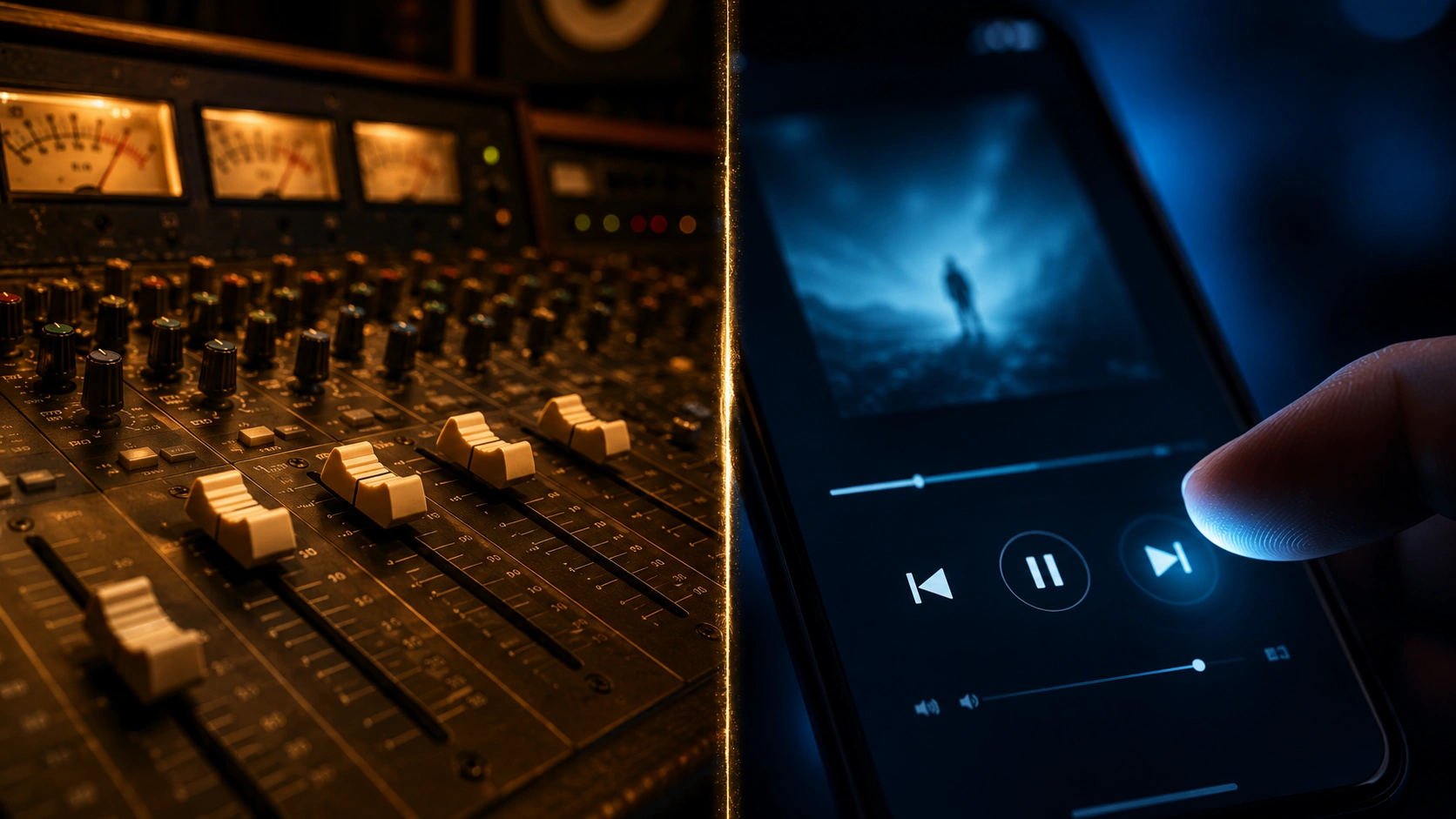
Intros vanished, runtimes slid under three minutes, and the hook now lands before you can reach for the skip button. This is not pop losing its nerve. It is the sound of a genre that learned to play the machine, and is now being played by it.
In 2022, Lil Yachty uploaded an eighty-three-second song to SoundCloud with a caption telling the world to stop leaking it. "Poland" had two keening hooks, a handful of loose bars, and nothing you could call a chorus. It also climbed to No. 40 on the Billboard Hot 100, which makes it a hit by every measure that actually pays out. A producer from an earlier era would have filed it under sketch, or idea, or voice memo. By 2022 it was simply a song built for the only economy that counts now, and it inspired tens of thousands of TikTok edits within a week of release. Shortness was the feature, not the bug.
Here is the short answer, for anyone who has typed the question into a search bar: hit songs keep shrinking because music streaming pays a full royalty only once a listener clears roughly thirty seconds, and that thirty-second threshold quietly rewrote what artists optimize for. When the meter does not start until second thirty and the exit is one thumb-flick away, every patient stretch of a song becomes a cost. The outcome is the most ruthlessly efficient pop architecture in history. And the architects, the people who figured out how to win this game first, were working in hip-hop and R&B.
The thirty-second rule that rewrote the song
Streaming did not ask anyone to write shorter. It simply changed the math and let the math do the asking. A platform that counts a play after thirty seconds rewards a song that earns its keep early and often, and it punishes the long instrumental runway. The pressure compounds at the front door: one widely cited study of listening behavior found that about a fifth of songs get skipped inside the first five seconds. That is the real ceiling every record now writes against. The musicologist who mapped this shift called the force behind it the "attention economy," and the phrase fits: a song competes not against the other tracks on its album but against the entire catalog of recorded music, all of it one tap away.
So the modern attention economy turns songwriting into triage. The decision is no longer how to build to a payoff but how fast you can deliver one before the listener's thumb decides for you. A high skip rate is the streaming era's version of a bad opening weekend, and producers now mix for it whether or not they would admit it out loud.
The disappearing intro
The clearest fingerprint of all this is the intro, or rather its near-total erasure. When Ohio State music theorist Hubert Leveille Gauvin analyzed top-ten singles from 1986 to 2015, he found that intros that once averaged more than twenty seconds had collapsed to about five, a drop of roughly seventy-eight percent. Over the same window the songs got faster, and singers started naming the title earlier, hustling the listener to the hook with less and less ceremony. Gauvin described the technique as front-loading, and once you hear it you cannot unhear it.
Put two records side by side and the redesign is obvious. Starship's 1987 hit "Nothing's Gonna Stop Us Now" makes you wait about twenty-two seconds before a single word arrives. Maroon 5's "Sugar," from 2015, has Adam Levine singing within five. That gap is not taste. It is thirty years of artists adapting, consciously or not, to an environment where the patient opening is a luxury almost nobody can afford anymore. The instrumental intro did not die of boredom. It was edited out by the math of the streaming era.
Three minutes is the new four
The whole song shrank to match. Engineer Michael Tauberg's analysis found the typical Hot 100 track fell from around four minutes and ten seconds in the early 2000s to roughly three and a half minutes by 2018, and the average top-ten length dropped to a brisk 3:07 in 2019. Zoom out further and the trend is genre-blind: since 1990 the average song length on the Hot 100 has slid from over four minutes to around three, regardless of style. By the 2024 charts the typical entry was hovering near the three-minute line, and a UCLA analysis of roughly 160,000 tracks pegged the broad streaming-era catalog average at about 3:17.
The receipts are everywhere on the chart itself. Lil Nas X's "Old Town Road" ran one minute and fifty-three seconds in its original cut, making it the shortest No. 1 by length since 1965. SZA's "Kill Bill" clocked 2:33. The Nicki Minaj and Ice Spice team-up "Barbie World" sprinted past in 1:49. These are not novelty cuts. They are the dominant shape of the modern hit, and the appetite for shorter songs rewards a structure that loops, repeats, and invites the replay rather than the slow build.
This is hip-hop's fingerprint, pressed onto all of pop
Here is where most write-ups stop, content to blame Spotify and move on. We want to go one layer deeper, because the convergence everyone keeps noticing has an author. The front-loaded, hook-first, loop-driven, replay-baiting record is not pop's invention that rap happened to adopt. It is the other way around. Mixtape logic taught the culture how to make a track that hits in the first bar. The ad-lib that doubles as a hook, the chorus that arrives before the verse earns it, the beat that loops instead of resolving, these were rap and R&B instincts long before they became the default grammar of the Hot 100.
The consumption data backs the lineage. R&B and hip-hop have been the most-streamed core genre in the United States for years, holding a commanding 25.3 percent share in 2024, when the category became the only one to clear 300 billion on-demand streams, roughly one of every four plays in the country. And the genre held its crown into the most recent count, with Luminate naming R&B and hip-hop the most popular U.S. genre again in its 2025 year-end report. When you dominate the listening, you set the defaults. The reason a country song and a pop song and a K-pop single now all rush to the hook is that they are all building on a template the culture wrote.
The blueprint turned on its own author
And then the machine the genre built came for the genre. On the chart dated October 25, 2025, something happened that had not happened in thirty-five years: there were no rap songs anywhere in the Hot 100 top forty for the first time since 1990. Current hip-hop and R&B releases were bleeding plays even as the category stayed No. 1 overall, with streams of new hip-hop and R&B down more than nine percent year over year in the first half of 2025, while catalog, the old stuff, swelled to roughly three-quarters of all U.S. streams.
Read that correctly and it is a warning, not an obituary. When you tune an entire genre to win the first thirty seconds, you get very good at consumption and you risk losing the thing that makes a single feel like an event. The skip-proof record is engineered to be tolerated, not awaited. It is the same tension we traced when JAY-Z rapped a hookless freestyle at the Roots Picnic and split the room straight down the middle by age: the streaming habits that trained younger listeners to expect a hook in the first five seconds are the very habits that leave them cold when an artist asks them to sit with something. The blueprint solved for attention so completely that it forgot to solve for anticipation.
What a hit is worth now
The counterexample is instructive. Kendrick Lamar's "Not Like Us" was the most-streamed song in the country in 2024, north of a billion plays, and it won precisely because it refused to behave like background. It was an event, a single that demanded you stop scrolling. The lesson is not that short kills culture. It is that efficiency is now the floor, not the ceiling, and the records that break through are the ones carrying something the algorithm cannot manufacture. You can see the same logic in the way the red graphic of Apple Music's all-time most-streamed artists reads less like a leaderboard and more like a map of who owns the sound.
The redesign is still underway. The bridge is going the way of the intro. Outros collapse into nothing. AI voices have started turning up in the streaming counts. As every record converges on the same lean, hook-forward silhouette, the most valuable thing a publication or a curator can offer is the human ear that knows which of these efficient little songs actually says something. The hit got shorter on purpose, and the genre that engineered the machine has the most to prove. The next move is not making the song tighter. Anyone can do that now. The next move is making a moment, the one thing the thirty-second rule was never able to optimize.
Comments (0)
No comments yet — be the first to share your thoughts.
Leave a comment