

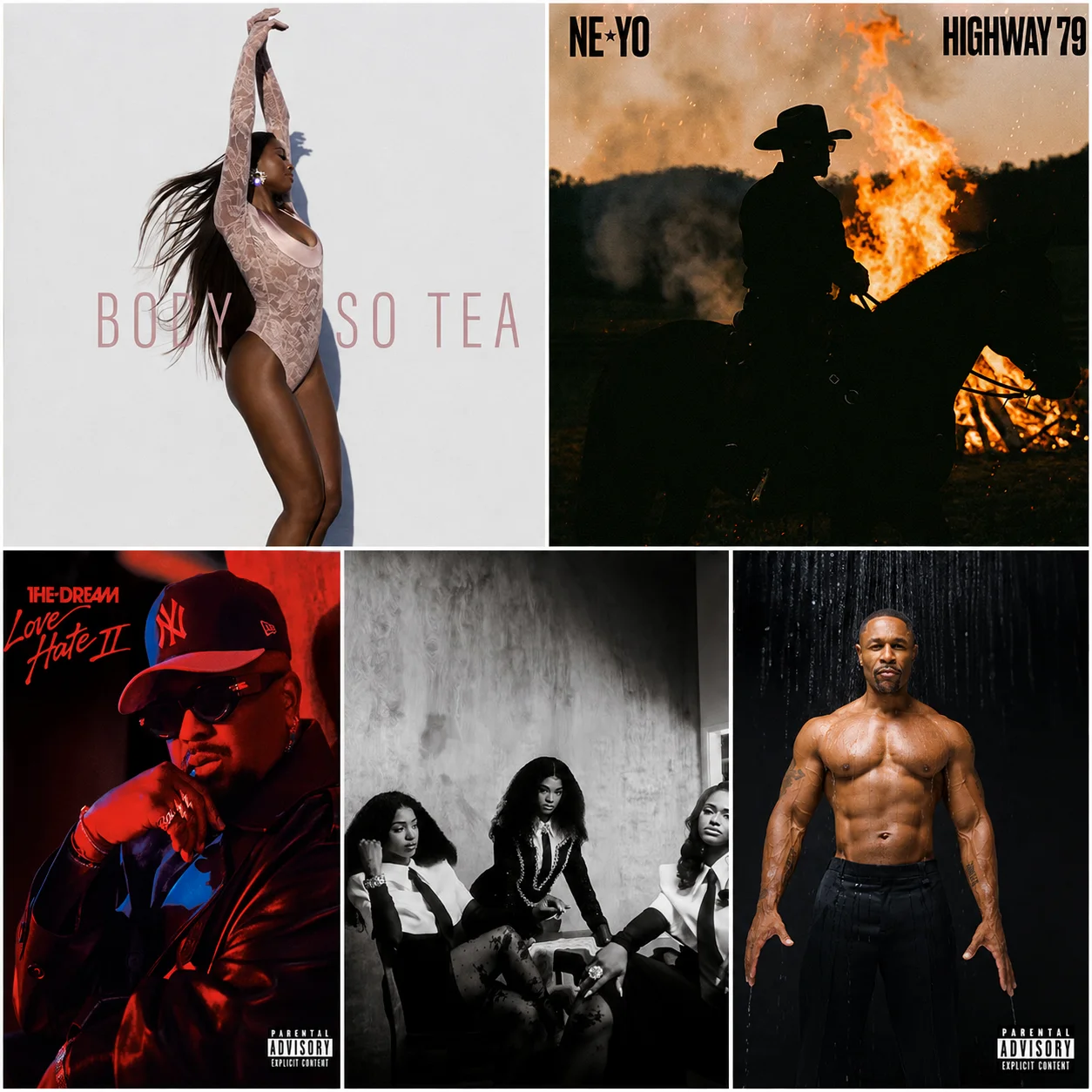
There are times when the machines get it right, and then there are times like this one, when a genre puts on a clinic and the algorithm barely looks up from its code. If you leaned only on your auto-generated playlists in mid-July, you would have been handed the same handful of viral snippets on loop. Meanwhile, off to the side, out of the spotlight the recommendation engines reserve for whatever is spiking that hour, R&B quietly stacked one of the deepest release weeks of the year.
This is the gap we live in. Not a shortage of great music, but a shortage of anyone pointing at it. So consider this a pointing.
The receipts: what actually dropped
Start with the headliner. The-Dream returned with Love/Hate II, a seventeen-track sequel to the 2007 debut that helped define a decade of radio, arriving through RadioKilla and Republic Records with a guest list that reads like a family reunion: Kelly Rowland, T.I., Rick Ross, Pusha T and Swizz Beatz. For a writer whose fingerprints sit on some of the most-sung choruses of the century, a full-length statement is not a nostalgia trip. It is a reminder that the people who built the modern songbook are still writing in it.
Then the independents made their case. Davion Farris released Alchemy, a thirteen-track album cut loose from the major-label system after his run with Def Jam, pulling in Kenyon Dixon, SiR, Iman Omari and Ray Vaughn. Baby Rose delivered YEARNALISM, a twelve-song project with Leon Thomas and Elmiene in tow. Zae France broke a three-year silence with the EP Final Say. None of these names come with a marketing budget large enough to buy their way onto a billboard in Times Square, and all of them made music worth more than the attention the feed will give them.
The singles ran just as deep. Tank dropped "YES," a reinterpretation of Floetry's 2003 slow-burn "Say Yes," fresh off his number one on Billboard's Adult R&B Airplay chart with "Control." Coco Jones offered "Body So Tea," a body-positive anthem that extends the run leading into her debut album era. Ciara returned with "Yes" to mark a tenth wedding anniversary. Ne-Yo went fully genre-blurring on Highway 79, a country-R&B fusion carrying the number one hit "Up Out and Gone." And the Womack Sisters previewed their August debut with "If I Let You," a Latin-tinged groove on Daptone Records.
That is a lot of grown-folks R&B for one week. It is also, almost none of it, the kind of thing a machine is built to celebrate.
Why the algorithm buries a week like this
Recommendation systems are not malicious. They are just single-minded. They optimize for engagement signals, the skips and saves and the first-week velocity that tells the system a track is catching fire. That logic rewards a very specific kind of song: short, immediate, built for a fifteen-second loop, ideally attached to something already going viral elsewhere. It is a machine that asks, over and over, what is spiking right now.
Veteran and independent R&B almost never answers that question the way the system wants. A seventeen-track album from a songwriter's songwriter is designed to be lived with, not sampled and discarded. A Womack Sisters single that carries the DNA of Sam Cooke, their grandfather, is a slow revelation, not a sugar rush. The music is built for repeat listening over months, which is precisely the behavior the algorithm is too impatient to measure. So it does what it always does with anything that does not spike. It looks away.
Legacy is not a metric the machine can read
Here is what a playlist cannot tell you. When Tank reinterprets Floetry, that is a conversation across two decades of the genre. When the Womack Sisters harmonize, you are hearing a bloodline that runs through soul history itself. When The-Dream assembles a sequel to a foundational album, he is asserting continuity, the idea that the lineage of this music is a living thing and not a museum. None of that shows up as a data point. There is no column in the controls for "this matters to the culture." That column is written by people, or it is not written at all. It is the kind of throughline we chase in our Deep Dives, and it is exactly what gets flattened when discovery is handed entirely to code.
The case for human curation is not nostalgia for the mixtape era, though we will happily make that case another day. It is a practical argument about what listening on purpose actually surfaces. A person who loves this music hears that "YES" is talking to "Say Yes." A person notices that Davion Farris walked away from a major label and still delivered a fuller, warmer record than most of what the system promoted that week. A person can tell you that Baby Rose and Leon Thomas on the same track is an event, because a person has been paying attention to both of their artistry. An algorithm sees a mid-tempo R&B song with modest first-day numbers and moves on.
This is the thesis Hits Culture was built around. The feed is very good at telling you what is popular. It is nearly useless at telling you what is good, or why it is good, or where it sits in the long story of the music. That second job belongs to human ears. When a returning veteran like Jon B stepped back into the game after a decade away, it was a moment worth marking precisely because no auto-playlist would have marked it for you.
Our advice is...
If you want in, the move is simple and it is old-fashioned. Go looking. Pull up Love/Hate II and sit with the full run, not the two tracks the app decides to serve you. Play Alchemy front to back and let an independent album breathe. Follow the human-led sources, the editorial roundups and the deejays and the writers who listen for a living, because they are doing the filtering the machine refuses to do. Hits Culture laid out plenty of releases from this week alone. That is not an algorithm. We just cared enough to make a list.
The reward for that small effort is the whole point. You stop being a passenger on a feed and start being a fan again, someone with taste and context and a reason for what you love. The music this month earned that from you. A stacked week of New Music came and went with barely a push from the platforms that claim to serve it, and it was excellent anyway.
R&B is not quiet. It is not fading. This July it was loud, prolific and deep, from the veterans reasserting the songbook to the independents proving they never needed the machine's permission. The only thing missing was the spotlight, and the spotlight was never the algorithm's to give in the first place. It was always ours. So take it back, one deliberate listen at a time, and let the people who make this music know that somebody out here is still paying attention on purpose.
Comments (0)
No comments yet — be the first to share your thoughts.
Leave a comment