

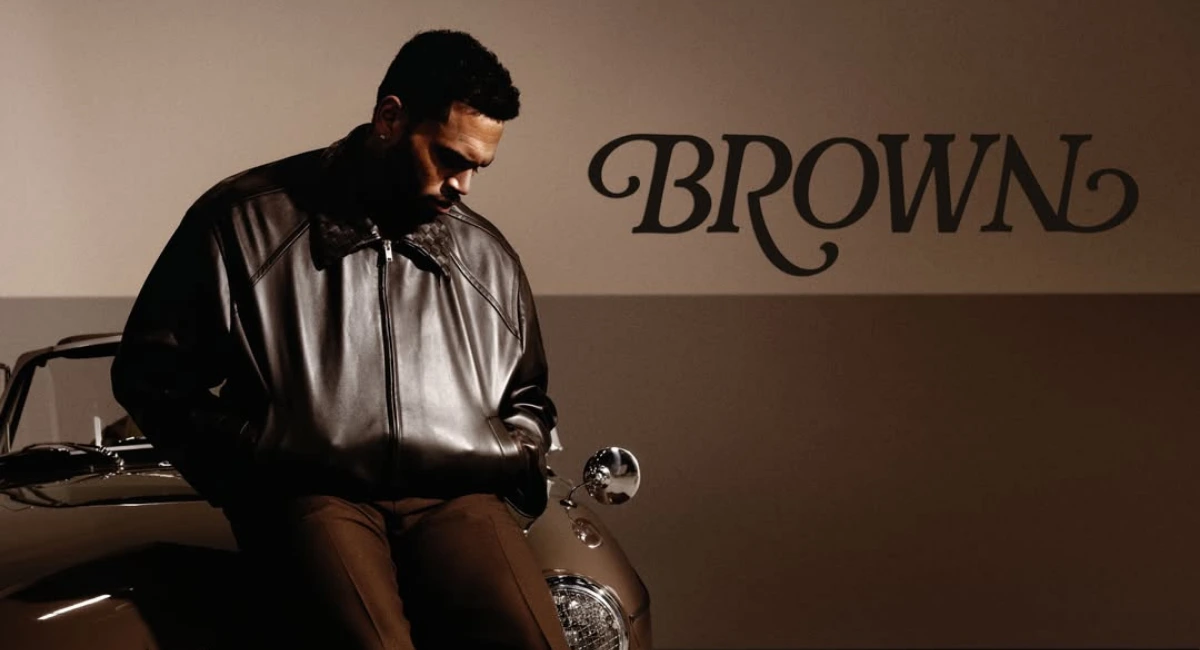
Opinion. A column about presence, pain, and the questions we should be asking before we pick a side.
Scroll one corner of the internet and Chris Brown is a smiling dad in a graduation photo, standing shoulder to shoulder with his oldest daughter Royalty and her mother, Nia Guzman, the three of them grinning like a family that figured something out. Scroll another corner and the same man is a villain in a courtroom slide, his face cut out against a black background, packaged for likes under a custody headline. Same week. Same man. Two completely different stories, and the culture has already decided which one it would rather sell you.
That gap is the whole problem. The conversation around Black fatherhood in this country almost never starts with the dad who showed up. It starts with the one who supposedly didn't. And when a father is visibly trying to stay in his child's life, the machine still finds a way to frame him as the suspect. So before anyone picks a side in the Chris Brown custody battle, it is worth slowing down and asking a harder set of questions than the comment section is asking.
Here is the thing I keep coming back to, and I will say it plainly because this is not a court transcript. When a father genuinely wants to be present, and he still ends up on the outside of his own child's life, it is rarely about nothing. There is usually something underneath. Sometimes it is a real safety concern, and those cases are serious and deserve to be treated as such. But often it is something quieter and more human. A wound that never closed. A relationship that ended badly and left someone holding more hurt than they know what to do with. Leverage. Control. And yes, sometimes money. When a kid becomes the field where two adults settle a score, the child is never the one who chose the war.
I am not in the business of telling you what lives inside any specific mother's heart, and I would not believe anyone who claimed they could. What I will say is that the pattern is old and it is real, and pretending it does not exist does no favors to the children caught in the middle. So instead of declaring who is right, let us look at what is actually on the record and ask what it suggests.
According to court filings, Diamond Brown filed a paternity and custody case in Los Angeles in April 2026 over the couple's four-year-old daughter, Lovely Symphani Brown, born in January 2022. Brown had already acknowledged paternity through a voluntary declaration years earlier and has publicly claimed Lovely since she was an infant, including showing up at her first birthday. In her filing, Diamond initially proposed that Brown receive visitation. By the spring, the ask had shifted to sole legal and physical custody for her, with Brown limited to visitation, plus a request that the court order him to cover her legal fees. Brown fired back asking for joint custody, legal and physical, and proposed that each parent pay their own costs.
Read that sequence again, because the shape of it is the story. One parent moving toward sole control while asking the other to fund the fight. The other parent asking to split everything down the middle. That does not tell you who the better person is. People are complicated and private family conflict is messy. But it is fair to ask why a father requesting an equal share of his daughter is the one being cast as the problem.
To her credit, Diamond has not been quiet about how she sees herself. After the filings went public, she pushed back on social media against being reduced to a label, writing on Social Media that she is a full-time, hard-working mother and adding, in her words, "I'm my child's mother, and I'm a damn good one." That is a real and human thing to say, and she is entitled to it. The exchanges between her camp and Brown's current partner, Jada Wallace, who has accused Diamond of blocking Brown's access to Lovely, have turned sharp and public. Diamond denies keeping Lovely from her father, though she has acknowledged pausing visitation once after an incident she framed as protective. All of that is allegation and counter-allegation, and a feed is the worst possible place to adjudicate it. The point is not to convict anyone. The point is that the co-parenting breakdown playing out here is the exact kind of situation where the adults' unfinished business quietly becomes the child's inheritance.
Part of why a present father gets so little benefit of the doubt is the lie we have all been marinating in for decades. The absent Black father myth is one of the most durable pieces of misinformation in American life, and the data has been quietly demolishing it for years. A landmark study from the Centers for Disease Control found that Black fathers were, by many everyday measures, the most hands-on dads in the country. Among fathers living with young children, Black dads led in bathing, dressing, and feeding their kids daily, in helping with homework, and in simply being there for the small unglamorous rhythms of raising a child. The study's lead researcher described the findings to Newsweek as the debunking of the absent Black father myth, full stop. Even among fathers who lived apart from their children, Black dads stayed more consistently involved than their white and Hispanic peers.
So the real story was never an epidemic of men who didn't care. The real story is a country that built a stereotype and then refused to update it even after its own health agency proved it wrong. That stereotype does damage in a custody fight, because it sets the default assumption that the Black father is the one who needs to earn his place rather than the one whose place should be protected. It is the same culture that deserves real curation and real reporting instead of algorithm-driven, gossip-fed noise, and too often gets the noise instead.
Strip away the celebrity and what is left is something millions of families live without cameras. There are fathers all over the country who pay child support on time, who request more time and get less, who watch their relationship with their own kids get rationed by an Ex who is still hurting. There are also, to be fair, fathers who earned their distance and mothers who are protecting their children from genuine harm. Both things are true at once. The tragedy is that our culture is terrible at telling the two apart, and the people who pay for that failure are too young to defend themselves.
The research on what a father's presence actually does for a child is not subtle. Children with involved, engaged dads show better emotional regulation, stronger academic performance, and fewer behavioral problems, and the quality of the relationship matters more than the raw number of hours. On the other side, research compiled by the Children's Bureau links the absence of an involved father to higher rates of depression, dropout, and incarceration, with children close to their fathers far more likely to finish school and find stable footing as adults. Father involvement is not a nice-to-have. It is a load-bearing wall in a child's development. How a kid shows up in the classroom, as outlets like The Standard NY have documented in their reporting on student outcomes, is shaped long before the kid ever reaches the schoolhouse door.
Which is why father absence should be treated as the serious outcome it is, not the convenient assumption it has become. When the system, or a co-parent, pushes a willing father to the margins, the loss does not land on the man alone. It compounds in the child for years, in ways that show up as anxiety, as anger, as a quiet question that never gets answered. The question of whether a custody arrangement is protecting a child or quietly enacting parental alienation is one our family courts and our culture should be brave enough to ask out loud, case by case, instead of defaulting to a script.
Let us also be honest about who profits when a four-year-old's family rupture becomes a carousel post with twenty thousand likes. The blogs are not in the business of healing families. They are in the business of conflict, and a famous father in a custody war is premium content. Every screenshot of a petty exchange, every deleted story resurfaced for engagement, every comment section turned into a courtroom feeds a machine that does not care how the actual child feels when she is old enough to read all of it. That is not journalism. That is extraction.
The healthier instinct, and the harder one, is to root for the lowering of the temperature. To want the adults to get whatever help they need to put down the weapon they have been swinging at each other, because the weapon is a child. Brown's own history is a reminder that this can move. The man co-celebrating Royalty's graduation with Nia Guzman is the same man who, back in 2015, was tangled in a contested custody fight with that very co-parent, complete with accusations that his time was being blocked. That case settled into joint custody, and years later they are smiling in the same photo. Conflict is not always permanent. Sometimes the hurt that drives it can be worked through, and when it is, the child gets both parents back.
None of this requires pretending Chris Brown is a saint. He carries a long and complicated public record, and a real reckoning with Black fathers and the courts has to hold space for accountability as much as advocacy. A man can be flawed and still deserve a real relationship with his kid. A mother can be exhausted and human and still be making a choice that hurts the child more than it protects her. Adults are allowed to be complicated. Children are not the ones who should pay for that complexity.
So here is the standard. When a father is asking for more of his child and being offered less, do not assume the worst about him by reflex. Ask what is actually driving the distance, and be willing to hear that the honest answer is sometimes a hurt that never got tended to. The same culture that can fill an arena for these artists, the way it will when Brown and Usher hit the road on their joint 2026 tour, can also decide to be more careful with their children than the gossip machine ever will be. And the families living this without a record deal deserve the same care. The work of repairing the adults, the kind of patient, unglamorous emotional labor that publications like Family Symposium keep pointing us toward, is the work that actually protects the kid.
The measure of where the culture stands is simple. Are we rooting for the father in the graduation photo, or the one in the gossip slide? Because they are the same man, and the four-year-old watching from the middle of it is going to remember which version we chose to believe.



Comments (0)
No comments yet — be the first to share your thoughts.
Leave a comment