

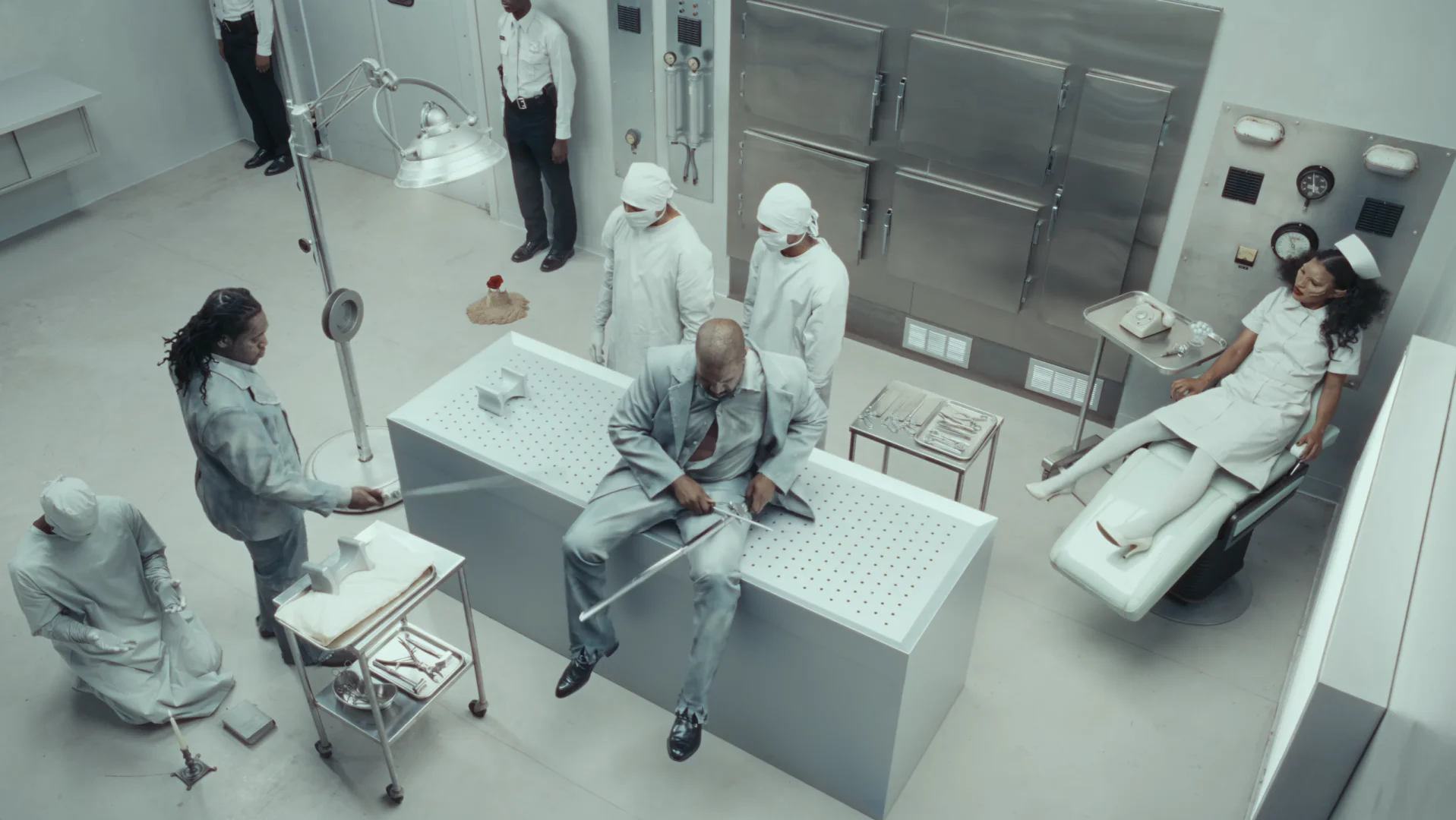
The video for "OK" opens on an overhead shot of a mortuary, and the man whose name is on the song is already dead. A body lies stretched out on a long white table. Ye's head sits on a tray table beside it. He stays in that condition for most of the runtime.
The song arrived June 19 on the deluxe edition of BULLY, with Don Toliver featured, released through YZY and gamma. The video went up August 17, directed and creatively developed by Bianca Censori, marking her fourth directorial credit on Ye's material after "Father," "Gemini Season" and "King." That makes the clip the third distinct release moment built from the same recording.
What plays out is worth describing precisely, because the coverage has been loose on the details.
Technicians work over the torso and remove objects from it one at a time. Doves come out. So do a set of apples arranged for juggling, a metal pan with a rose after, and a beating heart.
Toliver is pulled from a body vault to deliver his verse. When he finishes, he picks up Ye's head and attaches it to the body, and Ye sits up on the table. From there Ye starts sharpening swords while Toliver takes one and clears the room, the killings rendered entirely in shadow on the wall. Both men look up into the lens, and the video ends.
Promotional materials describe Censori's approach here as an "absurdist sequential narrative" that leans on objects and setting to carry hidden meaning. Absurdity is a defensible aesthetic. It is also not the same thing as incoherence, and this sequence has a clear internal logic once you stop reaching for symbolism and just watch who is doing what to whom.
The role Toliver plays in the video is the role he already plays on the record. The front half of "OK" is his, a chipmunk-soul lift under a choppy, stuttering hook that carries the track for most of its length. The 808s distort, the arrangement drops into a colder section, and Ye raps his verse over the wreckage. Toliver is the melodic engine. Ye is the mood shift.
The two have history worth noting. Toliver sang on "Moon" from Donda in 2021 alongside Kid Cudi, one of the few moments on that album that survived the chaos around it. Five years on, the pairing has inverted. In 2021 a Ye album was the platform that carried Toliver to a wider audience. In 2026 Toliver is the one bringing an audience to a Ye release.
That distribution of labor tracks with where both artists are commercially. Toliver's recent release, Octane, debuted at No. 1 on the Billboard 200 with 162,000 equivalent album units, his first solo chart-topper and the biggest week of his career. It logged 138.98 million on-demand streams and 31,000 in sales, topping both the streaming and sales album charts. "E85" reached No. 15 on the Hot 100. He followed it with a 31-city Live Nation arena run that began in May.
Ye's recent catalog has been built the same way. Travis Scott anchors "Father," Lauryn Hill turns up on the deluxe, and Toliver handles the hook here. There is nothing dishonorable about that structure, and rap has run on features since the eighties. The distinction worth naming is that a feature can do one of two things. It can extend a lead artist's reach into a room he does not already own, or it can supply the part of the record that actually moves. On "OK" the second description fits.
The Director Is His Wife, for the Fourth Time
Censori is an Australian-born, Italian-descended trained architect who ran design work at Yeezy before moving into creative direction. She has now directed four consecutive Ye videos across the BULLY cycle, and she has been open about how she builds them.
Speaking to Wallpaper, she described experiencing music as an image rather than a story, and said the world comes before the plot. "I build the world first," she told the magazine, adding that each song carries a color: "Father" registered as green, "Gemini Season" as ivory, "King" as blue. The operating room in "OK" is a fair extension of that method, all clinical white and surgical metal, with the objects doing the narrative work that dialogue would do elsewhere.
The point of raising this is not that the videos are bad. They are composed, they commit to a single idea, and the architectural instinct for building an environment first is visible in every one of them. The point is the size of the room. Ye's visual history ran through Hype Williams, Spike Jonze, Chris Milk, Nick Knight and Arthur Jafa, collaborators who arrived with their own authority and could push back. Williams edited the BULLY short film released in 2025, so the older relationships have not vanished entirely. But four videos in a row from the artist's wife, who also leads his brand's design, describes a creative circle that has contracted to almost nothing.
The cost of that contraction is not visible in any single video, which is part of what makes it hard to argue about. Each of the four clips holds together on its own terms, and the operating room is arguably the most fully realized of them. What a wider circle historically supplied was the person willing to tell an artist that an idea has already been done, or that a metaphor is landing differently than intended. That role does not appear to be filled anywhere in the current setup.
BULLY came out March 28. The deluxe followed June 19. The "OK" video landed August 17. That is three separate release events generated from one album cycle, and the spacing is not accidental.
Deluxe editions used to be filler appended to move a few more physical units. They now function as a second full commercial cycle. A standalone video two months later works as a third, timed to reset a track's streaming curve once the deluxe bump has flattened. The mechanics are the same ones that govern what breaks and what disappears on the platforms, and artists at every level now plan in staggered increments rather than single drops.
That is worth understanding as a listener, not just as an industry observation. A song reappearing in your feed in August does not mean it is new, and it does not mean it is gaining on merit. It often means somebody scheduled a second push. The whole reason human curation still matters is that the calendar is designed to make a two-month-old album track feel like a discovery.
Ye has more reason than most to lean on the calendar. He signed with gamma in January, an independent distribution partnership that hands him control over timing without a major label release schedule sitting on top of it. He also has a narrower touring lane than he did a year ago.
The sequence there is documented. In January he ran a full-page open letter in The Wall Street Journal apologizing for years of antisemitic remarks and addressing his bipolar diagnosis. In April the Home Office denied his travel authorization on the grounds that his presence would not be conducive to the public good. Wireless Festival in London, where he had been booked to headline all three nights, canceled the entire event within a day. Sponsors including Pepsi and Diageo had already withdrawn before the ruling came down. When territories close, the release calendar has to carry more weight.
Taken at face value, "OK" is a resurrection video, and resurrection videos are a standard move for an artist mid-comeback. What separates this one is the casting. The subject of the comeback spends the piece in the least active role available to him, horizontal and in pieces on a table. The featured artist revives him, and the director builds the world he wakes up in.
Staging your own persona is not new territory in rap, and Future spent twenty-two tracks doing a version of it earlier this summer. The difference is authorship. Future is the one holding the mask in place. Here the man on the table is the object being operated on, and the choice was made by the person behind the camera.
Whether any of that was intentional is unknown, and Censori's stated method of building the environment before the narrative leaves plenty of room for the reading to be accidental. What is not accidental is the release architecture around it, which was planned months out and has now produced three commercial moments from one album. The video is on YouTube, Apple Music and Spotify, BULLY deluxe remains on streaming, and Toliver's arena run continues into the fall.
Comments (0)
No comments yet — be the first to share your thoughts.
Leave a comment