

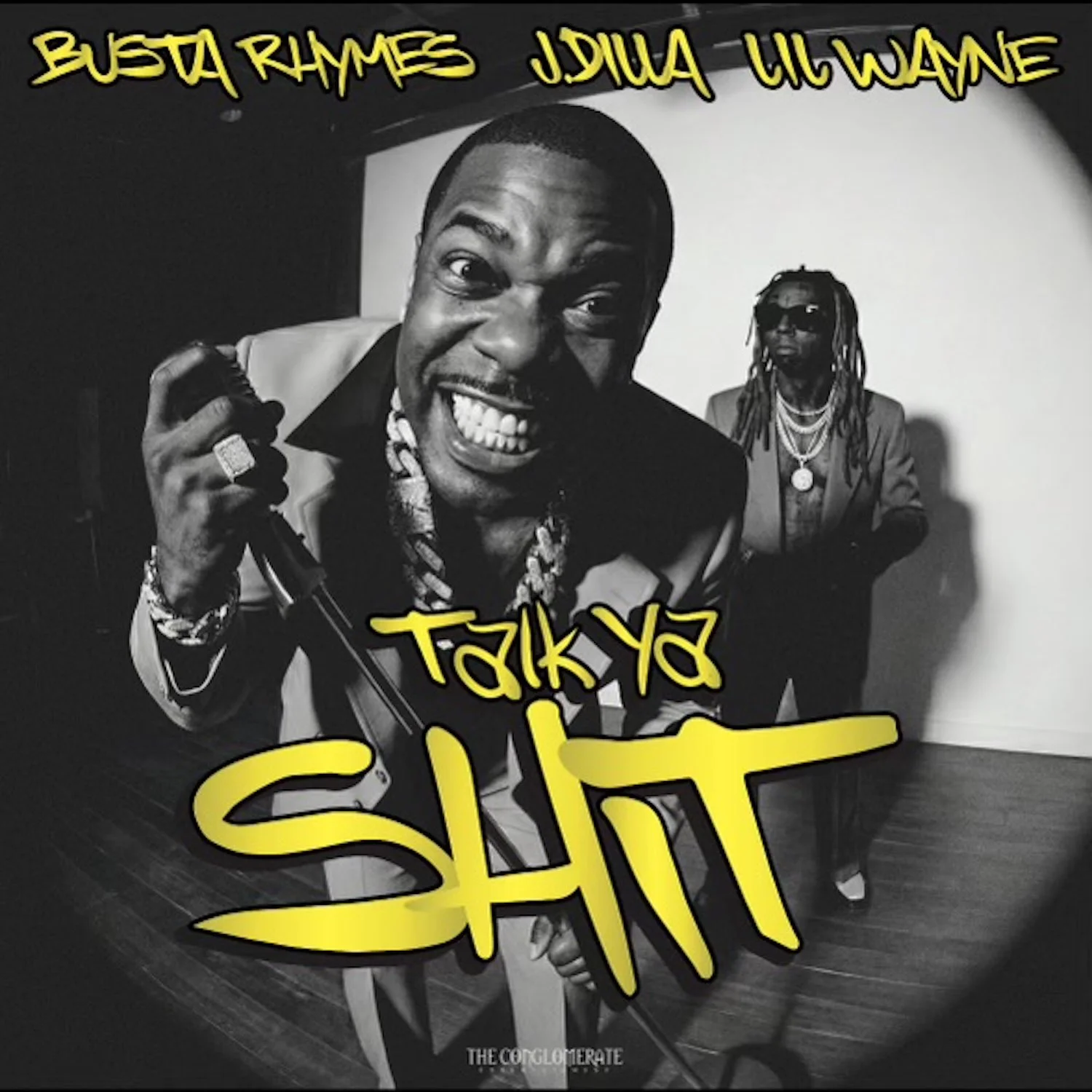
Busta Rhymes released "Talk Ya Sh*t" on Thursday, Aug. 13, marking the second single in eight days from Dillagence 2, an album built entirely around previously unreleased production by the late J Dilla. The track features Lil Wayne, who had never recorded over a Dilla beat during a career dating to the mid-1990s. Busta’s Conglomerate Entertainment is scheduled to release the project on Aug. 25.
“Talk Ya Sh*t” moves at a relaxed, buoyant pace. Wayne delivers one verse packed with punchlines about money and pain, while Busta frames the feature with verses of his own. The track’s defining element is its drum programming: a distinctly vintage Dilla rhythm, reportedly created in Detroit or Los Angeles before February 2006 and left unheard for nearly 20 years.
In a 2020 interview with GQ, Busta said J Dilla left him more than 300 beats before his death. That archive is not merely background to Dillagence 2; it is the foundation of the project and the reason its long-delayed production feels central rather than incidental.
The archive Dilla handed over
J Dilla died on February 10, 2006, at age 32, from complications related to TTP and lupus. During much of his final years, he was in and out of Cedars-Sinai Medical Center in Los Angeles. His landmark instrumental album, Donuts, was released on February 7, his birthday, just three days before his death. At the time, however, the public did not know how much completed music Dilla had already given to trusted collaborators, including Busta Rhymes.
Dilla's partnership with Busta began early in the rapper's solo career. In Dilla Time, Dan Charnas writes that Q-Tip introduced Dilla to Busta's debut project. Busta was reportedly so struck by the producer's off-kilter, stuttering kick pattern that he reshaped his cadence to match it. The resulting song, “Still Shining,” appeared on The Coming in 1996. Dilla later produced tracks for six of Busta's first seven studio albums, contributing to every release except Extinction Level Event. Their collaboration included “Show Me What You Got” from Anarchy (2000) and “Turn Me Up Some” from It Ain't Safe No More (2002).
The creative exchange also moved in the opposite direction. When Dilla's posthumous album The Shining was released in August 2006, Busta provided its opening vocals. In November 2007, Busta and DJ Mick Boogie followed with Dillagence, a 17-track mixtape featuring Busta rapping over Dilla's instrumentals. Q-Tip, Talib Kweli, Raekwon, M.O.P., Rah Digga, Cassidy, and Papoose joined the project, which opened with a spoken introduction by Maureen Yancey, Dilla's mother.
Dillagence is now out of print and has never been officially available on Spotify, Apple Music, or Tidal. Physical CD-R copies have become increasingly difficult to find, while some are beginning to fail during playback. As its sequel arrives, the original remains largely inaccessible to listeners who did not download it when it was released in 2007.
Where Lil Wayne fits
Wayne is not a stunt booking, and he is not a new addition to Busta's phone. The two have been recording together since at least April 2009, when "Respect My Conglomerate" put Wayne alongside Jadakiss on Busta's Back on My B.S. In 2011 they both appeared on Chris Brown's "Look at Me Now," which reached No. 6 on the Hot 100 and remains the highest chart position Busta has ever held.
That November, Busta signed to Cash Money Records, making Wayne his labelmate. He released Year of the Dragon free through Google Play in 2012 with a Wayne feature on it, then put out "Thank You" in November 2013 with Wayne, Kanye West, and Q-Tip. Busta announced his departure from the label in July 2014, citing creative differences. That is a seventeen-year working history across four different label situations.
What never happened in those seventeen years, or in the fifteen before them, was Wayne and Dilla crossing paths. Dilla's placements moved through Detroit, through the Native Tongues circle in New York, and through the Soulquarian and Stones Throw orbits on the West Coast. Wayne came up inside Cash Money in New Orleans, where Mannie Fresh produced essentially everything through 2005. Two of the most heavily documented rappers of their generation shared a decade of the industry without ever sharing a session.
Every new Dilla placement in 2026 runs through whoever controls the beat. Busta picked this one, picked the rapper for it, and introduced an artist to a producer who died before they could meet. The verse is a conservative decision as much as a collaboration.
The stewardship problem
Posthumous rap releases carry a long record of families and estates discovering the work after it ships. Busta has structured this rollout to answer that objection before it gets raised. The announcement video posted August 4 was not a trailer or a cover reveal. It was footage of Ma Dukes listening to an album track, timestamped March 7, 2026, five months before the public heard a note.
He also played the record for a room first. On the night of February 20, Busta hosted a private listening session in New York with Statik Selektah and DJ Tony Touch. The Wayne collaboration surfaced there in a snippet on Statik's Instagram Stories, months before either camp confirmed the song existed.
It is a sharper approach than most vault releases manage. HitsCulture has argued before that an artist who does not manage the archive eventually loses control of how it gets told. The Dilla catalog has been mined for twenty years by people with widely varying claims to it. Busta is the rare holder who can point to a documented handoff from the producer himself.
A three-week rollout for a twenty-year project
The campaign is moving unusually fast. Busta announced the album on August 4 and put out the lead single "Spazzz," with a video, two days later. "Talk Ya Sh*t" followed on August 13, and the full project ships August 25. That is twenty-one days from announcement to release for a record two decades in the making, and no tracklist has been published yet.
Compressed rollouts have become standard for veteran artists who no longer have radio building anticipation on their behalf. The Dilla name draws the press and the Wayne feature draws the streams, and a longer runway mostly gives a leak time to beat the release. HitsCulture recently broke down how a legacy artist can engineer a rollout that actually lands, and Busta is playing the speed version of the same idea.
The album has eleven days to settle whether 300 beats is an archive or an inventory. Dilla's posthumous catalog has produced genuine masterpieces and it has produced filler, sometimes from the same batch of files, and the variable has usually been who was doing the choosing. Busta has the deepest personal claim to this material of anyone living, plus a documented blessing from Dilla's mother and two singles that sound like they came off the same reel.
What nobody outside the room has heard yet is the other ten or twelve tracks.
Comments (0)
No comments yet — be the first to share your thoughts.
Leave a comment