

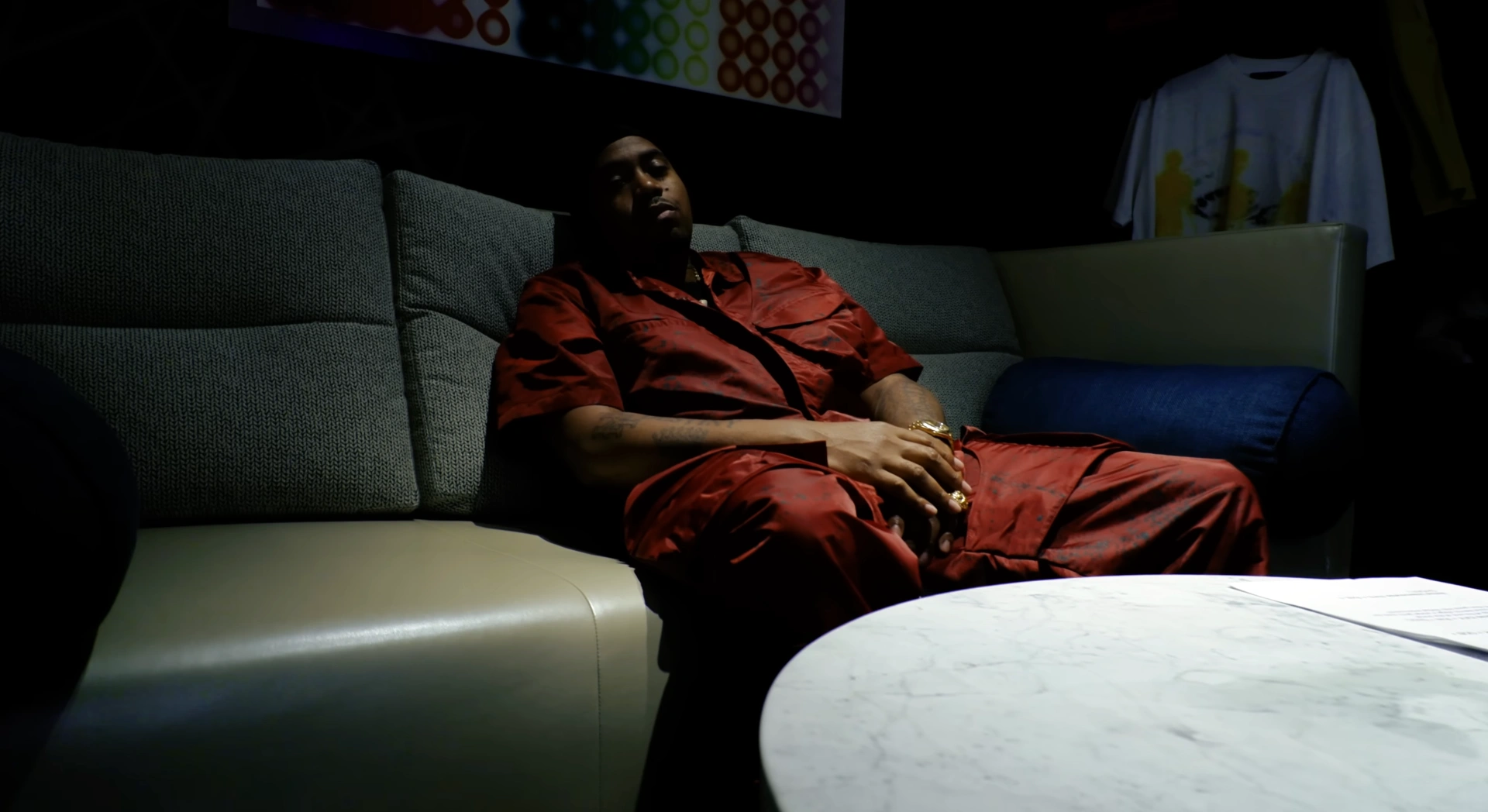
From the Queensbridge projects to a $200M empire, Nasir Jones keeps proving that greatness has no expiration date.
There is a version of this story that goes the way most rap careers do. You drop a classic debut album, spend a decade chasing that moment, and quietly fade into a legacy act. You do the nostalgia tours. You do the interviews where you talk about the old days. You become a museum piece of yourself.
Nasir Jones did not get that memo.
Thirty-one years after Illmatic redefined what a rap album could be, Nas is not slowing down. He is not coasting. If anything, the man known as God's Son is operating at a level of creative and business output that makes most artists half his age look like they are not trying hard enough. Now in his early 50s, Nas has delivered a Grammy, launched one of the most ambitious label projects in recent hip-hop history, dropped a long-awaited collaborative album with DJ Premier, and built a venture capital portfolio worth hundreds of millions of dollars. The question is no longer whether Nas belongs in the conversation about the greatest rappers of all time. The question is: how does he keep finding new rooms to walk into?
To understand why what Nas is doing right now matters, you have to understand what he was carrying from the start.
On April 19, 1994, a 20-year-old kid from the Queensbridge Houses in Long Island City dropped ten tracks that would permanently alter the geography of hip-hop. Illmatic was a cinematic document of street life told with the precision of a novelist and the soul of a jazz musician, which makes sense given that his father, Olu Dara, was exactly that. Productions from DJ Premier, Pete Rock, Q-Tip, and Large Professor gave Nas the canvas. He painted something that has never fully dried.
Nas Talks New Albun, 20th Anniversary of Illmatic, Congac, More
The album has since been inducted into the Library of Congress's National Recording Registry and is consistently ranked among the greatest hip-hop records ever made. But here is where the Nas story gets complicated: most artists who release a debut that legendary spend the rest of their careers trying to convince the world they still matter. Nas spent thirty years actually proving it.
The late 1990s tested him. Albums like I Am... and Nastradamus drew criticism for inconsistency. A very public feud with Jay-Z threatened to define him more by conflict than craft. But in 2001, he responded with Stillmatic, a comeback record that reminded the world exactly who they were dealing with. The diss track "Ether" alone became a cultural landmark, with the word itself entering the hip-hop lexicon as a verb.
What followed was not a straight line but it was always forward motion. God's Son, Street's Disciple, Hip Hop Is Dead, and Untitled each revealed different dimensions of an artist who refused to be one thing. Then in 2010 came Distant Relatives, a collaborative album with Damian Marley that donated its royalties to African charities, signaling that Nas was thinking beyond chart positions altogether.
The Grammy That Took 30 Years to Arrive
Perhaps no chapter in the Nas story hits harder than his Grammy journey. He received thirteen nominations over the course of his career without a single win. For any other artist, that kind of repeated near-miss would be the footnote of a complicated legacy. For Nas, it became fuel.
In 2020, he released King's Disease, entirely produced by Hit-Boy, and something clicked. The album was sharp, focused, and critically celebrated in a way that felt earned rather than nostalgic. At the 63rd Grammy Awards, King's Disease won Best Rap Album. After three decades in the game and thirteen previous nominations, Nasir Jones finally had his Grammy. And then he kept going.
He and Hit-Boy did not stop at one. They proceeded to release King's Disease II, Magic, King's Disease III, Magic 2, and Magic 3 in rapid succession, all of them meeting with critical praise. NME described the King's Disease III era as proof that Nas, three decades deep, was still a force to be reckoned with. That is not a compliment you give to someone who is fading. That is a statement of fact about someone who is thriving.
In December 2025, Nas delivered one of the most anticipated releases in hip-hop history. Light-Years, his collaborative album with DJ Premier, finally arrived through Mass Appeal Records after nearly twenty years of anticipation. The partnership between these two had been teased since a 2006 Scratch Magazine cover story announced it was coming. Hip-hop fans have been patient people.
The 15-track project delivered everything those fans were waiting for. Premier's signature boom-bap production provided the architecture and Nas filled it with bars that moved between reflection and current reality with total ease. Tracks like "NY State of Mind Pt. 3", "Writers", and "3rd Childhood" honored their shared history while proving neither man was living in the past. "I can't wait for people to finally hear it," Nas told Rolling Stone before the release. "For me and him, it was personally a long time coming."
Light-Years also served as the closing chapter of Mass Appeal's Legend Has It series, a 2025 initiative that Nas orchestrated through his own label, releasing new albums from Slick Rick, Raekwon, Ghostface Killah, Mobb Deep, De La Soul, and Big L. The series was a declaration of intent: Nas was not just preserving the culture, he was actively funding and curating its continuation.
What makes the Nas story truly modern is that the music is only half of it. Long before hip-hop artists made venture capitalism fashionable, Nas co-founded QueensBridge Venture Partners, a firm that made early investments in companies like Dropbox, Lyft, Robinhood, Coinbase, Ring, and Pluto TV. Several of those bets made him significantly more money than any album ever could. His net worth is now estimated at $200 million, a figure that represents a lifetime of thinking beyond the next record deal.
He is also a partner in the Sweet Chick restaurant chain, with locations across New York, Los Angeles, and London. In 2024, he partnered with Resorts World New York City on a proposed $5.5 billion casino and resort project at Aqueduct Racetrack in Queens, essentially bringing major economic development to the borough that made him. The kid from Queensbridge is now investing in Queensbridge's future.
He also co-founded the Paid in Full Foundation alongside Steve Stoute and Ben Horowitz, a nonprofit dedicated to supporting hip-hop pioneers who never received financial recognition proportional to their cultural contributions. In 2024, the foundation hosted its Grandmaster Awards in Las Vegas, honoring legends like Kool Moe Dee and Roxanne Shante. This is what separates Nas from simply being rich and successful. He is actively using his position to repair the economic inequities that the music industry built on the backs of the culture's founders.
In 2006, Nas famously declared that hip-hop was dead. It was a provocative statement and a brilliant piece of cultural criticism wrapped in an album title. In 2025, he revised that verdict publicly, crediting artists like Kendrick Lamar and Clipse for reigniting the creativity and energy that drive the genre forward. He called out Kendrick's "Not Like Us" and his album GNX as key forces in hip-hop's resurgence. He also acknowledged the growing power of female artists reshaping the genre's direction.
That kind of perspective, earned and generous rather than defensive, is what distinguishes the elder statesman Nas has become. He is not threatened by what is new. He helped build the foundation that new stands on.
"It's 1995 all over again," he told Rolling Stone in 2025, reflecting on the energy behind the Legend Has It series. "It's not going backwards, it's going forward. It's that feeling of urgency, that vibration, the celebration of life and these songs."
What Longevity Actually Looks Like
There is a reason why artists from Kendrick Lamar to J. Cole have cited Nas as a primary influence. There is a reason why a 15-year-old discovering hip-hop today can put on Illmatic and feel like they are listening to something urgent rather than historical. Nas built his catalog with such intention and with such commitment to lyrical authenticity that it does not age the way most music does. It deepens.
He has been ranked second on The Source's "Top 50 Lyricists of All Time," appeared on Billboard's "10 Best Rappers of All Time" list, and was named the Greatest MC of All Time by About.com. These rankings matter less than the simple truth they are pointing at: few people in the history of this art form have done it longer, with more consistency, and with greater cultural purpose than Nasir Jones.
He turned 50 in September 2023, releasing Magic 3 on his birthday. He performed at a charity concert in Mumbai in April 2025. He executive produced a concept album with Lin-Manuel Miranda. He dropped the culminating album of a year-long legacy series. He is being woven into the Marvel multiverse through the Legend Has It comic collaboration. He has summer 2026 tour dates already locked in across the US and UK.
At an age when most rappers are accepting tribute mics and hosting panels about the good old days, Nas is still in the studio, still in the boardroom, still on the stage. Still writing the next chapter of a story that has never once moved in a straight line but has always, somehow, moved up.
The legacy is not something Nas is protecting. It is something he is still building. And if Light-Years is any indication, he is not close to finished.

Comments (0)
No comments yet — be the first to share your thoughts.
Leave a comment