

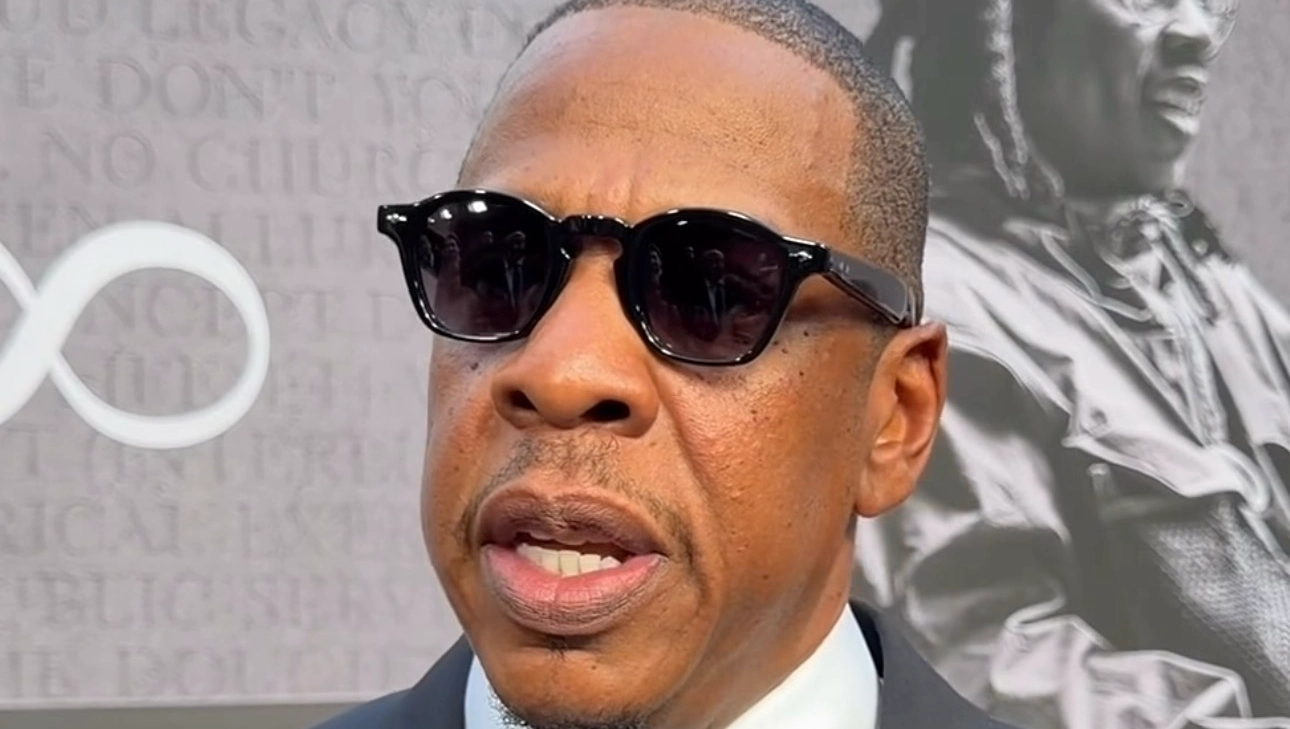
Jay-Z met his father once as an adult, and about a month after that meeting his father was gone. He tells the story to Rick Rubin in the third and fourth episodes of JAŸ-Z in 8, which HBO aired Friday night (Sept 25), and he tells it without ornament: "I know if I had not spoken to him, oh, forget it… I don't know what happens… I don't know where I go," he says in the passage.
The eight-part Jay-Z HBO docuseries premiered Friday, September 18 at 8 p.m. ET on HBO and streams on HBO Max, with two new episodes arriving each Friday through the October 9 finale. Its structure is a single long conversation in which Rubin, directing for the first time, walks the rapper back through more than 25 songs from a 30-year catalog and asks where each one came from, which people and places fed it, and what it cost him to write.
The world premiere was held Sunday, September 13, at the Metropolitan Opera House at Lincoln Center, with SZA, Leonardo DiCaprio and Daniel Kaluuya among the guests. Kaluuya is also an executive producer alongside Jay-Z and Rubin, and Leila Mattimore and David Rohde are credited as producers, a small circle of people close to the subject steering a project built almost entirely out of his own recollections.
Rubin is not a neutral interviewer in this story and has never pretended to be one. He co-founded Def Jam with Russell Simmons in 1984 out of a New York University dorm room, and nearly two decades later he produced "99 Problems," the rock-guitar crunch at the center of The Black Album in 2003. The series arrives three decades after Reasonable Doubt, the debut HitsCulture revisited in July when it examined how that album became cultural property, and the calendar gives Rubin's patient questioning a clear frame: a 56-year-old explaining the young hustler who wrote the early records.
Rubin's wider résumé explains why HBO handed him the chair. He produced LL Cool J's debut Radio in 1985 and the Beastie Boys' Licensed to Ill a year later, spent the 1990s and early 2000s recording Johnny Cash's American Recordings series, and in 2023 published The Creative Act: A Way of Being, a book about the habits behind making work rather than the results. His questions to Jay-Z follow the same line, circling how a verse got written, who was in the room and what the writer was carrying that day, and only later arriving at what the song did on the charts or in the culture.
The father material lands hardest because Jay-Z has written around it for years without explaining it at this length. Adnis Reeves left the family when his son was 11 and living in Brooklyn's Marcy Houses, a wound that surfaced on "Where Have You Been" in 2000 and returned on "Adnis," the letter to his father that sits near the end of 4:44 in 2017. In the new episodes, he credits his mother, Gloria Carter, with understanding what was at stake, saying she knew that if his father "had passed without a conversation, I would never recover."
That same album comes back when Rubin raises the title track. "It's so raw, and so honest… the last verse, you're dealing with your children…" Jay-Z says of "4:44," the title track of a 2017 album produced start to finish by No I.D., and the song whose closing section turns from apology toward the children who would one day hear it.
Episodes three and four also spend time on the distance between the persona and the man who built it. Asked about the violence that runs through his mid-1990s records, he draws a hard line between selling and shooting. "All my years of hustling, I always stayed away from violence. I was a hustler, not a gangsta," he tells Rubin, a distinction he has drawn in verses for years but rarely in plain conversation on camera.
The line sits uneasily next to the story he tells about the Streets Is Watching era, named for the 1998 direct-to-video film that Roc-A-Fella built around songs from his first two albums, when the bulletproof vest he wore to a photo shoot was protection rather than wardrobe. "That's how I came to the shoot… I just got here and the photographer was like, 'You look great, let's shoot it.' But I was in a war," he says, and the no-violence claim and the vest arrive in the same hour of television, left for the viewer to reconcile.
Some of the most useful minutes for working musicians are procedural. Jay-Z describes treating studio time like a shift, arriving around 2 or 3 in the afternoon and leaving around 10 at night, roughly a 2-to-10 working day. When Rubin asks whether he ever pushes through the night, the answer is short: "Very rarely. If I get an idea that I can't let go, I'll go till the next morning… it's not normal to me." For an artist whose reputation rests on writing without paper, the routine behind the no-pen songwriting method reads as office hours more than mystique.
Money enters the conversation through his mentor. Jaz-O, the Brooklyn rapper who brought a teenage Shawn Carter into studios in the late 1980s, signed a recording contract with EMI for $400,000, the figure that showed a kid from Marcy what rap could pay. Jaz-O's major label run was brief, and when the labels later passed on Jay-Z, he built Roc-A-Fella Records with Damon Dash and Kareem "Biggs" Burke in 1995 and released Reasonable Doubt through it the following year, the ownership decision the rest of his catalog stands on.
The remarks that have traveled furthest this weekend concern Kanye West. Rubin asks about "Jail," the 2021 collaboration from Ye's Donda, and Jay-Z calls his old collaborator "one of the most brilliant creatives we're ever going to see." No matter what, he's always... had this space for me and this reverence as his big brother," he continues, before adding, "Obviously he does his things... But I know he hasn't lost that feeling."
The two have not released a full project together since Watch the Throne in 2011, and their relationship cooled in public in November 2016, when Ye aimed a stage rant at Jay-Z during a Saint Pablo tour stop in Sacramento. "Jail" was heard in 2021 as a thaw after years of distance. Jay-Z's comments to Rubin keep that door open without describing any new music, and nothing in the series so far points to a joint release.
The series is also landing in a crowded year for him. This summer brought his Yankee Stadium run, and Reasonable Doubt turned 30 on June 25. JAŸ-Z in 8 fits into that calendar as the reflective counterweight to the stadium nights, two men who have known each other for decades talking through verses written when one of them was still working corners in Brooklyn and Trenton.
Episodes five and six arrive on HBO Friday, October 2, and the final two air Friday, October 9, closing out a four-week run that began with the September 18 premiere. Both nights start at 8 p.m. ET, and each pair reaches HBO Max the same evening.
Comments (0)
No comments yet — be the first to share your thoughts.
Leave a comment