

D'Angelo has been gone since October 2025, yet the culture is still searching for a meaningful way to grieve him. Streaming his catalog can keep the music close, but it cannot create closure. That is why it matters that the first major rapper to respond to his legacy did not reach for a nostalgia loop or a hashtag. She reached for a seed.
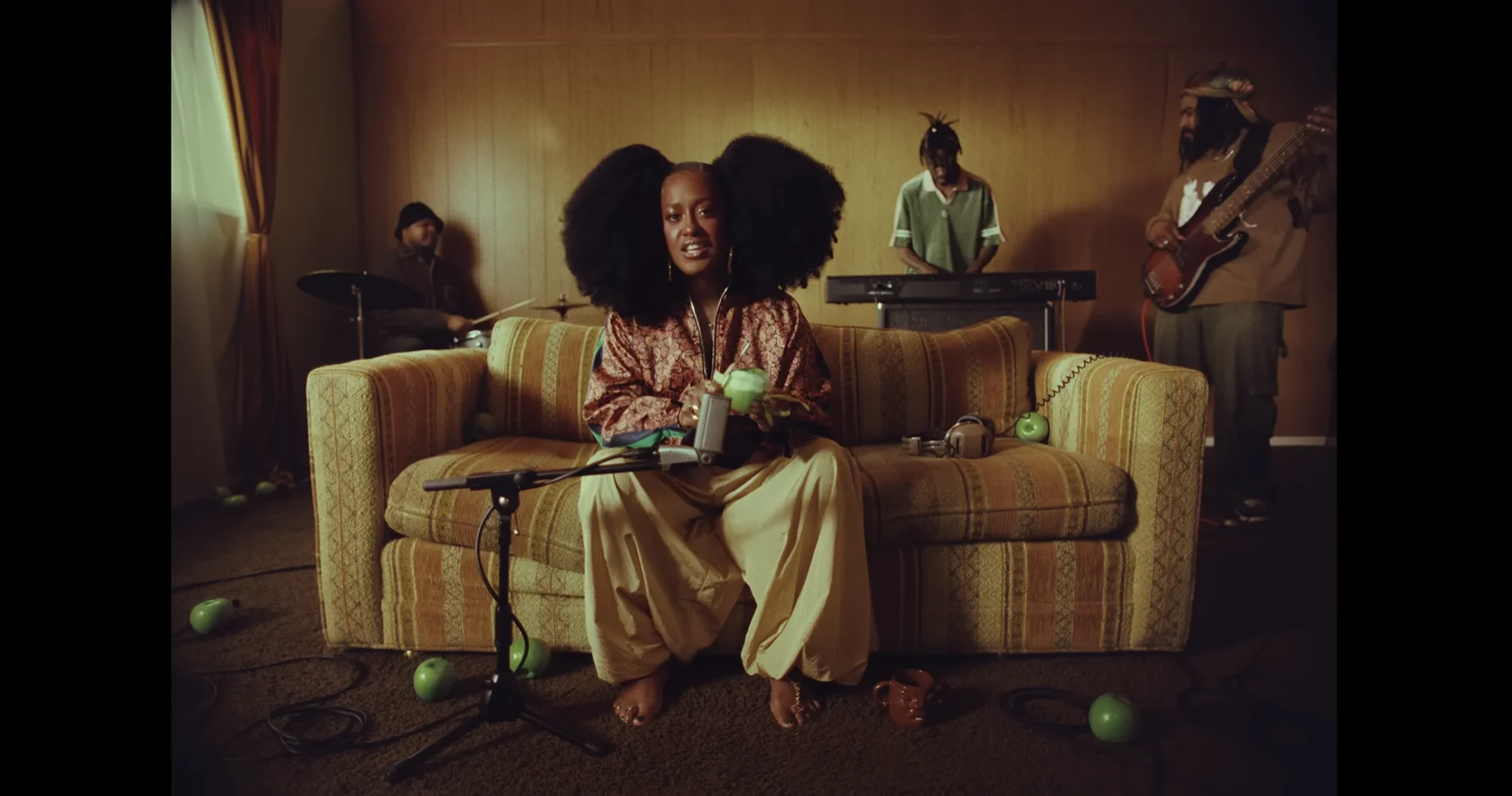
On July 31, Rapsody released “Apple Juice,” the lead single from her forthcoming album. Built around D'Angelo's Voodoo, the track is tender, easygoing and unconcerned with the algorithm’s demands. It may also be the most thoughtful use of D'Angelo's memory by an MC so far, not because it imitates him, but because it extends what he began.
Rapsody's Apple Juice is not a club-oriented flip or a sample designed merely to trigger recognition. The song interpolates "One Mo’Gin" from Voodoo, D’Angelo’s 2000 masterwork, and turns it into a conversation between artists separated by a generation. The One Mo’Gin sample supplies the track’s foundation, but Rapsody never treats it as a shortcut. She writes with it, over it and around it, addressing an elder rather than simply quoting one.
Rapsody recorded “Apple Juice” in Johannesburg with producer Mr. Porter and included South African voices such as Seth Mazibuko of the Native Rebels and vocalist Nomisupasta. That setting is more than a production detail. It connects American neo-soul’s lineage to the wider African diaspora, then sends it back in a renewed form. For an artist as assured as Rapsody, the international collaboration feels purposeful rather than ornamental.
The song’s restraint is equally important. A more predictable approach would have chopped “One Mo’Gin” into a bright, immediate hook built for short-form video. Rapsody does the opposite. She lets the track move slowly enough to breathe and trusts listeners to stay with it. In an attention economy that rewards instant payoff, that patience becomes a statement: mature, lyric-driven music still deserves time.
Why the D’Angelo connection matters
The D’Angelo Voodoo sample carries a different emotional weight now. Following D’Angelo's death in 2025, when he passed on October 14 at 51 after a battle with pancreatic cancer, every return to his catalog feels more momentous. Sampling D’Angelo was once an aesthetic choice or a display of musical taste. Now it also raises a question of stewardship: what does an artist do with an inheritance?
Rapsody gives a clear answer. She described the song’s spirit as “the fruit from the seeds D’Angelo planted,” a concise explanation of what makes this Rapsody D’Angelo tribute effective. The song’s imagery also nods toward his debut album, using the innocence of apple juice and the warmth of brown sugar to evoke a world shaped by his music. These details suggest close listening, not opportunistic name-checking.
“the fruit from the seeds D’Angelo planted.”
A tribute that continues the work
The strongest way to honor a transformative artist is to extend his work, not preserve it like an artifact. A successful neo-soul hip-hop homage does not trap its influence in amber. It treats the catalog as living soil, something that can support new voices and new ideas.
That is what Rapsody accomplishes. Rather than releasing a solemn tribute post that might trend for an afternoon, she made a song that sounds like continuation, a new verse in an artistic conversation D’Angelo began in the 1990s. “Apple Juice” does not attempt to reproduce his mystique. It demonstrates what his example made possible.
This is also the space HitsCulture has identified in its coverage of R&B’s grown-folks renaissance: lyric-first, adult music that does not flatten itself to fit a recommendation engine. Rapsody represents that movement from hip-hop’s side. The audience for patient, sophisticated music did not disappear; the platforms searching for it often relied on the wrong signals.
The alternative is familiar. A tribute graphic appears, a ten-second clip circulates, and an automated playlist arrives within hours of an artist’s death before disappearing by the weekend. That system processes grief as quickly as it processes content. Rapsody offers something slower and more durable. “Apple Juice” takes time to make and rewards repeated listening. It asks the audience to pay attention, and that demand is part of the tribute.
Why Rapsody was the right artist
Not every rapper could have made this song convincingly. Rapsody has built a career as a critic’s favorite and a dependable standard-bearer for lyricism. She has earned Grammy nominations and created a catalog that treats Black womanhood as a subject worthy of sustained exploration, not a detail confined to a single verse.
When an artist with that record samples a figure as singular as D’Angelo, the gesture does not feel opportunistic. It feels like one meticulous musician tending another artist’s garden.
Trust matters, too. D’Angelo guarded his work carefully, releasing only three albums across two decades and maintaining long periods of silence between them. To sample him responsibly is to understand that scarcity and treat each borrowed phrase as valuable. Rapsody’s track behaves as if it knows exactly what it is holding. That is the distinction between homage and heist: the former carries an influence forward, while the latter only takes from it.
About the album
Rapsody’s new album in 2026 is taking shape as one of the year’s most anticipated hip-hop releases. God Gotta Afro & Gold Hoops, her fifth studio album, is scheduled for August 21. Early reports suggest that the influence of D’Angelo extends beyond “Apple Juice,” the project’s lead single. The record follows 2024’s Please Don’t Cry and arrives during a busy release week, but its appeal is not built on spectacle. Rapsody appears to be prioritizing intimacy, musical lineage and patience, qualities that stand out in a market often driven by speed and volume.
The album’s context is equally important. D’Angelo’s live appearances were rare, which made his headline performance at The Roots Picnic in 2025 especially significant. We covered the festival announcement at the time. Rapsody’s decision to continue that musical conversation less than a year after his death gives the project emotional weight without turning it into a conventional memorial. It is a connection between artists, traditions and audiences that may not generate the loudest headlines, but deserves close attention.
The South African contributors also matter beyond the album credits. Seth Mazibuko brings significant historical and cultural weight, while the Johannesburg voices on “Apple Juice” expand the song’s frame. A track rooted in American soul becomes a dialogue about how Black music travels, evolves and returns to its sources. That makes the single more than a tribute: it is an argument for continuity and exchange. Rapsody is looking backward to honor D’Angelo while also pointing toward a broader musical future.
What to listen for
Start with “Apple Juice” and do not expect a conventional beat drop. Instead, listen for the details: Rapsody’s measured flow over a groove that recalls Voodoo without copying it, the way the Johannesburg vocals widen the arrangement, and the deliberate pacing that gives each element room to breathe. The song’s central achievement is restraint. Rapsody uses her own chords and perspective to acknowledge D’Angelo, turning admiration into a living piece of music rather than a replica. For listeners exploring the album early, focus on the vocal interplay, the groove and the cross-continental production choices; those details point to the project’s larger ambitions.
Comments (0)
No comments yet — be the first to share your thoughts.
Leave a comment