

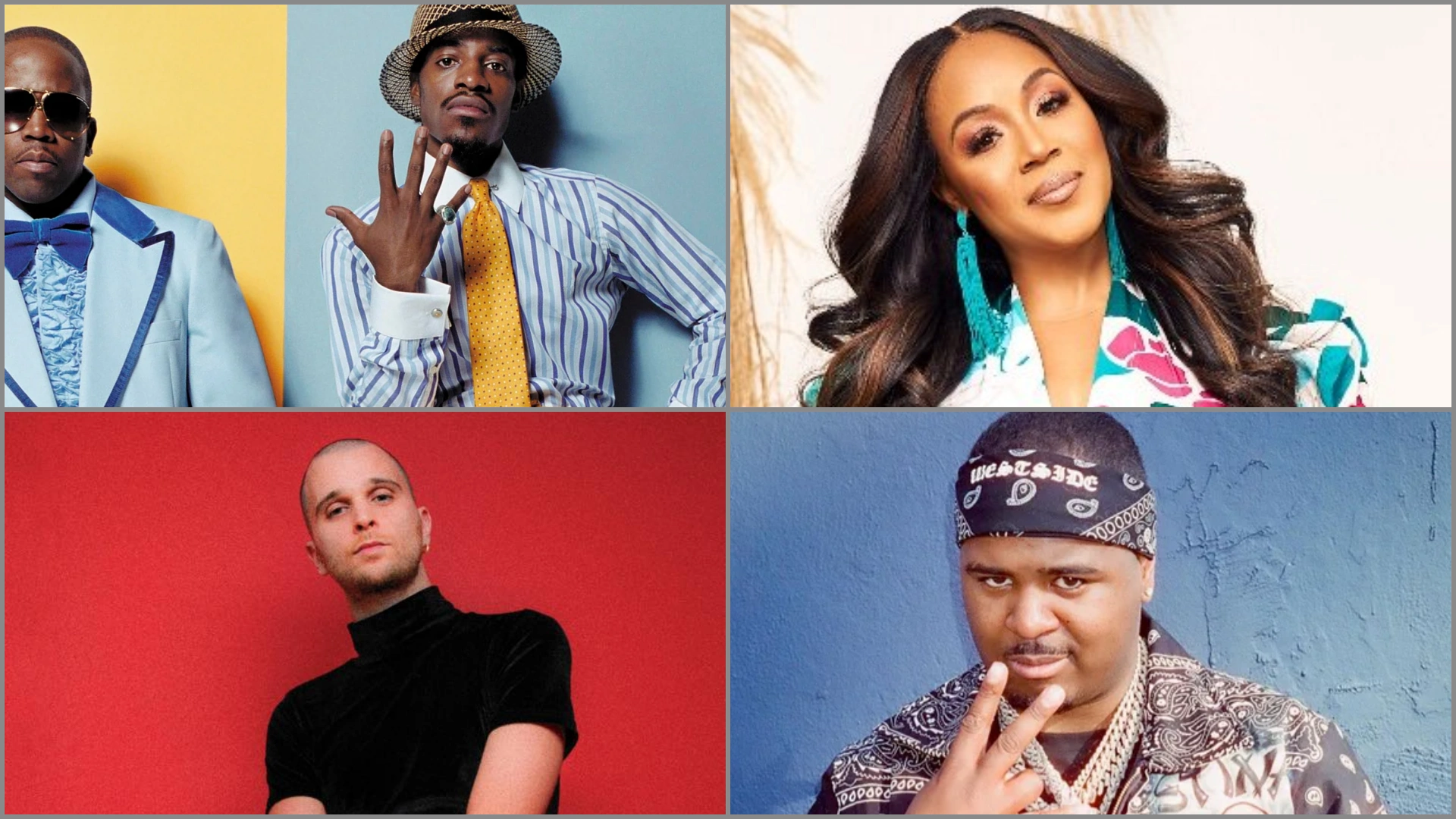
JMSN has spent the back half of this week telling his own fans that he never sold "Love Me" to the White House. The Michigan-raised singer, who puts out music through his own White Room Records, heard his 2023 single under a 30-second, taxpayer-funded spot praising President Trump on Fox News and Newsmax. On Instagram, he told followers, "I am looking at lawyers and handling this internally."
His case leads a docket that also runs through Los Angeles, where a judge cut into the damages theory of Drakeo the Ruler's family two months before trial. In federal courts in Atlanta and Manhattan, OutKast is fighting over a name and Erica Campbell's label is asking where its royalty statements went. All four cases turn on questions working artists hit long before they can afford a lawyer, starting with who owns what and what a court can actually force the other side to do.
JMSN and "Love Me": A Claim Against the Government
The spot uses footage of President Donald Trump alongside claims about tax cuts, manufacturing, and law enforcement, while displaying the line, “Paid for by the U.S. Government.” The White House described the video as a “public service announcement,” adding, “The ad is educational and unapologetically patriotic.” Musician JMSN wrote that the situation “could have gone 2 ways”: Trump’s team could have sought a license, which he would have refused, or used the song without permission. “Obviously it went the second way,” he added.
Rep. Jamie Raskin’s objection focuses on the taxpayer funding behind the Trump ad, not solely on the unauthorized song use. He called the video “felony criminal theft and conversion of government property for political campaign purposes” and said it was “blatantly unethical under numerous federal ethics provisions [prohibiting] the use of government resources for political campaigns.” The dispute now centers on federal ethics and appropriations rules. Even if Raskin’s challenge succeeds, however, it would not require the government to compensate JMSN for using his recording.
His own claim is copyright, and putting a song in a commercial takes two separate licenses, one for the composition and one for the master recording. "Love Me" came out in 2023 on Soft Spot through White Room Records, so the label that would normally sign off on the master belongs to JMSN himself. Whoever holds the publishing, whether JMSN alone or JMSN with co-writers and an administrator, controls the other half of the claim.
Because the United States paid for the ad, the lawsuit an ordinary infringer would face is not available. Under 28 U.S.C. § 1498(b), an owner whose copyright is infringed by the federal government has one route, a suit in the U.S. Court of Federal Claims. There is no jury in that court, and the remedy is money rather than an order pulling the ad. The statute promises "reasonable and entire compensation," including at least the minimum statutory damages set by the Copyright Act. It also reaches a private contractor that made the spot with the government's authorization, which puts any outside production company in the same forum.
Two steps come before any filing. A U.S. copyright registration is generally required before an American author can sue for infringement, and the Copyright Office's public catalog shows within minutes whether "Love Me" has been registered. The same section lets the responsible agency settle with the copyright owner before a case is filed, which makes a demand letter from a music attorney the likeliest opening move. Section 1498 also carries a three-year limitations period, so JMSN has time to build the claim.
Copies of the ad posted to YouTube, X or Instagram are a separate matter, because a DMCA takedown notice goes to the platform hosting the video and does not require suing anyone. For an independent artist with no legal department behind him, that notice is the fastest and cheapest thing he can file this week.
Drakeo the Ruler's Estate Heads to Trial With a Narrower Case
Darrell Caldwell, the Los Angeles rapper known as Drakeo the Ruler, was 28 when he was stabbed to death backstage at the Once Upon a Time in LA festival on Dec. 18, 2021. The festival was held at what was then Banc of California Stadium in Exposition Park. His mother, Darrylene Corniel, and his minor son sued promoters Live Nation Worldwide Inc. and C3 Presents LLC, seeking punitive damages on the theory that the companies acted with malice and oppression.
On Sept. 24, Los Angeles Superior Court Judge James I. Montgomery denied the family's request for pretrial access to both companies' financial information in a five-page ruling. "Plaintiff contends that it has shown a substantial probability that the estate will prevail on a claim for punitive damages by a finding of malice and oppression," he wrote. "However, the court is not persuaded by plaintiff's argument."
That wording tracks California Civil Code Section 3295, which blocks pretrial discovery of a defendant's finances unless the court first finds a substantial probability that the plaintiff will win punitive damages. The order is a discovery ruling rather than a dismissal, so the punitive claim remains in the complaint. With trial set for Nov. 30, though, a judge has now put in writing that the family has not shown it is likely to prevail on it. If a jury does reach punitive damages, California lets defendants keep evidence of their wealth out until after the jury finds them liable for those damages.
Defense lawyers called the lawsuit "a premises-security negligence case dressed up as intentional wrongdoing," and argued it lacks "the base, vile, and contemptible conduct" that punitive damages require. If the trial proceeds as a negligence case, any award would be measured by what Drakeo's mother and son lost rather than by the companies' size.
OutKast v. Ovrkast: A Name Deal Nobody Signed
High Schoolers LLC, the company that holds OutKast's rights for André 3000 and Big Boi, sued Oakland rapper and producer Silas Wilson, who records as Ovrkast, in Georgia federal court on Sept. 16. The complaint alleges trademark infringement, unfair competition and breach of contract, and says Wilson agreed in an earlier confidential settlement to switch to an approved alternate spelling but kept using Ovrkast. It asks for a permanent injunction, destruction of materials bearing the name and money damages.
Wilson has pushed back in public, and he has 30 days to answer the complaint in court. "For the record, I NEVER SIGNED any agreement," he said. "It was verbal, and I did not ignore their date." Whether a spoken settlement binds him is now a question for the court. OutKast's lawyers are also leaning on a 2025 Rolling Stone interview in which Wilson acknowledged that people read his name as OutKast. That is actual-confusion evidence, and trademark plaintiffs rarely get it from the other side.
An artist still choosing a stage name can run the same search OutKast's lawyers ran before a first release. Federal registration of an artist name turns rights that stop at a regional fan base into rights that hold nationwide.
Erica Campbell's Label Wants Its Royalty Statements From SRG
My Block Records, the label founded by producer Warryn Campbell, has sued distributor SRG/ILS Group in Manhattan federal court for breach of contract. The label says three releases distributed from 2022 to 2024 produced more than 113 million streams and over $1 million in sales without a single royalty statement. The releases are Erica Campbell's 2023 album I Love You, home of the Grammy-nominated "Feel Alright (Blessed)," plus Lena Byrd Miles' Brand New and The Walls Group's Four Walls. My Block is seeking more than $1 million.
SRG disputes the claims and says it "made repeated efforts after the distribution deal ended to work with My Block Records on the transfer of masters, accounting and payments." It is the distributor's second royalty fight this year with an act from the gospel and R&B world. In February, R&B singer Kenny Lattimore sued SRG over his 2021 album Here to Stay, a project his suit says produced a No. 1 R&B single. He says he received a single $4,400 check when he was owed more than $100,000, and SRG denies wrongdoing in that case as well.
Both suits rest on the accounting terms in a distribution contract, which set how often statements are due and whether the label or artist can audit the books. Those clauses let My Block go to court over missing paperwork before anyone has proven the exact amount owed.

Comments (0)
No comments yet — be the first to share your thoughts.
Leave a comment