

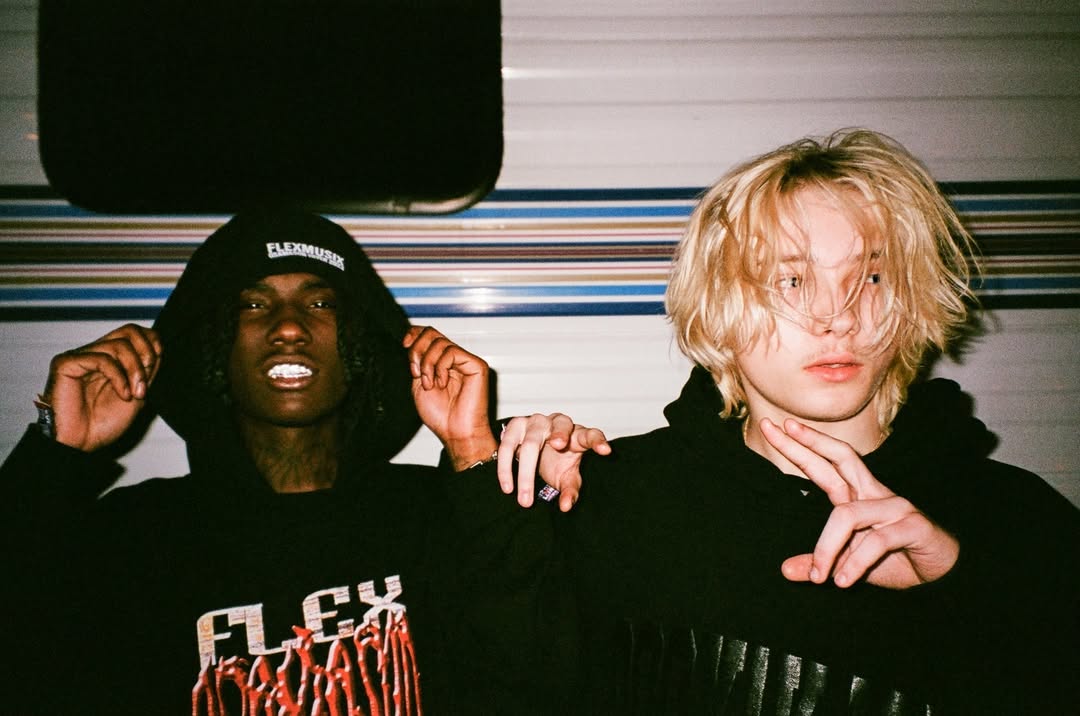
You will not hear either of them on a radio station at 2 p.m. on a Tuesday. Their names do not show up in Grammy nomination announcements next to legacy artists or corporate-facing chart climbers. No late-night television bookers are putting them in rotation. And none of that has slowed them down for a single second. Nettspend and OsamaSon are two of the most search-trafficked, obsessively followed, and culturally influential young artists operating in hip-hop right now, and they are doing it entirely on their own terms, through a system that the traditional music industry still does not fully understand how to process.
This is the story of what they are building, where it comes from, and why Gen-Z's relationship with their music is unlike anything the industry has mapped before.
Before getting into these two specifically, it helps to understand the sonic world they inhabit. Rage rap is not a label that radio programmers invented. It is a genre that emerged organically from SoundCloud, grew through internet communities, and was formalized by a generation of listeners who wanted something rawer, more disorienting, and more sonically extreme than what the mainstream was offering.
The foundation was laid by artists like Playboi Carti, whose OPIUM label and early experimental work established a blueprint built on frenetic hi-hats, distorted bass, minimal melodic structure, and an approach to Auto-Tune that treats glitches and artifacts as features rather than production mistakes. Where traditional trap used Auto-Tune to smooth vocals into something radio-friendly, rage rap pushed Auto-Tune into uncomfortable, deliberately unstable territory. The vocal delivery becomes an instrument in itself, not a vessel for clean enunciation but a textural element that functions more like feedback or noise.
Nettspend's style takes that foundation and adds what fans and Apple Music's editorial team have described as a "jerk" approach, a layered, disorienting production method that makes his tracks feel like they are clipping and warping in real time. The glitches are not accidents. They are the sound. OsamaSon pulls from a related but distinct place, building his music around high-voltage trap production that Pitchfork and The FADER have both framed as aggressive, distorted, and deeply physical in its impact. When OsamaSon's music hits a speaker, you feel it before you intellectually process it. That is the point.
Nettspend: From SoundCloud to the Billboard 200
Gunner Green Shepardson, born March 18, 2007, in Richmond, Virginia, started releasing music to SoundCloud in December 2022. He was 15 years old. By late 2023, a snippet of "Drankdrankdrank" went viral on Twitter, and the trajectory that followed was one of the more remarkable organic ascents in recent hip-hop memory. The song moved not because a label promoted it or a radio program picked it up, but because his core audience found it, shared it, and built a community around it before any institutional structure got involved.
That community affiliation is central to understanding who Nettspend is. He is affiliated with underground rap collectives including NOVAGANG, Crashoutboyz, Nitemare, and 1c34, a network of artists and fans who operate largely through Discord, SoundCloud, and TikTok comment sections rather than traditional press cycles. When Nettspend signed with Interscope Records and Grade A Productions in 2024, the deal was understood by his audience as a resource acquisition rather than a creative redirection. The sound did not shift toward commercial palatability. The infrastructure simply got bigger.
His December 2024 debut mixtape, Bad Ass F*cking Kid, launched at number 197 on the Billboard 200, which for an artist whose entire fan base had been built in internet communities was not just a chart number. It was proof of concept. Then his debut studio album, Early Life Crisis, released March 6, 2026, debuted at number 39 on the Billboard 200 and number 13 on the US R&B/Hip-Hop chart. The jump from 197 to 39 in the span of one project is not something that happens through playlist manipulation or radio promotion. It happens when a real audience doubles down.
The features on Early Life Crisis tell their own story. OsamaSon appears on the album, as does YoungBoy Never Broke Again, whose cult-level loyalty from his own audience mirrors exactly the kind of parasocial, fiercely defensive fanbase that Nettspend has cultivated. The collaboration between Nettspend and YoungBoy is not a mainstream crossover moment. It is two internet-native audiences finding common ground through shared sonic values.
Nettspend also walked the runway at Miu Miu's Paris Fashion Week show in March 2025, which was not a celebrity booking. It was a signal from a major fashion house that his cultural positioning as an artist speaks to something larger than chart metrics. Teen Vogue covered his Gucci runway debut, and yet none of that press access has moved him any closer to the kind of mainstream institutional center that would have defined "success" for an artist from a previous generation. He is building something adjacent to that center, intentionally.
OsamaSon: The Underground's Most Consistent Threat
Amari Deshawn Adham Middleton, born in 2003 and raised between Goose Creek, South Carolina and Columbus, Ohio, learned to produce music in FL Studio from his uncle, a geechee musician. That origin detail matters because it means OsamaSon did not come to production through formal training or studio access. He came to it through family, tradition, and self-teaching, a path that fundamentally shapes how he hears sound and what he is willing to do with it.
He became widely known within the underground rap scene after "Cts-V" and "Troops" gained traction online in 2023, and his debut studio album Osama Season followed in July of that year. By the time his second album Flex Musix dropped in December 2023, he had already signed with Atlantic Records and Motion Music, giving him major-label distribution without major-label creative oversight. That balance is the central tension of his career, and by every measure he has managed it well.
His third studio album, Jump Out, released January 2025, became his first project to chart on the Billboard 200, debuting at number 151. The album earned a Best New Music designation from Pitchfork with an 8.2 rating, and The FADER described him as "the closest thing rage-rap has to a Playboi Carti heir." Rolling Stone, XXL, and Complex all covered the project extensively. For an artist operating in a lane that mainstream media historically ignores or mischaracterizes, the critical reception was unusually comprehensive.
What happened next is even more telling. Almost entirely while on his 20-stop Jump Out Tour across Europe, OsamaSon recorded his fourth studio album, Psykotic, released October 2025. The album debuted at number 81 on the Billboard 200, fifty spots higher than Jump Out had placed just ten months earlier. To prevent leaks, his team distributed advance copies to journalists on burned CDs. That detail alone tells you everything you need to know about how OsamaSon and his team think about the relationship between art, audience, and industry gatekeeping.
Hypebeast described Psykotic as "a brazen and bold-faced rendering of his rise to the top of the underground," noting the symbiotic relationship between OsamaSon and his audience as the core engine of his momentum. His fans do not just stream his music. They show up. His tours sell out. His social media engagement operates at a level that is disproportionate to his mainstream name recognition, which is precisely the metric that tells you where the real audience attention is sitting.
Nettspend and OsamaSon have not just operated in the same lane. They have actively built together.
Their 2024 collaborative single "Withdrawals," produced by OK and released through Atlantic Records, is the kind of record that crystallizes what both artists do best. The production is experimental rage and trap, the delivery is high-pressure and confrontational, and the track moves through its two-minute runtime with the focused intensity that defines their shared aesthetic. It did not need a superstar feature or a radio-friendly hook to generate attention. It landed because their combined audiences already knew what they were getting into and leaned toward it.
OsamaSon also appears on Early Life Crisis, further cementing a creative relationship that is less about mutual promotion and more about genuine artistic alignment. Both artists share production contacts, particularly the producer OK, who has worked extensively with both and whose fingerprints are on some of the most distinctive tracks in both catalogs.
The reason Nettspend and OsamaSon generate massive search traffic despite minimal mainstream press is a structural story about how music discovery actually works in 2026. TikTok's recommendation algorithm does not care about label priority or radio adds. It cares about engagement rate, completion rate, and the speed at which new users are finding and reacting to a piece of content. Both artists make music that is inherently reactive. The disorienting production choices, the short track lengths, the intensity of the delivery, all of it is built for a clip. It is built for 15 seconds that make someone stop scrolling and ask "what is this?"
YouTube operates similarly. When a new Nettspend or OsamaSon track drops, the reaction video ecosystem activates immediately, music heads post first-listen responses, niche rap channels do production breakdowns, and the comment sections fill up with debates about subgenre taxonomy, comparisons to adjacent artists, and arguments about who is pushing the sound furthest. All of that activity feeds back into the search engine. Google indexes the conversation, not just the music, and that is why lyric searches, "who is Nettspend" queries, and OsamaSon album ranking videos stay in circulation long after a release cycle would normally go quiet.
The cult-following dynamic also plays a role that is easy to underestimate. Fans of both artists do not engage casually. They argue, curate, and share with a ferocity that resembles sports fandom more than typical music consumption. That intensity of engagement is exactly what platform algorithms reward, regardless of whether a label is spending promotional dollars to push the content.
OsamaSon is booked for Rolling Loud 2026 and is set to make his Australian concert debut in October 2026, dates that were announced this week and sold through within days. His Australian shows at Melbourne's Festival Hall, Sydney's Enmore Theatre, and Brisbane's Fortitude Music Hall mark the kind of international expansion that typically follows years of major label investment, not two years of self-directed catalog building on the back of internet communities.
Nettspend, still only 19 years old, has an entire creative adulthood ahead of him with Early Life Crisis as his formal first statement. The Billboard trajectory from his mixtape to his debut album is the kind of momentum curve that labels spend millions trying to manufacture artificially. His has been organic from the first SoundCloud upload.
What both artists represent for the culture is something more significant than their individual careers. They are proof that the next generation of hip-hop does not need the traditional infrastructure to build a real, lasting audience. They need a sound, a community, and a platform ecosystem that rewards intensity. They have all three. The mainstream media will catch up eventually. But by the time it does, these two will have already moved somewhere new.
Comments (0)
No comments yet — be the first to share your thoughts.
Leave a comment