


There are artists who define a genre. There are artists who define a generation. And then, on rare occasion, there is an artist who defies both categories entirely, someone whose very existence reshapes the way a culture understands itself. Erykah Badu is that third kind. Since she walked into the room in 1997 with a headwrap taller than most people's ambitions and a voice that sounded like Billie Holiday reincarnated with a philosophy degree and a joint, Badu has operated on her own frequency, one that the rest of music has spent nearly three decades trying to tune into. She is 55 years old now, still performing, still creating, still the most singular presence in any room she enters. This is the full story of how she got there.
Erica Abi Wright was born February 26, 1971, in Dallas, Texas, the eldest of three children. Her mother, Kolleen Maria Gipson, was an actress and singer, while her father, William Wright Jr., left the family early, leaving her to be raised primarily by her mother and grandmother. That matrilineal foundation would define her sense of self for the rest of her life. At age seven, Badu learned to play piano. At 14, she began freestyle rapping at a local radio station. The raw material was always there. What Dallas gave her was the stage to start understanding it.
She attended the High School for the Performing and Visual Arts in Dallas, where she began freestyling on local radio station KNON under the name DJ Apples. She became known as the talented rapper MC Apples in the hip-hop duo the Def Ones, and it was also during high school that she changed the spelling of her name to Erykah, with the 'kah' meaning inner light in Egyptian, as she wanted to shed what she called her "slave name." She later changed her surname to Badu, borrowing from a favorite scat-singing phrase, which she subsequently learned meant "to manifest light and truth" in Arabic. The name was not a stage persona. It was a declaration.
After graduating, she enrolled at Grambling State University in Louisiana, where she majored in dance and theatre. She dropped out in 1993 to pursue a singing career and formed the group Erykah Free with her cousin, while also working as a waitress and a drama teacher. Those years of straddling art and survival built something in her that no conservatory program could replicate: the understanding that music is not a career path. It is a calling, and a calling does not stop because the shift is over.
In 1995, while the group was opening for D'Angelo, Badu came to the attention of Kedar Massenburg, who was just starting his own record company. The meeting would change everything. Massenburg signed her with one condition: she would record as a solo artist. She agreed. By 1997, the world would understand why that condition was unnecessary. Erykah Badu does not need a group. She is the gravitational center of every room she enters.
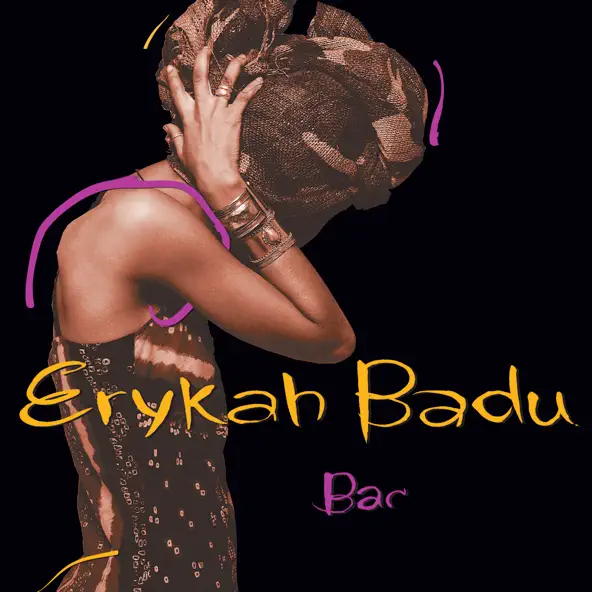 Baduizm arrived February 11, 1997, and it did not just debut well. It announced something. The first single "On & On" became the first neo-soul single to top Billboard's R&B chart. Within a month, Baduizm was released, rising to number two on the pop album charts and going triple platinum. The music industry had not heard anything quite like it, and the critics who were paying attention knew it immediately. Pitchfork, in its retrospective assessment, called it the "influential crown jewel of the neo-soul movement." Kedar Massenburg later said: "Toné! kind of opened the door, D'Angelo took it to the next level in terms of edginess, and Erykah solidified it. That's what Baduizm did. You're saying, 'I don't need to wear these kinds of clothes or look this kind of way, this is my -izm.'"
The album's visual signature was as important as its sonic one. Badu performed with incense burning and candles lit. The enormous headwrap. The ankh jewelry. The spiritual consciousness woven into every lyric. On the wings of signature singles like "On & On," "Appletree," "Next Lifetime," and "Otherside of the Game," Badu secured her spot as the queen of neo-soul. She won the Grammy for Best R&B Album and Best Female R&B Performance at the 1998 ceremony. She was 26 years old and had already built a sound that artists are still studying today.
What made Baduizm remarkable was not just the music. It was the permission it granted. Permission to be spiritual without being preachy. Permission to be Black and Southern and woman and weird and brilliant all at the same time, without softening any of those edges for the market. Badu has said of her musical ability: "I consider my musical ability to be a gift from the Creator. It's not that I try to work hard or nothing like that, it's a gift, it was given to me, and I appreciate it." That humility, genuine and specific rather than performed, is part of what her audience has always trusted about her.
Baduizm was followed the same year by Live, a concert recording that captured what naysayers and fans had already begun to sense: Badu's live performances were a different category of experience entirely. Three years later, in 2000, she released Mama's Gun, a fuller, darker, more personal album that pushed her artistic language forward without abandoning the warmth that had made Baduizm a home for so many listeners. Apple Music describes Badu's trajectory from Baduizm onward as a creative vision "much broader than the slinky, coffee-bar-ready jazz and soul of her early releases," evolving into "her own bewitching and sometimes bewildering brand of soul, funk, and psychedelia, laced with stinging sociopolitical commentary and sly humor."
Worldwide Underground, released in 2003, arrived as a surprise EP that blurred the lines between album and experiment, capturing a jam-session creative freedom that felt like Badu thinking out loud in real time. Recorded during an unstructured, collaborative process at Electric Lady Studios, the album featured contributions from longtime collaborators like Questlove and Raphael Saadiq, giving it an organic, live feel. Then came the most ambitious chapter of her studio career.
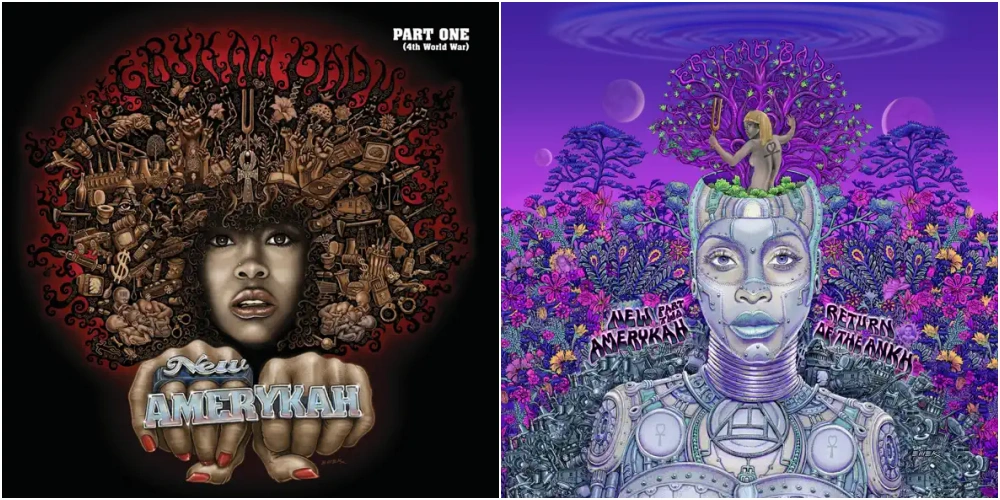 New Amerykah Part One (4th World War), released February 26, 2008 (her birthday), was a seismic shift. The album was recorded mainly on laptops with Apple's GarageBand software, with Badu emailing sessions and files back and forth with producers including Madlib and 9th Wonder. The album merges futuristic funk with complex political commentary, creating a soundscape that is both challenging and thought-provoking. Tracks like "The Healer" and "My People" dive deep into themes of cultural identity, systemic oppression, and self-awareness. It earned an 84 from critics and announced that Badu had no interest in making the same record twice, or even the same kind of record twice.
Two years later came New Amerykah Part Two (Return of the Ankh), an album centered on romance, vulnerability, and self-examination, and the record that would produce the most talked-about music video of her career. Beyond the catalog proper, Badu released the mixtape But You Caint Use My Phone in 2015 to generally positive reception, and more recently has been working alongside The Alchemist, with collaborative material surfacing in 2025. As Badu told Pitchfork in 2015: "I have so much music that I do. Just like how a visual artist is always sketching something but they might not share it, I'm always writing songs or coming up with melodic lines on piano or guitar. It's therapy. It's always happening."
On the afternoon of March 13, 2010, Erykah Badu walked into Dealey Plaza in downtown Dallas, Texas, with no permits, no closed set, no crew, and one camera. Rarely meeting the eyes of the people she passed, groups of adolescents, men and women, parents with children, Badu sequentially removed her sunglasses, coat, hooded sweatshirt, shirt, pants, bra, and underwear. When she arrived, nude, at the approximate site of President Kennedy's assassination, a gunshot rang out and she collapsed to the ground. As she lay there, blue streaks of "blood" spread across the pavement, spelling the word "groupthink." The whole thing was filmed in a single take. Then she ran.
On the video's guerrilla production, Badu herself described the shoot as: "no crew, 1 take, no closed set, no warning, 2 min., Downtown Dallas, then ran like hell." On the choice of Dealey Plaza, Badu told the Dallas Morning News that the location was chosen intentionally because the video was about "the character assassination one would go through after showing his or her self completely." The stripping, in other words, was never about nudity. It was about exposure in the most radical sense, the act of becoming fully visible in a world that punishes visibility.
The internet erupted. The video went viral overnight. The result of filming in public without permits was a $500 fine and six months' probation on a disorderly conduct charge after a witness filed a sworn statement with police. Badu pleaded not guilty. The charges were ultimately resolved. The video, meanwhile, has never stopped circulating. It is taught in art and cultural studies programs. It has been analyzed by academics, debated on podcasts, and cited as one of the most politically and artistically charged visual statements in the history of the music video format. Badu described the project as "shot guerrilla-style" and as a "protest" against "groupthink" and about "liberating yourself."
What makes "Window Seat" endure beyond its initial shock is precisely what Badu always understood: the most powerful art forces the viewer to confront something uncomfortable about themselves, not just about the artist. The people who were outraged by a nude woman walking through Dealey Plaza had nothing to say about the metaphor being enacted right in front of them. That gap between reaction and reflection is exactly where Badu has always chosen to live.
Erykah Badu's personal life has attracted as much cultural conversation as her art, partly because she has never hidden it, and partly because the cast of characters involved reads like a who's who of hip-hop royalty. She has three children by three different men, all of whom are major figures in the music world, and the family structure they have collectively built is one of the more genuinely functional and unconventional arrangements in the industry.
Her eldest child, Seven Sirus Benjamin, was born to Andre 3000 of OutKast, with whom Badu was romantically involved from 1996 to 1999. The relationship was significant for both artists creatively and personally. Of their bond years after the relationship ended, Badu told Rolling Stone: "Over these years, we've just become closer and closer as friends, as humans, as man, as woman." When asked on the August 2025 episode of Drink Champs to choose between Andre 3000 and Black Thought as the better rapper, Badu quipped: "Now you're messing with my child support," before adding that she thought the crew would have her pick between "two of the baby daddies." The line landed as classic Badu: disarmingly funny, completely unguarded, and somehow also a deflection that reveals more than a straight answer would have.
Her middle child, Puma Curry, born 2004, is the daughter of The D.O.C., the Dallas-born rap legend. The D.O.C. has described Badu as "probably my closest friend" outside of his children, and confirmed that despite no longer being in a romantic relationship, "there is no hate in that house," characterizing Andre 3000 and Jay Electronica as "great friends." Her youngest child, Mars Merkaba Thedford, born 2009, is the daughter of Jay Electronica. Of Jay Electronica, Badu has said: "we're very close. He's very protective. He's a soldier. He wouldn't let anything happen to me or any of my kids or any of the fathers."
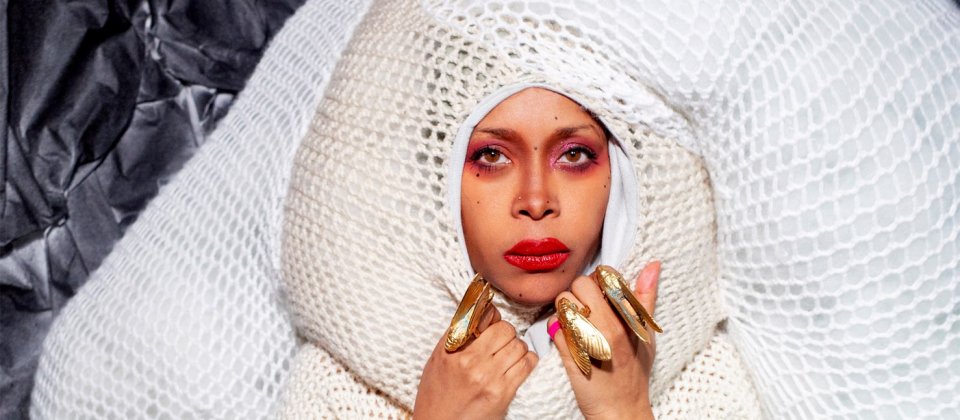 From 2000 to 2002, Badu was also publicly linked to Chicago rapper Common. The relationship produced one of the great creative partnerships of that era. Common told People Magazine of Badu: "With Erykah Badu, that was my first love where you're just open and floating." He dedicated his fifth album, Electric Circus, to her, and their Grammy-winning collaboration "Love of My Life (An Ode to Hip Hop)" remains one of the definitive documents of that entire period in conscious R&B and hip-hop.
On the subject of her unconventional family and the public's judgment of it, Badu said during a Breakfast Club interview: "I didn't know anything... no one would expect to have three baby daddies, who plans that? But, when those things start to happen, you don't stop living." That answer is Erykah Badu is honest, philosophical, unbothered, and entirely her own.
One of the most important things to understand about Erykah Badu is that she has always understood herself as something larger than a recording artist. Acting, fashion design, DJing, producing, doula work, community activism through her nonprofit B.L.I.N.D. (Beautiful Love Incorporated Non-Profit Development), which provides arts-based programming for inner-city youth, all of it is part how she moves through the world. She appeared in Blues Brothers 2000 and the Oscar-winning drama The Cider House Rules, and her role as Rose Rose in the latter earned her recognition at the 2008 Black Reel Awards.
In 2024, the Council of Fashion Designers of America named her their Fashion Icon, recognition of a visual sensibility that has influenced everything from streetwear to high fashion for nearly 30 years. She has hosted the Soul Train Awards multiple times, each appearance a reminder that her command of a room is not transferable to any other medium. It is simply hers.
Her own words on what performance means to her say it better than any summary could. In a March 2025 Billboard interview, Badu said: "That's what I do. I am a performance artist. I am not a recording artist. I come from the theater. It's the immediate reaction between you and the audience and the immediate feeling. The point where you become one living, breathing organism with people. That's what I live for. It's my therapy. And theirs, too. We're in it together. And I like the idea that it happens only once."
And on the role of music in her identity, she has said: "What does music mean to me? I don't think I would really be much without it, without it coming through me. It's my means of communication, my means of growth, my means of transportation from one point in my life to another."
The easiest way to understand Erykah Badu's legacy is to listen to almost any significant R&B, neo-soul, or conscious hip-hop album released in the last 25 years and find her fingerprints. Badu has said of her influence: "I can see the evidence of that when I listen to music or hear young artists talk and they're not shy at all about telling me thank you for the things I've contributed to them." Billie Eilish has credited her. SZA came up in a world shaped by her. Kendrick Lamar's most introspective work lives in the same philosophical tradition. The list extends in every direction.
But what Badu's influence looks like is not just sonic. It is the permission she modeled. The permission to be politically aware without being didactic. To be sensual without being objectified. To be spiritual without being preachy. To be deeply rooted in Black Southern culture while being globally resonant. To take breaks on your own timeline, raise your children on your own terms, love who you love without issuing a press release, and make music that reflects your actual interior life rather than the version the market would prefer.
In a 2017 Billboard interview, Badu said of her relationship to the artists who came after her: "I don't have to be open-minded about it, because in order to be open-minded, it would mean that there's a part of my mind that's closed. I am them. They're extensions of me. And to me, music is about your truth."
That is the whole thing, right there. Erykah Badu has never been building a brand. She has been building a truth. And the reason that truth has lasted 30 years, earned five Grammys, produced some of the most enduring music of the modern era, and generated a level of audience devotion that most artists never come close to, is because truth is the one thing that does not go out of style.
The Queen of Neo-Soul did not need a crown. She brought her own headwrap.

Comments (0)
No comments yet — be the first to share your thoughts.
Leave a comment