

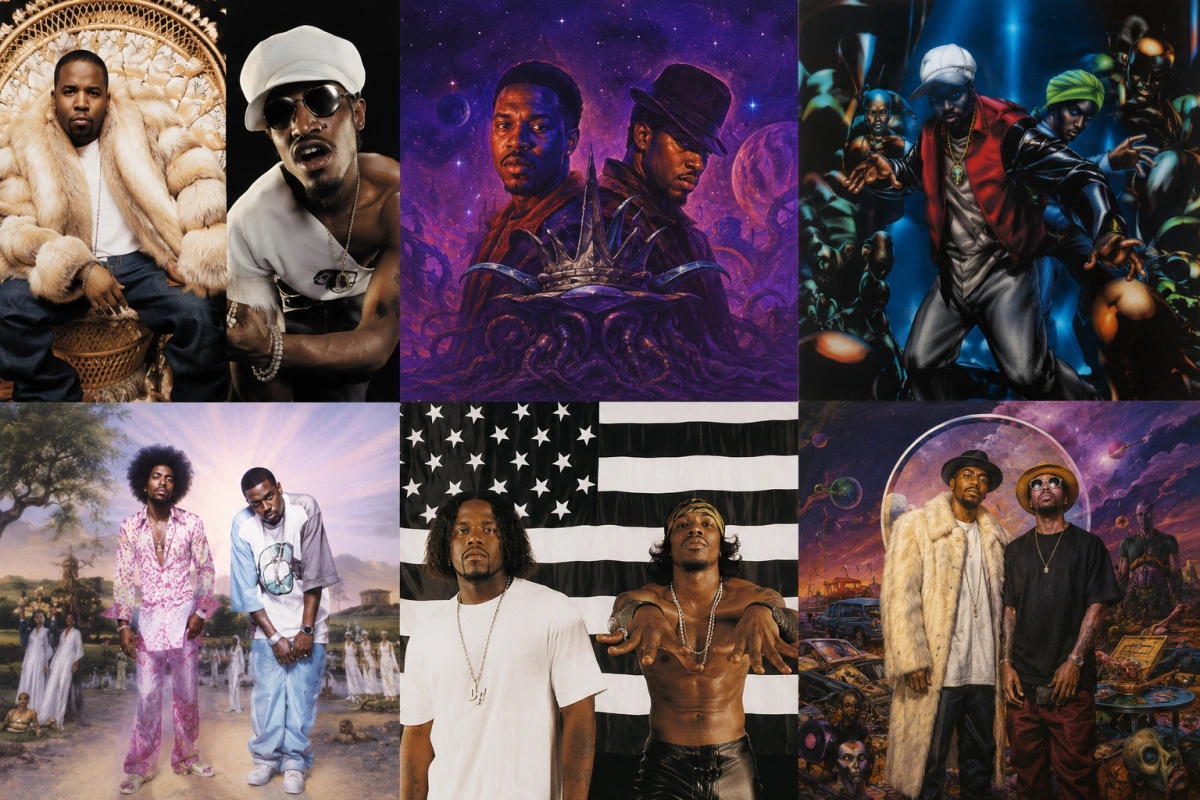
Before Drake turned Toronto into a music mecca. Before trap redefined what Atlanta could sound like. Before the South became the center of gravity for American hip-hop, there were two teenagers from East Point, Georgia, rapping into a tape recorder in somebody's basement, trying to get anybody to listen. That duo was OutKast. And the world eventually had no choice but to pay attention.
The story of André 3000 and Big Boi is one of the most important stories in the history of Black American music. Not just hip-hop. Music. Their journey from a scrappy underground collective in Southwest Atlanta to the Rock & Roll Hall of Fame is a masterclass in artistic fearlessness, cultural defiance, and the power of refusing to be boxed in by anyone's expectations. This is that story, all the way through.
André Lauren Benjamin and Antwan André Patton met as students in Atlanta in the early 1990s. Their shared love of rap pulled them together, and by 1992, when both were just 16 years old, they formed the group called OutKast. What happened next was made possible by a basement.
In East Point, Georgia, a producer named Rico Wade ran a makeshift recording studio out of his mother's house. The space was cramped, unfinished, and magnetic. They called it The Dungeon. Wade, along with Ray Murray and Sleepy Brown, operated under the name Organized Noize, and together they became the sonic architects for a loose collective of Atlanta artists who would eventually call themselves the Dungeon Family. OutKast and Goodie Mob became the family's most prominent members, alongside future legends like CeeLo Green and, in later years, artists connected to the collective including Killer Mike and Janelle Monáe.
It was through Organized Noize and the Dungeon Family that OutKast caught the attention of L.A. Reid, who had relocated to Atlanta with Kenneth "Babyface" Edmonds to launch LaFace Records. LaFace was primarily a pop and R&B operation with major distribution through Arista Records, but Reid took a chance on OutKast, making them the label's first hip-hop act. The duo got their first mainstream exposure through a remix of TLC's "What About Your Friends" and a holiday compilation placement with "Player's Ball," which became their first proper single. The stage was set.
OutKast released their debut album, Southernplayalisticadillacmuzik, in April 1994. Produced entirely by Organized Noize, the record was a rich, soulful portrait of Black life in Atlanta. The pimps and rides and neighborhood characters that filled its lyrics were rendered with a specificity and warmth that felt genuinely different from what was dominating the airwaves. Southern hip-hop had a voice, and it sounded like this. The album sold over one million copies, and "Player's Ball" became one of the most enduring rap records of the era.
But success didn't mean respect. Not yet.
On August 3, 1995, the second annual Source Awards were held at Madison Square Garden's Paramount Theater in New York City. The East Coast vs. West Coast rap war was at full boil. Every major award that evening had gone to an artist from New York or California. When OutKast was announced as the winner of Best New Artist (Group), the crowd in the building didn't applaud. They booed.
What happened next became one of the most important moments in the entire history of hip-hop.
André 3000 walked to the microphone and refused to fold. In a raw, defiant statement that lasted only a few seconds, he said: "It's like this though… I'm tired of folks, those close-minded folks, you know what I'm saying? It's like, we got a demo tape but don't nobody wanna hear it. But it's like this, the South got something to say and that's all I got to say."
Six words. "The South got something to say." Cultural critic Kiana Fitzgerald later described the moment as placing "the heart of hip-hop right over Atlanta." T.I. called it "the first time when people began to take Southern rap seriously." OutKast didn't just win an award that night. They declared a revolution.
A year after the Source Awards, OutKast returned with ATLiens (1996). If Southernplayalisticadillacmuzik was the introduction, ATLiens was the mission statement. The production pulled further from mainstream conventions, weaving in cosmic, stripped-back textures that gave the album an otherworldly feeling. "Elevators (Me & You)" became one of their most beloved records, a slow-burning meditation on progress and identity that sounded like nothing else on the radio. André's pen was sharpening. Big Boi's street-savvy rhythms were locking in. The OutKast sound was becoming its own genre.
Then came 1998 and Aquemini, the album many critics and fans consider their greatest work. Named for the combination of André's Aquarius and Big Boi's Gemini sun signs, the record went further than anything they had attempted before. Live instruments flooded the production. George Clinton of Parliament-Funkadelic made an appearance. New York rap legend Raekwon showed up on "Skew It on the Bar-B." The sprawling closer "SpottieOttieDopaliscious" was built around a brass-led arrangement so soulful it felt more like Southern jazz than hip-hop. Aquemini went double platinum and earned OutKast a Grammy nomination for "Rosa Parks." The duo that had been booed in New York just three years earlier was now undeniable.
By the time Stankonia dropped in October 2000, OutKast had outgrown the underground. The album was named after their Atlanta recording studio, and it sounded like it was recorded in a place with no ceiling. Drawing from drum and bass, psychedelic rock, P-Funk, and experimental electronics, Stankonia was the most expansive and ambitious rap record of its era. "B.O.B. (Bombs Over Baghdad)" opened at a tempo so frantic it felt like the future arriving ahead of schedule. "Ms. Jackson," one of the most emotionally direct songs either man had ever recorded, became a genuine crossover phenomenon and a cultural touchstone for anyone who had ever navigated a complicated breakup in the public eye.
The album won Grammys for Best Rap Album and Best Performance by a Rap Duo or Group. Stankonia was praised by Rolling Stone as "the most expansive and promising Black pop record of the last decade." OutKast was no longer just the most important group in the South. They were the most important group in hip-hop, full stop.
In 2003, OutKast released the project that would cement their place in the larger sanctuary of American music. Speakerboxxx/The Love Below was a double album in which each member essentially released a solo record packaged together under the OutKast name. Big Boi's Speakerboxxx was funky, tightly constructed hip-hop full of wit and streetwise energy. André's The Love Below was something else entirely: a genre-defying journey through jazz, pop, psychedelia, and neo-soul, featuring almost no rapping at all.
The result was eleven-times platinum. "Hey Ya!" became one of the biggest songs in the world in 2003, a genre-less, era-defying pop explosion that played on country stations and hip-hop stations and rock stations simultaneously. "The Way You Move," Big Boi's lead single featuring Sleepy Brown, topped charts with its irresistible groove. "Roses" showed OutKast could be cutting and hilarious in equal measure. The album was credited with reviving the double album format in hip-hop and was nominated for Album of the Year at the Grammy Awards, one of the very few rap projects ever to achieve that recognition.
Rolling Stone called it "two separate discs packaged together" that amounted to a single statement about how different two men who had grown up as best friends could ultimately become, while still producing something remarkable together.
In 2006, OutKast released the soundtrack to their musical film Idlewild, a Prohibition-era story set in the American South. It was a creative swinging-for-the-fences move that showed their ambition hadn't dimmed, even as the cultural moment had shifted. The film received a mixed reception, and the soundtrack, while containing moments of genuine brilliance, didn't land with the same seismic force as their previous work. After Idlewild, OutKast entered an extended hiatus. There was no formal announcement. The music just stopped.
In 2014, they reunited for a worldwide tour headlining Coachella and a string of major festivals. Fans who had waited years to see them perform together again were rewarded with electrifying sets spanning their entire catalog. But no new music came. The tour felt both triumphant and, in retrospect, like a final curtain call.
Both men have remained creatively active on their own terms since the hiatus, moving in directions that say everything about who they each are as artists.
Big Boi has released three solo albums, including Sir Lucious Left Foot: The Son of Chico Dusty (2010), Vicious Lies and Dangerous Rumors (2012), and Boomiverse (2017), each showcasing his mastery of traditional Southern hip-hop craftsmanship. He purchased The Dungeon, the house where OutKast recorded its earliest material, and listed it on Airbnb to allow fans to sleep in the very space where the history was made. "Atlanta is my home, and I grew up with The Dungeon Family in this house," Big Boi said of the property.
André 3000 took an entirely different path. After years of deliberate public silence, he reemerged in 2023 with New Blue Sun, a full-length ambient jazz album on which he plays the flute. No rapping. No verses. Just instrumental exploration across long, meditative tracks recorded with musicians Carlos Niño, Nate Mercereau, Surya Botofasina, and Deantoni Parks. The album earned a Grammy nomination for Album of the Year, making André one of the very few artists to receive that nomination in both hip-hop and instrumental jazz contexts. He toured in support of it through 2024.
In a 2024 interview with The Bitter Southerner, André addressed his relationship with Big Boi directly: "You know, people always ask about me and Big Boi. We cool, man. That's my homie forever. We were friends before doing music." But on the question of a new OutKast album, André was candid in a separate conversation with Rolling Stone: "I think it's a chemistry thing. We have to be wanting to do it. We are further away than we've ever been."
On November 8, 2025, André 3000 and Big Boi were inducted into the Rock & Roll Hall of Fame as part of the Class of 2025, sharing the ceremony with Soundgarden, The White Stripes, Cyndi Lauper, Salt-N-Pepa, and others. Donald Glover delivered the induction speech, connecting OutKast's music to the larger Atlanta identity and his own creative formation. "OutKast didn't just represent the South, they redefined it," Glover said. "Atlanta is not the music mecca it has become without you. There is no Childish Gambino without you. There is no South without you."
The ceremony included a star-studded tribute medley performed by JID, Tyler, the Creator, Doja Cat, Janelle Monáe, Killer Mike, and Sleepy Brown, each taking on a piece of the OutKast catalog with reverence and fire. André and Big Boi did not perform together, but their presence was the point. When they settled the question of who would speak first by playing three rounds of rock-paper-scissors on the live stage, the room erupted. It was very OutKast.
During his acceptance remarks, André grew emotional and brought the ceremony's energy to a quiet focus with one line that landed like a full album: "Great things start in little rooms. We started in a little room."
He also credited everyone who shaped the music in ways that went beyond the two of them: "A lot of times it's a lot more than just the notes or the instruments that you playing. It's everybody that's around you. It's the family, and this is my family."
Big Boi closed his portion of the speech by turning to André and saying: "I wanna say especially to my brother right here: Man, thank you for making me be the best I can be, man. Going toe to toe on the records. And iron sharpen just to be the best man."
The ceremony also carried a tender undercurrent of grief. Rico Wade, the architect of The Dungeon and the creative ecosystem that produced OutKast, had passed away in April 2024. André's repeated references to "family" throughout his speech felt like a coded tribute to the man who gave them their first room to work in. "Rico gave us a chance," André said in the extended version of his remarks.
It is difficult to overstate how much OutKast changed. They legitimized the South in hip-hop at a time when the industry had drawn a clear line at the Mason-Dixon. They proved that genre-defying music made by Black artists from the American South could be commercially dominant and critically celebrated at the same time. They influenced virtually every major Atlanta artist who followed, from T.I. to Young Jeezy to Future to Childish Gambino to Cardi B, each of whom came up in an industry that OutKast had forced open.
Their catalog holds up in a way that few catalogs from any era do. From "Player's Ball" to "Elevators" to "Rosa Parks" to "B.O.B." to "Ms. Jackson" to "Hey Ya!" to "SpottieOttieDopaliscious," there is no filler, no coasting, no playing it safe. Every album they made was an act of creative risk. Most of those risks became timeless records.
Whether or not another OutKast album ever arrives, the story is already complete. Two teenagers from East Point, Georgia, walked into a basement in 1992 and walked out carrying something that would outlast almost everything around them. They played it for a hostile crowd in New York in 1995 and told the room, plainly and permanently, that the South had something to say.
The world has been listening ever since.
Comments (0)
No comments yet — be the first to share your thoughts.
Leave a comment