

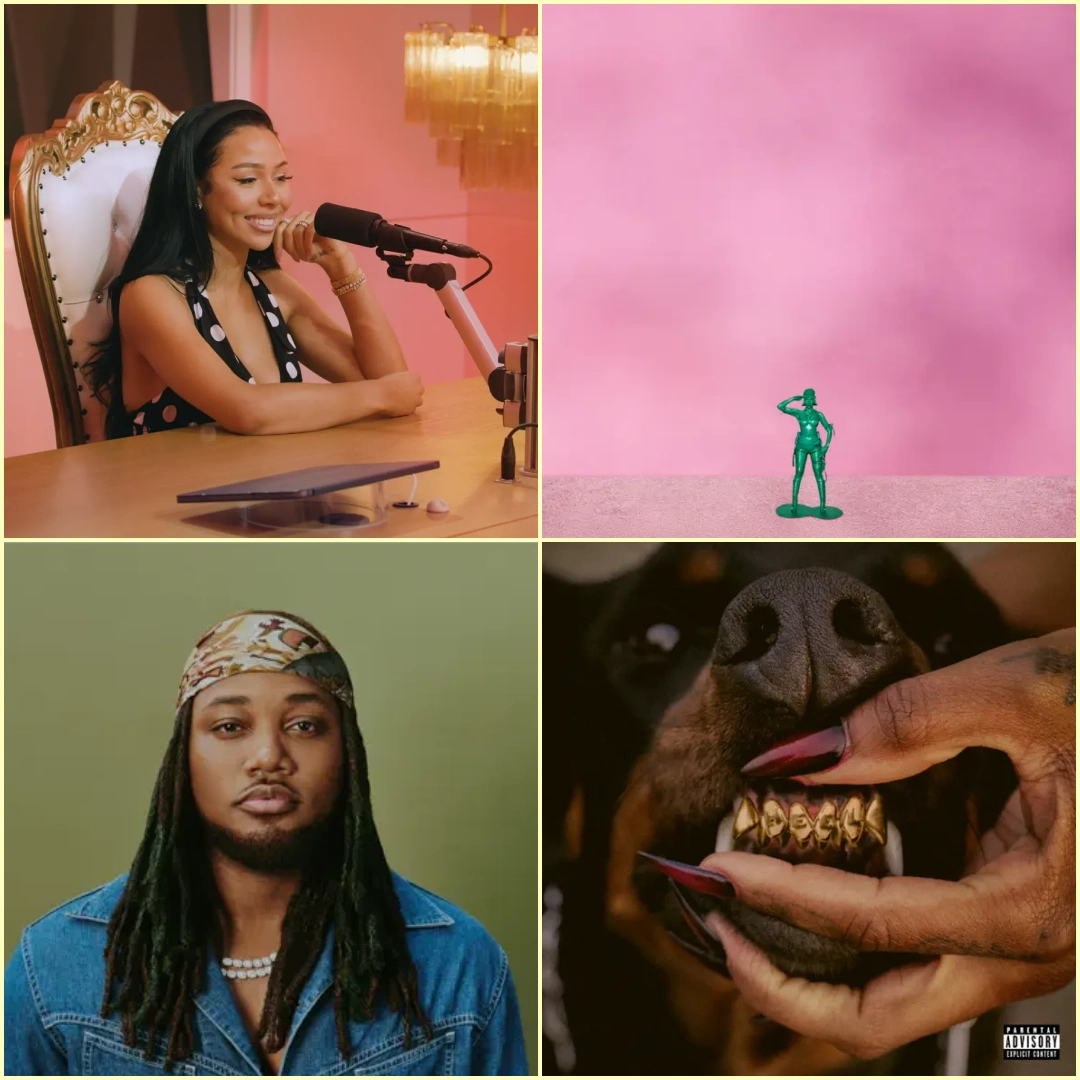
For a genre that spent most of the early 2020s being eulogized by critics and second-guessed by labels, R&B's comeback hit differently than most people expected. It did not come back louder. It did not come back with bigger features or brighter production. It came back darker, more vulnerable, more atmospheric, and more emotionally honest than it had been in years. And at the center of that shift, two artists in particular have done more than just release great music. Mariah the Scientist and Leon Thomas have quietly redrawn the sonic blueprint that modern R&B is now being built on.
The conversation around R&B's decline was real but always slightly overstated. What was actually happening was a sorting process. The genre was separating artists who were chasing radio formulas from artists who were willing to go somewhere more interior, more difficult, more cinematic. The audience was always there. What was missing were voices willing to fully commit to that darker, more introspective lane without softening it for accessibility.
By 2025, that calculation had shifted in a meaningful way. As Billboard noted in a year-end analysis, R&B's mainstream resurgence in 2025 was "the direct result of several intersecting scenes that have ridden larger cultural and sociopolitical shifts to usher in a new, rich, diverse era of R&B." Mariah the Scientist and Leon Thomas were not just beneficiaries of that shift. They were two of its primary architects.
There is a specific kind of courage required to make the album Mariah the Scientist made with Hearts Sold Separately. Released in August 2025 through her own Buckles Laboratories imprint and Epic Records, the 10-track project arrived with a visual concept that told you everything you needed to know before you pressed play: a miniature green toy soldier standing at attention against a pink backdrop. The imagery was deliberate. Mariah described the album as being about "the war on love," casting herself and women broadly as soldiers who fight fully for love only to realize they are often treated as disposable.
That kind of conceptual clarity is rare. What made it land even harder was that the music matched the metaphor without being heavy-handed about it. "Burning Blue," the lead single released in May 2025, became her commercial breakthrough, debuting at number 25 on the Billboard Hot 100 and marking her first-ever top 40 entry on the chart. It moved with the ease of a classic R&B ballad while Mariah sang with a restraint and emotional precision that critics recognized immediately. The song earned her a Video of the Year nomination at the 2026 BET Awards alongside a Viewers' Choice nod, and the search traffic around it has sustained for months.
The second single, "Is It a Crime," featuring Kali Uchis, showed a different dimension of the album entirely. The pairing of two artists who both operate in that atmospheric, emotionally layered space created something critics described as an "ethereal match," two voices that individually traffic in vulnerability and together produce something that feels almost cinematic. The collaboration also earned Mariah a Best Collaboration nomination at the 2026 BET Awards, and it is the kind of track that rewards repeated listening in a way that single-play streaming culture rarely accommodates.
Pitchfork scored the album a 7.7, and Rated R&B praised the "improved songwriting and enhanced production," noting the "brutal honesty in her lyrics that makes heartbreak almost comforting." That last phrase is worth sitting with. Music that makes difficult emotions feel comforting rather than overwhelming is a specific kind of skill, and it is exactly the kind of emotional service that listeners have been gravitating toward in large numbers. Hearts Sold Separately is not background music. It is the kind of album people play when they need to feel understood.
Leon Thomas's story is one of the more interesting trajectories in recent music history, and understanding it matters for understanding why MUTT and its deluxe expansion MUTT Deluxe: Heel hit as hard as they did. Most casual listeners came to Thomas through "Mutt," the title track that climbed to number 13 on the Billboard Hot 100, hit number one on Hot R&B Songs, Adult R&B Airplay, and Urban Radio, and went viral on TikTok and social media in a way that felt genuinely organic rather than engineered.
But Thomas had been building toward this moment for years from behind the boards. His production and songwriting credits include SZA's "Snooze," which won Best R&B Song at the 2024 Grammys, Rick Ross's "Gold Roses" featuring Drake, and Toni Braxton's "I'd Rather Be Broke." He is the kind of artist who understands music structurally, not just emotionally, and that depth of knowledge shows in how precisely crafted MUTT is as a full project.
The album explores duality in identity and in love, blending psychedelic R&B, rock textures, soul, and experimental production in a way that refuses to sit in any single lane. Billboard called it "the most stunning R&B album of 2024." Essence said it "pushes the boundaries of modern Black music" and called it "a daring and emotionally rich album." VIBE described it as "one of the best R&B albums of the year." That kind of unanimity across major outlets is not something that happens for albums playing it safe.
When Thomas released MUTT Deluxe: Heel in May 2025, adding nine new tracks and collaborations with Kehlani, Big Sean, and Halle, he deepened the project rather than just expanding it. As he put it himself: "MUTT has always been about embracing complexity in sound, in identity, in experience. HEEL is me leaning even deeper into that chaos, and finding beauty in it." The Mutts Don't Heel World Tour that followed sold out globally, cementing his status as an arena-level live act and not just a streaming artist. His viral NPR Tiny Desk performance, which peaked at number two on YouTube, introduced him to an entirely new audience that had no prior frame of reference for who he was.
It is worth being specific about what Mariah and Leon are doing sonically, because the "dark and atmospheric R&B" description only gets you so far. The more accurate frame is this: both artists are making music that treats emotional complexity as the primary subject rather than a backdrop. The production choices, the restraint in vocal delivery, the willingness to let silence do work in a track, all of it serves the emotional content rather than competing with it.
This is a direct counterstatement to the maximalist, feature-heavy R&B that dominated the mid-2010s, where the production and the collaborator list often felt like the point. What Mariah and Leon are offering is something more like intimacy at scale. The music sounds like it was made in a small room, and yet it is reaching audiences in the millions. That tension between the personal and the large-scale is part of what makes it so compelling.
The atmospheric R&B resurgence they are helping to lead also connects to a broader emotional need in the culture right now. People are looking for music that meets them where they are, not music that tells them where they should be. Vulnerability, authenticity, and emotional precision are not just aesthetic choices for these two artists. They are the entire value proposition.
Both Mariah and Leon enter 2026 with serious institutional momentum. Mariah earned five total BET Awards nominations this cycle, tied for second overall behind only Cardi B, including Album of the Year, Best Female R&B/Pop Artist, and Video of the Year for "Burning Blue." She was also honored at the Billboard Women in Music event, taking home the Rising Star award. For an artist who has operated in a critically respected but commercially modest space for most of her career, this level of mainstream recognition represents a genuine inflection point.
Leon, meanwhile, won Best New Artist at the 2025 BET Awards, earned six Grammy nominations for the 2026 ceremony, and was named Billboard's Breakthrough Artist of the Year. His Mutts Don't Heel World Tour sold out across multiple continents. The Recording Academy named him its 2025 Music Advocacy Day Artist Ambassador. That is not the profile of an emerging artist anymore. That is the profile of someone who has already arrived and is now figuring out how to define what comes next.
Together, what Mariah the Scientist and Leon Thomas represent is not a trend. Trends fade. What they are building is a standard, a new expectation for what modern R&B can be when it commits fully to emotional depth, sonic intentionality, and the kind of storytelling that does not let listeners off the hook. The audience has already voted with their streams, their concert tickets, and their search behavior. The genre is not coming back. It never left. It just found the right voices to say something worth listening to.
Comments (0)
No comments yet — be the first to share your thoughts.
Leave a comment