

There was a time when the phrase "blog era" described a messy present rather than a polished memory. Music arrived through embedded players, leaked links, message boards, mixtape sites, college radio, early social media, and writers who could turn a left-field song into the week's shared obsession.
Now that period has become a touring proposition, and the receipts say fans are paying for it.
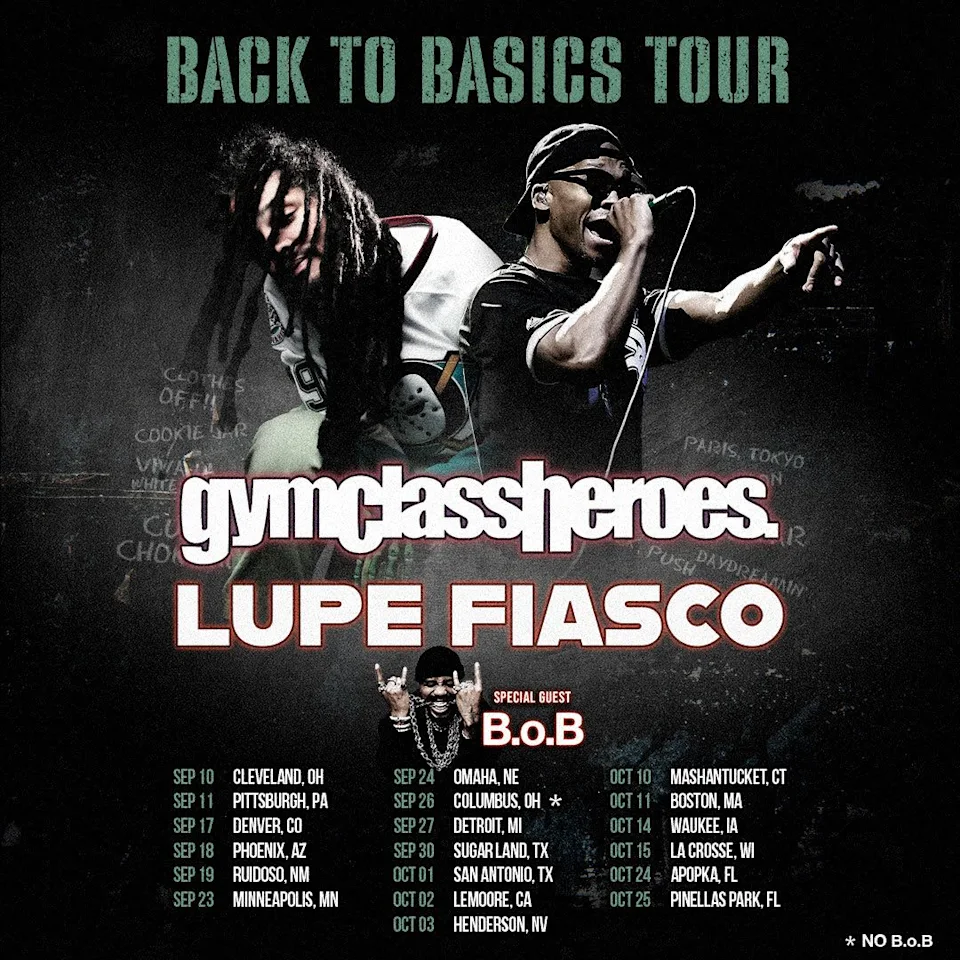
Lupe Fiasco and Gym Class Heroes have announced the 19-city Back to Basics Tour, with B.o.B appearing as a special guest on most dates and Billy Blue joining select stops. The run begins September 10 in Cleveland and closes October 25 in Pinellas Park, Florida. General ticket sales opened July 17, following an artist presale that had already moved a meaningful share of seats. The lineup collects three platinum-selling acts whose biggest crossover moments helped define the late 2000s and early 2010s.
It would be easy to file the announcement under nostalgia. The stronger read is economic. A generation that discovered music before streaming completely reorganized listening is now old enough to buy premium tickets, travel for concerts, and pay to hear the songs that once lived on burned CDs, MP3 folders, Tumblr pages, and dorm-room playlists.
The blog era is not merely being remembered. It is becoming a durable live-music market.
The tour pairs three artists whose commercial peaks overlapped without ever sounding alike. Lupe Fiasco's lyrical ambition, Gym Class Heroes' rap-rock-pop crossover, and B.o.B's melodic hitmaking all flourished during a period when genre boundaries were becoming porous but had not yet dissolved into the endless mood categories of streaming playlists.
These artists were not interchangeable, and that is precisely why the package works. The lineup evokes an era when a rap fan could move from dense wordplay to pop hooks to live-band energy in a single evening without feeling the playlist had changed identities.
Gym Class Heroes is treating this tour as a comeback, not a victory lap. The band returned in July with its first new single in nearly a decade, "Universal Language," and frontman Travie McCoy has described it as the opening statement of a full-length album still to come, the group's first in fourteen years. That timing turns Back to Basics into something more layered than a heritage act cashing in on old hits. It is a reintroduction happening in front of an audience that already knows the words to the old songs and is being asked to learn new ones too.
That is a harder trick than a straight nostalgia run. It requires a crowd that came for "Cupid's Chokehold" and "Stereo Hearts" to also make room for whatever Gym Class Heroes sounds like in 2026, on the same stage, in the same set.
Nostalgia is sometimes dismissed as an artistic retreat, but touring economics treat it differently. Familiar catalogs lower marketing risk. Fans already know the hooks, associate the songs with specific life stages, and understand the emotional promise of the night before they ever click buy.
Millennials who were teenagers or young adults during the late 2000s and early 2010s are now in their thirties and forties, with more disposable income than they had when these records first arrived and less patience for open-ended music discovery. A lineup they already trust is exactly what closes the sale.
That is the real shape of millennial nostalgia as a business model. Artists with durable songs do not need to dominate today's charts to create demand. They need an audience large enough to still care, a coherent package, and a live show that treats the old catalog as living material rather than museum property.
Lupe is particularly well positioned for this kind of run because his catalog holds both the songs casual fans recognize and the deeper cuts diehards still argue about. His career has never rested on one commercial peak. Earlier in 2026 he marked the 20th anniversary of Food & Liquor with a run of commemorative shows, and he followed that with a live album recorded with the Nu Deco Ensemble, reimagining tracks like "Kick Push" and "Superstar" with a 33-piece orchestra behind them.
That is an artist treating older music as material for reinterpretation, not repetition. It gives the tour intellectual weight beyond the obvious singles.
B.o.B's presence adds another layer. At his commercial height, he showed how quickly a rapper could move between technical verses, pop choruses, acoustic textures, and arena-sized production. His catalog includes records built for radio dominance, and his career also reflects how unstable crossover fame can be once an industry that celebrated the reach stops knowing what to do with the artist behind it.
On this tour, B.o.B does not need to relitigate his career. He needs to perform the songs that connected and let the stage answer whether that old versatility still lands live.
The artists on Back to Basics emerged before personalized streaming became the dominant architecture of listening. Fans used different platforms and belonged to different scenes, but there were still more shared cultural intersections than there are now. A major song could travel through radio, television, blogs, clubs, campuses, and word of mouth until it became difficult to avoid.
Today a record can generate hundreds of millions of streams while remaining nearly invisible to listeners outside its algorithmic lane. That fragmentation is exactly what makes a tour like this valuable. It restores a temporary sense of shared musical history, the rare feeling that everyone in the room arrived through a common door.
That is the deeper appeal behind music discovery before streaming as a selling point. The tour is not only selling songs. It is selling consensus.
Legacy touring once implied an artist's creative life was over. That assumption no longer holds. Artists can release new music, produce, teach, host podcasts, build independent businesses, and still tour around a beloved catalog without any of it reading as decline.
The modern market rewards segmentation. An artist does not need universal visibility. A focused audience of a few hundred thousand committed fans can support theaters, festivals, merchandise, and anniversary events on its own. For acts from the blog era, this catalog-driven touring model offers independence from the pressure to chase current sounds. Their competitive advantage is history, not relevance.
Jay-Z proved a version of this at scale just weeks ago, when his Yankee Stadium residency broke the venue's attendance record twice in one weekend, effectively writing the template other legacy artists are now following into arenas and amphitheaters of their own size. Back to Basics is a smaller room than Yankee Stadium, but the underlying economics, a built-in audience willing to pay premium prices for catalog they already love, are the same.
Hip-hop is now old enough for several generations of memory to exist at once. Golden-era tours, 2000s reunion packages, and blog-era lineups can all attract different audiences without canceling one another out. That is the same logic behind why B2K's twenty-fifth anniversary comeback single "Mileage" is landing as a statement rather than a stunt: audiences are no longer treating any of these eras as closed books.
This creates opportunities beyond concerts: documentaries, archival reissues, oral histories, and independent media that can preserve the period before the links disappear and the platforms erase the context around them. Lupe Fiasco, Gym Class Heroes, and B.o.B are not merely revisiting old hits. Their tour signals that the late 2000s and early 2010s have become a distinct historical category with commercial value of its own.
The Back to Basics Tour will attract fans who remember exactly where they were when these songs arrived. That emotional recognition is enough to sell tickets, but it should not be the tour's only ambition. The most compelling legacy shows let audiences hear growth: lyrics landing differently, pop records revealing stranger details, songs tied to youth acquiring the weight of adulthood.
That is why the tour matters beyond its lineup. It shows the blog era touring economy has completed a cultural cycle, moving from disruption to mainstream success, from saturation to distance, and now from memory into organized economic power. The algorithms may control most of today's discovery, but they do not own yesterday's emotional attachments. Lupe Fiasco, Gym Class Heroes, and B.o.B are betting those attachments can still fill a room, and a new Gym Class Heroes album, if it lands the way "Universal Language" suggests it might, could give the whole run a second act nobody was expecting.
Comments (0)
No comments yet — be the first to share your thoughts.
Leave a comment