

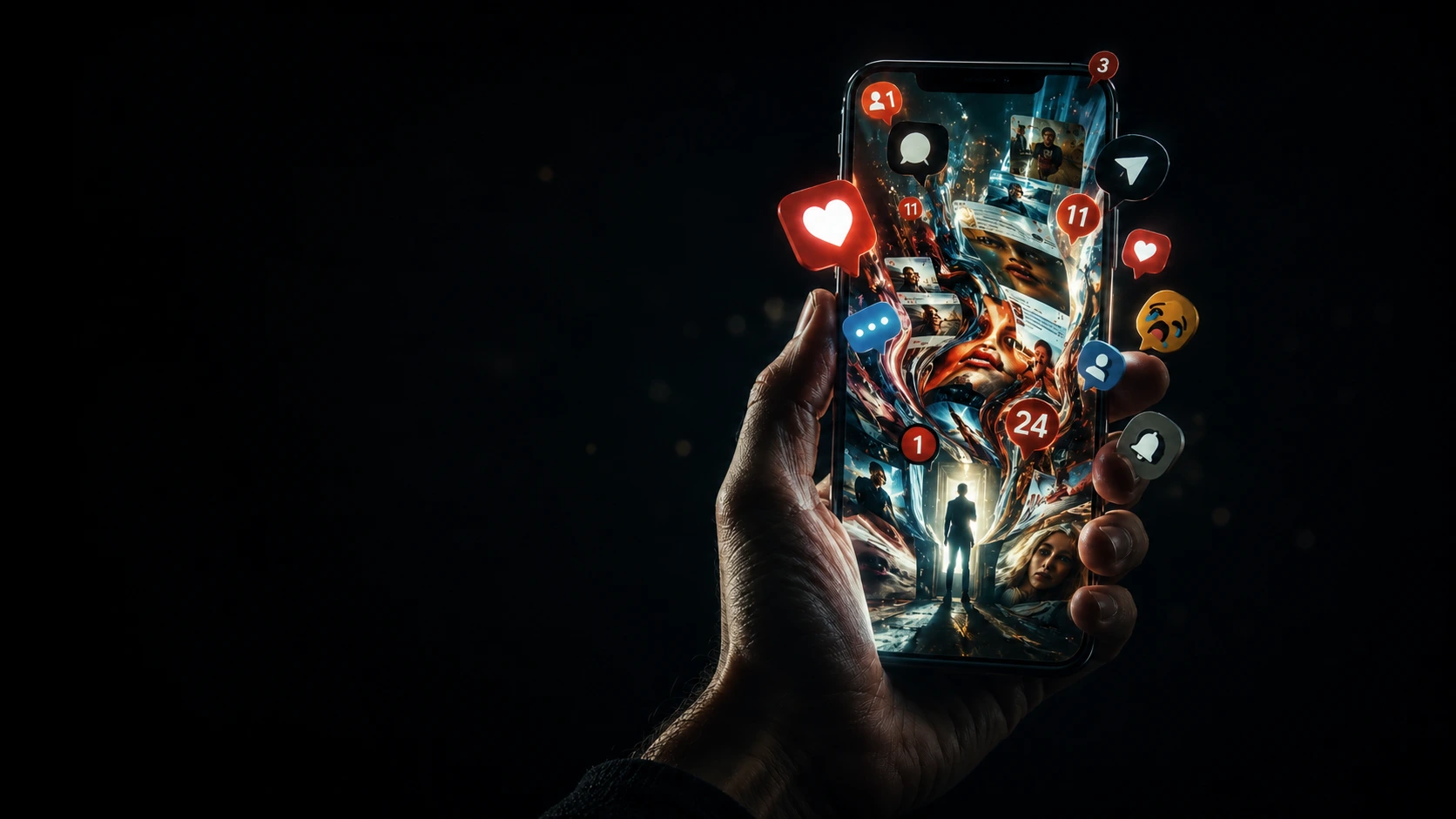
A cultural integrity audit of the engagement machine, the beefs it rewards, and the Black excellence it quietly buries at the bottom of your feed.
Social Media Apps are designed to keep us scrolling, double-tapping, and coming back for more. That is not a conspiracy theory, it is the business model. And once you understand how the business model actually works, you start to see the timeline differently. The thing you have been calling "the culture online" is not a neutral reflection of where Black people are. It is a curated highlight reel of our worst arguments, sold back to us as entertainment. Here is what is really going down, and more importantly, what we can do about it.
The short version, for anyone who wants the answer up top: social media algorithms are built to maximize the time you spend on the app, and conflict holds attention better than almost anything else. That single design choice is why a messy beef between two artists can dominate your feed for a week while a community food drive disappears in an hour. The good news is that the system is legible. Once you can read it, you can stop letting it read you.
At the heart of this whole dynamic sits the sophisticated, slightly sinister logic of the recommendation system. These systems have one job: keep you here longer. What keeps you here, unfortunately, is rarely what builds community. The messiest beef gets the most reach. Think about how fast a Boosie and Lil Nas X exchange traveled compared to anything either of them actually released. Arguments and clapbacks generate more engagement than genuine Black excellence ever does. When our cultural leaders clash, it becomes instant viral content, and sensationalized narratives about Black communities routinely overshadow the everyday success stories that never get a fraction of the same reach.
This is the same curation logic we have broken down before in our look at how curated playlists and short-form video quietly decide which records break. The machine that picks your next song and the machine that picks your next argument are running on the same fuel: attention, measured in seconds. Consider how the platform magnified the controversial chapters of Ye's public life while his Sunday Service work and his support of Black businesses barely registered on the timeline. Look at how a single round of Joe Budden Podcast drama outran years of substantive cultural conversation the show actually hosted. When a heated exchange between figures like Snoop Dogg and Iggy Azalea goes viral, the collaborations and the uplifting moments stay buried, reinforcing a false narrative of perpetual conflict that was never the full picture.
While the negative content dominates, an enormous amount of positive interaction happens daily on these exact same platforms. Black Twitter networks and secures bags in real time. Neighborhood organizers coordinate clean-ups and food drives. Artists with real street credibility use their reach to move resources where they are needed, the way The Game volunteered alongside firefighters and pledged free housing during the 2025 Los Angeles wildfires, and Snoop Dogg turned his Inglewood store into a donation hub and floated a benefit concert with every dollar going to victims. Educators break down Black history thread by thread. Established names like Tyler, the Creator and Issa Rae build entire lanes for new talent. And the community shows all the way up for its own, the way it rallied behind the so-called "Gorilla Glue Girl" when she needed help most.
Here is the cruel part. These constructive moments are not rare. They are constant. They simply generate lower engagement metrics, so the system declines to promote them. A food drive does not make you angry enough to comment. A mentorship does not bait a quote tweet. The math of the feed treats care as low-value inventory, which means the most important things our community does online are structurally invisible by design.
The constant amplification of negativity is not just annoying. It rewires how we see ourselves. Confirmation bias is the first trap: if you already believe there is deep conflict within the Black community, the feed will happily fill your screen with evidence and starve you of the counterexamples. When you see nothing but beef, you start to believe beef is all there is.
Then comes the emotional exhaustion. A steady drip of drama, from Ye's latest controversy to a divisive round of awards-show snubs, wears people down and leaves them quietly cynical about the very idea of Black unity. Were you not, at some point, pressured into picking a side during the Megan Thee Stallion situation, whether you wanted to or not? That fatigue is not a personal failing. It is the predictable output of a system engineered to keep your nervous system engaged.
The most dangerous effect is normalization. When public conflict, like the back-and-forth between Cardi B and Offset, consistently earns the most attention, that behavior starts to read as normal, even aspirational. There are young people coming up right now who genuinely believe online discourse built on beef is the fastest path to getting noticed, because that is the example the feed keeps placing in front of them. That is also why this is not only a music story. The way kids learn to perform conflict for clout shows up in classrooms and at kitchen tables, a thread explored in our coverage of how digital culture is reshaping schools and communities across New York State.
None of this is accidental, and understanding the economics is the whole game. Platforms profit directly from conflict. Controversial content keeps users on the app longer, which generates more ad inventory, which generates more revenue and more data to sell. The companies have almost no financial incentive to promote the constructive, community-building interactions that make us stronger, because those interactions are quieter and shorter. Every time two of our favorite artists go at it, somewhere a dashboard is lighting up green. Ask yourself how many billions of impressions, how much ad money, was generated by the Drake and Kendrick Lamar beef alone, a saga we tracked closely in our breakdown of Drake's Iceman era and the bars everybody tried to decode. The conflict was real. So was the revenue it printed for everyone except the culture.
"We are decoded, that is why there is so much controversy and negativity. We have given the power away by speaking too freely and sharing our codes." So says JusMusic, the creator of HitsCulture. The question he leaves us with is simple and uncomfortable: do we keep swimming in the controversy, or do we build something better?
If you choose to build, the moves are not complicated. They just require intention. Start by actively seeking out and sharing content that documents Black achievement and collaboration, the lane 50 Cent has lived in for years through his entrepreneurial empire and quiet philanthropy. Support the creators who keep it productive instead of rewarding only the ones who keep it messy. Learn how the system works well enough to consciously resist its pull, because the algorithm cannot manipulate a user who understands it.
The bigger play is ownership. Build and support our own digital spaces rather than renting attention on platforms designed to monetize our conflict. That is the same principle behind the playbook independent artists use to build careers and own their platforms instead of handing all the leverage to someone else's algorithm. And finally, teach the next generation to use these tools to construct rather than destroy, a conversation worth having early and often, the way families are already navigating it in guides on raising kids in a social media age.
The relationship between social media and Black community discourse is genuinely complicated. These same platforms that amplify our worst moments also gave us Black Twitter, grassroots fundraising, and a global stage for our culture. The point is not to log off. The point is to recognize that the feed is a funhouse mirror, not a window. When Beyoncé drops a visual album celebrating Black culture, that is the energy worth amplifying. When Rick Ross shares a business gem or Jay-Z drops knowledge about building generational wealth, that is what should be going viral, not the next manufactured feud.
From Nipsey Hussle's Marathon mentality to Tyler, the Creator's entrepreneurial moves, the blueprints for what is possible are sitting right in front of us. The work is to shift the culture online from drama to development, from beef to building. We can let the social media algorithms tear us down, or we can use the same reach to lift each other up. The choice has always been ours. And real talk: we have always been stronger together than apart.
Comments (0)
No comments yet — be the first to share your thoughts.
Leave a comment