

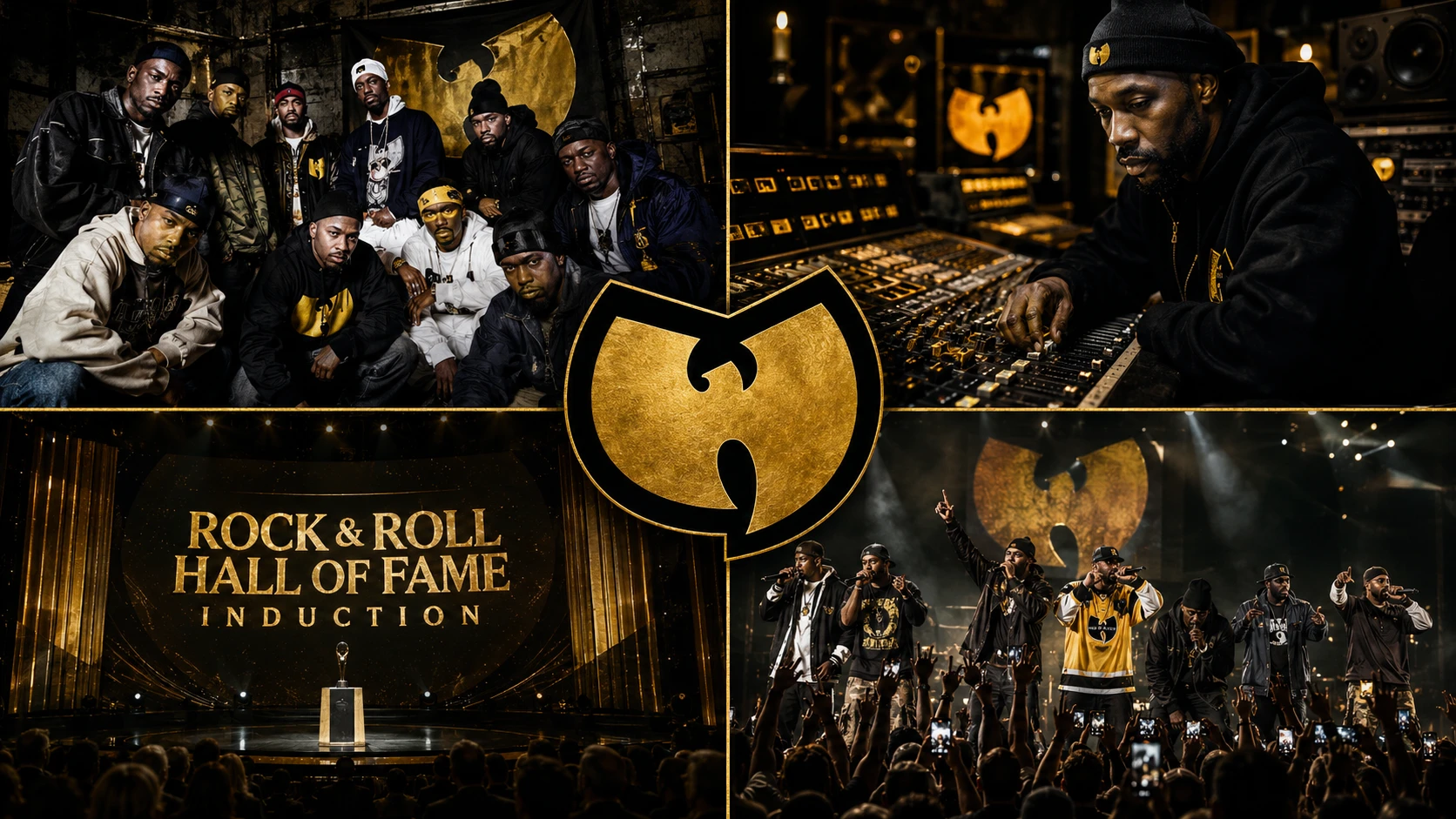
Thirty-three years after a nine-man swarm out of Staten Island rewrote the rules, the Rock & Roll Hall of Fame did the inevitable. Here is the full highlight of how the Clan turned a basement experiment into the most ambitious empire hip-hop has ever built.
There is a particular kind of recognition that arrives late and somehow still feels like a surprise. When the Rock & Roll Hall of Fame revealed its Class of 2026 in April, the Wu-Tang Clan was on the list, first-ballot, no hesitation. The ceremony lands November 14 at the Peacock Theater in Los Angeles, with the Clan sharing the marquee alongside Oasis, Sade, Phil Collins, Iron Maiden, Luther Vandross, Billy Idol, and Joy Division/New Order. That's great company! The records your parents slow-danced to, the stadium anthems, and a crew that once opened an album by daring America to even try to keep up. That is the point. That is the whole story.
For an institution that spent decades treating rap as a guest in someone else's house, putting RZA, GZA, Method Man, Ghostface Killah, Raekwon, Inspectah Deck, Ol' Dirty Bastard, U-God, Masta Killa, and Cappadonna on the wall is not charity. It is a correction. And RZA, the architect of the entire thing, sounded less like a conquering general and more like a man still processing the math. He told Rolling Stone he was still just absorbing the idea that this was real, which is a remarkable thing to hear from someone who built one of the most deliberate empires in American music.
To understand why this induction matters, you have to rewind to a man with a plan nobody believed in. Robert Diggs had already failed at fame. His early run as Prince Rakeem went nowhere, a single deal that quietly evaporated. Most artists take that as the universe closing a door. RZA treated it as research. He pulled together his cousins GZA and Ol' Dirty Bastard, then a circle of childhood friends from Staten Island, a borough they rechristened Shaolin after the kung fu films that soundtracked their imaginations, and he sold them on something close to insane. Give him total control for five years, he said, and he would make them all stars. Not famous individually first. Famous together, then famous apart, in that exact order.
That sequencing is the genius nobody talks about enough. The mythology layered on top, the martial-arts samples, the chess metaphors, the Five-Percent mathematics, the W logo that would end up on hats from Tokyo to Topeka, all of it was real and felt lived-in because it was. But underneath the Shaolin folklore sat one of the sharpest business minds the genre has ever produced, running a long game while everyone else chased the next single.
The Blueprint: Enter the Wu-Tang (36 Chambers)
On November 9, 1993, Loud Records released Enter the Wu-Tang (36 Chambers), and hip-hop did not so much shift as crack open. Recorded in a Brooklyn basement studio on a budget that would embarrass a modern TikTok rollout, the album sounded like nothing on radio. RZA's production was dusty, off-kilter, built from chopped soul records and grainy kung fu dialogue, leaving deliberate space where other producers piled on polish. Over those skeletal beats, nine distinct voices fought for the same microphone like the crown depended on it, because to them it did.
"Protect Ya Neck," "C.R.E.A.M.," "Method Man," "Can It Be All So Simple." The singles were not crossover bait. They were the opposite, raw enough that America had to come to the Clan rather than the other way around. The record went platinum, then kept climbing for thirty years, eventually hitting quadruple platinum in 2025. Rolling Stone parks it at number 27 on its 500 Greatest Albums of All Time list, and the reason is simple. Enter the Wu-Tang (36 Chambers) became the blueprint for hardcore hip-hop through the rest of the decade. Nas, JAY-Z, The Notorious B.I.G., and Mobb Deep all studied it. It dragged New York back to the center of a genre that had drifted West, and it did so by sounding like the city at its grimiest and most alive.
Here is the move that should be taught in business schools, not just sampled in documentaries. RZA negotiated the Loud/RCA deal so that every member remained free to sign a solo contract with any label he chose, while the collective stayed intact. No precedent existed for it. Labels hated it because it gave the artists leverage they had never held. The Clan loved it because it turned one group into a distribution network, planting Wu-Tang flags across half the industry while reinforcing the central brand with every release.
The solo run that followed is arguably the most stacked two-year stretch any crew has ever produced. Method Man's Tical arrived first and broke big, and his Mary J. Blige duet earned the Clan a Grammy, making Meth a bona fide star before the group even reconvened. Then came Ol' Dirty Bastard's gloriously unhinged Return to the 36 Chambers, GZA's surgical Liquid Swords, Raekwon's cinematic Only Built 4 Cuban Linx..., and Ghostface Killah's Ironman, later followed by the widely worshipped Supreme Clientele. Each disc deepened a single member's personality and, in doing so, made the debut album sound even richer in hindsight. No other rap collective has generated a body of interconnected work this deep. It is the difference between a group and a universe.
By the time the double-disc Wu-Tang Forever dropped in 1997 and debuted at number one, the Clan had outgrown the word "group." There was Wu Wear, one of the first artist-owned clothing lines to actually move units at retail. There was film scoring, video games, comic books, and eventually The Wu-Tang Manual, RZA's literal attempt to codify the philosophy into text. The Staten Island slang and the iconography became a global shorthand for a certain kind of authenticity. You did not need to know a single bar to recognize the W. That is brand penetration most corporations would trade a quarter's earnings for, and a scrappy crew of MCs pulled it off without a marketing department.
The Wu-Tang legacy was never going to stay contained inside music, and it didn't. Their fingerprints are on the way modern artists think about ownership, collective bargaining, and the long con of building something that outlives the charts. When you trace the through-line of East Coast hip-hop lyricism, from the Clan straight to a poet like Nas, you are following a lineage the Hall is finally acknowledging on the same night, the same wall, the same permanence. We mapped exactly how that torch keeps burning in our deep dive on Nas and the art of outrunning your own legacy, and the Wu chapter sits right at the root of that family tree.
No Wu-Tang retrospective is complete without the saga of Once Upon a Time in Shaolin, the single-copy album the Clan pressed exactly once and sold as a one-of-one piece of art. The buyer turned out to be a now-disgraced pharmaceutical executive who was later forced to forfeit it, after which the United States government sold the lone copy in 2021 for an undisclosed sum. A Sundance documentary recently dug into the whole controversial experiment. It is the kind of move that only makes sense coming from a crew that always treated music as both product and provocation. Whether you read it as a brilliant statement on art and scarcity or an elaborate troll, it is unmistakably Wu-Tang, which is to say it could not have come from anyone else.
Legacy this large is never free. The Clan lost Ol' Dirty Bastard in 2004 at just 35, a loss that still shadows every reunion and every roll call of the original lineup. The internal tensions, the competing solo schedules, the friction RZA himself has admitted slowed later albums, all of it is part of the honest record. A brotherhood of nine fiercely individual artists was always going to strain at the seams. What is remarkable is not that the Clan fought. It is that, more than three decades in, they still answer the bell together. The phrase Wu-Tang is for the children, ODB's accidental gift to the culture, somehow became a real mission statement about knowledge, community, and continuity.
The induction lands during the Clan's farewell run, Wu-Tang Forever: The Final Chamber, which gives the November ceremony the weight of a closing argument. This is not a nostalgia lap. It is a coronation arriving exactly as the group decides how it wants to be remembered, on its own terms, which is the only way the Wu has ever done anything.
Rap has been steadily claiming its rightful real estate inside music's highest honor, and the genre's presence in recent classes is no longer a novelty but an expectation. We broke down that same shift when another genre-defining crew got the call in our OutKast Rock Hall deep dive, and the Wu's induction is the next domino in a wall that should have had hip-hop on it years ago. The Class of 2026 does not elevate Wu-Tang Clan. Wu-Tang Clan elevates the Class of 2026. Shaolin built the chamber. The Hall just finally walked through the door.
Comments (0)
No comments yet — be the first to share your thoughts.
Leave a comment