


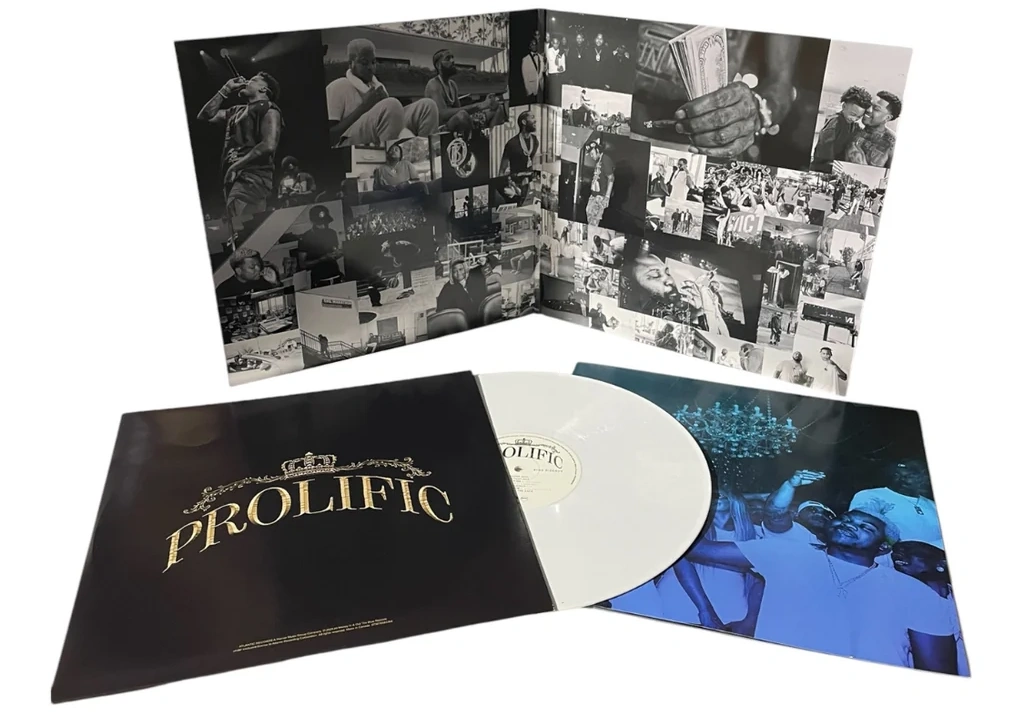
Fifteen tracks arrive Friday from an artist who has been gone for seven years, but the most important detail about this posthumous rap album appears in the legal credits rather than the tracklist. At the bottom of the PROLIFIC listing, the phonogram notice reads: “2026 All Money In and Out The Blue Records, under exclusive license to Atlantic Recording Corporation.”
Under exclusive license to, not owned by. Those four words may matter more than any guest feature.
Posthumous rap releases often follow a familiar pattern. A label reviews the artist’s hard drives, selects unfinished songs, adds guest verses and packages the project with archival imagery. The estate may approve the result, but its influence depends heavily on the contracts governing the recordings. When the artist retains meaningful control, an estate can help determine what is released, how it is presented and when it reaches listeners.
PROLIFIC arrives August 14, one day before what would have been Nipsey Hussle’s forty-first birthday. Its release is different for a straightforward reason: Nipsey spent much of his career building business leverage, and the licensing language indicates that control remains connected to All Money In and its partners.
The album was recorded before Nipsey Hussle's death
Nipsey and Bino Rideaux recorded the project in 2017, about two years before Nipsey’s death. It serves as a sequel to their No Pressure project, released that same year. Their first collaboration, “The Field,” appeared on Nipsey’s 2016 mixtape Slauson Boy 2. Two songs from PROLIFIC, “Sacrifices” featuring James Fauntleroy and “Reckless” with Static Major, have already been released with music videos.
Samiel Asghedom, Nipsey’s brother and the executive behind All Money In, emphasized the project’s origins when the album was announced. “This isn’t something that our team compiled together,” he said, adding that the release would follow the way his brother envisioned it.
That promise carries weight because Asghedom appears to have the authority to help deliver it. Family approval alone cannot preserve an artist’s intentions after death. Contractual rights determine who can authorize a release, alter a sequence, approve artwork or reject additional material. A license can preserve an artist’s plan only when the people managing the estate still have the legal power to enforce it.
Bino Rideaux is now thirty-three, the same age Nipsey was when he was killed. He has spent roughly nine years waiting for the other half of a project recorded during a formative period in both artists’ careers. For context on how the release fits into Nipsey’s catalog, see our guide to hearing the whole Marathon.
Why Nipsey’s 2017 deal still matters
Atlantic announced its partnership with All Money In in November 2017, with Victory Lap as the first release. Nipsey described the agreement in a line that captured his business strategy: “This deal represents exactly how I wanted to exist in this business.” He capitalized the final two words when he delivered the quote: “As a partner.”
The deal’s full terms were never made public. Critics, including Master P, have argued that Nipsey may have surrendered more than necessary. That debate remains unresolved. The more concrete question is how the agreement treats the recordings today, especially when the original artist is no longer able to renegotiate.
Artist ownership of masters is not simply a branding point. It determines whether an estate can approve a posthumous project from a position of authority or merely receive financial and accounting statements after another party makes the key decisions. The PROLIFIC credit does not disclose every term of the arrangement, but “under exclusive license” provides a meaningful clue about how the release is being distributed.
Compare that situation with Salt, who owns nothing she made in the eighties. Both stories involve the same music business, but the legal positions are fundamentally different. Artists and estates should review who owns the sound recording, who controls licensing, how long rights last and what happens after an artist’s death.
AI music claims show the value of a written contract
Two developments from the past ten days add another dimension to the ownership discussion.
An anonymous producer sued Ye, alleging in a complaint that he created 13 AI voice models and generated more than 400 vocal takes for five Vultures 2 songs and two Bully tracks. The producer says there was no written contract covering the work and is seeking at least $110,000, plus potential double damages under a Los Angeles freelance-worker ordinance. These allegations have not been proven in court. The practical issue is clear: a person who says they performed significant creative and technical work may lack documentation establishing payment, credit or ownership rights.
Separately, Tyga confirmed that Suno generated the retro synthesizers and a guitar solo on $TARFACE. He wrote and recorded the vocals, while the platform created the instrumental elements he identified. There is no reported lawsuit connected to that disclosure. Instead, it offers a relatively direct example of an artist explaining where generative AI was used.
Viewed together, the three stories illustrate how rights agreements shape music’s afterlife. Nipsey’s album can be released as an established project because the relevant parties appear to have a documented framework for control. A living producer says he built voice models without a written agreement. Tyga publicly identifies AI-generated elements in his song.
Music industry contracts determine whether creative work becomes a controlled legacy, a disputed credit or an undocumented data set. Artists, producers and estates can reduce that uncertainty by putting ownership, licensing, payment, credits, AI permissions and posthumous approval rights in writing before a release reaches the public.
What All Money In built that other estates do not have
All Money In Records was more than a vanity imprint. It operated as a working label, pressing and selling Crenshaw for $100 per copy in 2013. The release was widely treated as a stunt, but it also demonstrated a clear business strategy built on direct sales, scarcity and control. When Atlantic Records became involved, the imprint had a catalog, operating infrastructure and a reason to protect its licensing position.
Estate stewardship in hip hop often breaks down at the same point. An artist dies while another company controls the masters, leaving relatives with a claim but not necessarily a revenue-producing asset. From there, release plans can become negotiations in which the family has limited leverage. Discussions of the Nipsey Hussle legacy often focus on the Marathon store, the Vector 90 building and the mural. Those landmarks matter, but his less visible achievement may prove more durable: he built an administrative structure capable of managing music after his death.
That structure helps explain why recordings made in 2017 can be released in 2026 without automatically being reshaped to match current marketing trends. For listeners, the practical question is whether the estate has preserved the original performances, mixes and creative intent, rather than simply adding contemporary features or production.
What we are listening for Friday
We have not heard the full album. No one on the outside has, based on the available information. Any report claiming otherwise appears to be drawing conclusions from two singles and a press release. The most useful approach is to judge the finished project on its own terms.
The album reportedly pairs two 2017 Nipsey Hussle vocals with Benny the Butcher, a rapper whose style and perspective have developed significantly over the past nine years. Nipsey’s verses may remain strong, but the key test is whether Benny’s later-career identity fits naturally beside those performances. Listeners should also pay attention to vocal placement, beat selection and mixing choices. Those details can reveal whether the estate preserved the original recordings or attempted to modernize them.
The release arrives on a crowded Friday that also includes projects from Trippie Redd, Paul Wall and Open Mike Eagle. That makes human-led curation especially valuable. Streaming platforms may group every posthumous release under the same category, but a carefully completed album is not equivalent to a project assembled from unfinished files.
The broader lesson is easy to miss in the credits and licensing details. Independent label leverage may not be an artist’s most visible achievement, but it can become the most important asset after his death. Before judging a posthumous release, check who controls the masters, who manages the estate and whether the project reflects a documented creative plan.
Comments (0)
No comments yet — be the first to share your thoughts.
Leave a comment