

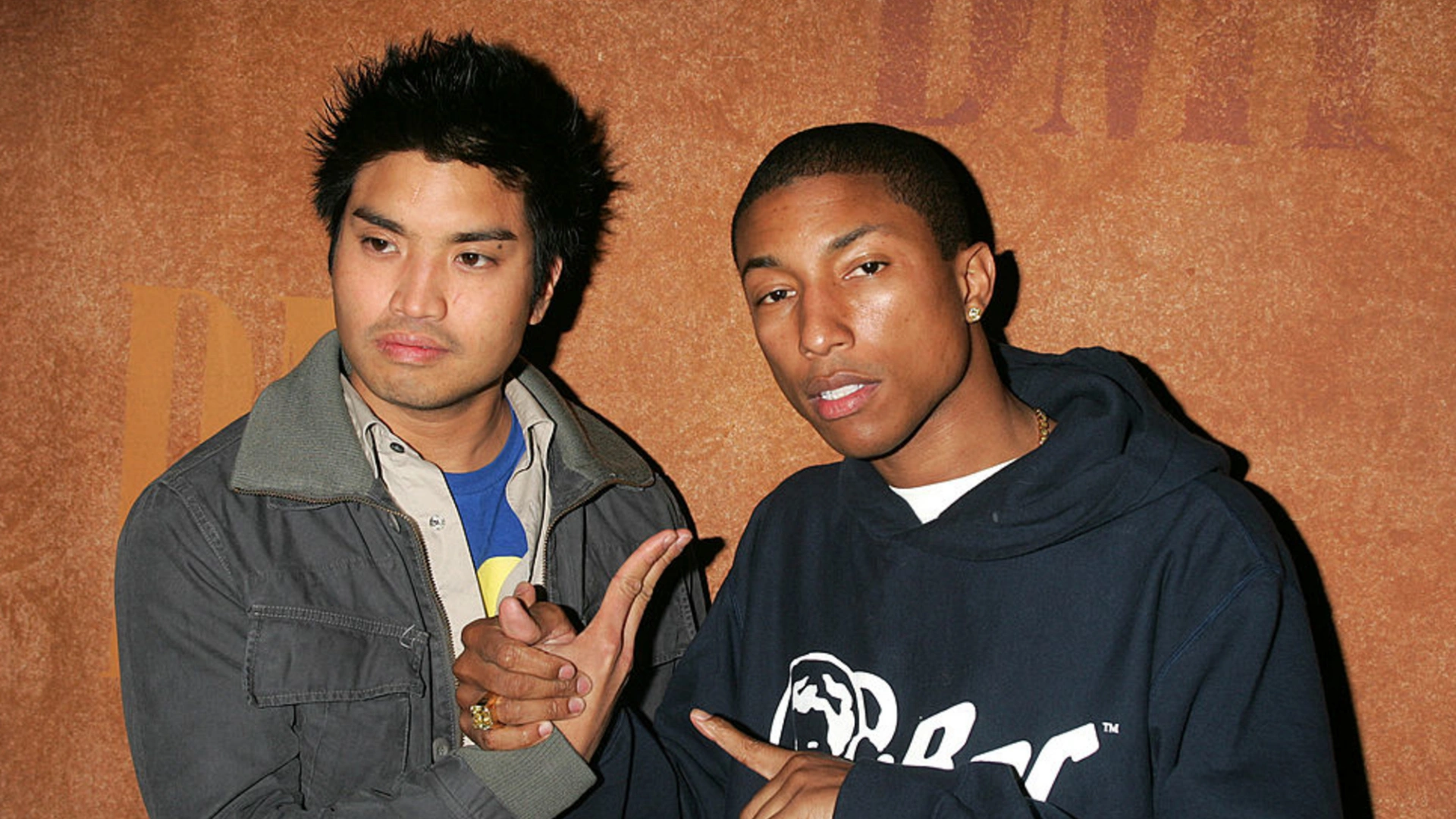
For most of three decades, the production credit on a Neptunes record said very little about who did what in the room. It read The Neptunes, or it listed Pharrell Williams and Chad Hugo side by side. The money behind that line moved through companies the two Virginia Beach friends owned together and, by Hugo's own account, split down the middle. On Tuesday (Oct 6), that arrangement became the foundation of Pharrell's legal defense.
In a motion to dismiss filed in federal court in Los Angeles, Williams's attorney Edwin F. McPherson argued that Hugo's latest complaint never identifies which songs he co-wrote or what he contributed to them. The filing says it appears that "Hugo has no idea which compositions or sound recordings he supposedly authored," even though he claims to have worked beside Williams the entire time.
The motion asks the court to throw out Hugo's copyright claims and, with them, the reason the case sits in federal court at all. If the judge agrees, Hugo's money claims would have to start over in California state court. Those include his estimate that he is owed as much as $1 million from N.E.R.D.'s 2017 album No One Ever Really Dies. The court has not ruled on the request or set a hearing date.
Three Complaints and a Shrinking Song List
Hugo sued on January 23 in the U.S. District Court for the Central District of California, accusing Williams of breaching his fiduciary duty and keeping him from the books of their shared businesses. The original complaint described nearly 50 recording sessions between 2019 and 2021 but named no individual song, pointing instead to No One Ever Really Dies and to income from touring and merchandise. Within weeks, U.S. District Judge André Birotte Jr. ordered Hugo's lawyers to explain why a dispute built on contract and fiduciary claims belonged in federal court.
Their answer arrived on February 12, an amended complaint asserting copyright interests in eight songs from that stretch. Among them were Rosalía's "Motomami" and "La Combi Versace," Latto's "Real One" and Nigo's "Lost and Found" with Tyler, the Creator. The judge discharged his order six days later. One of the eight, "Lost and Found," already lists Hugo among its songwriters on Spotify, alongside 13 other contributors.
A second amended complaint filed in September dropped all eight titles. According to the motion, the only song it now names is EarthGang's "U Gotta," and it never says whether Hugo wrote music, wrote lyrics, played an instrument, programmed sounds, recorded the master or mixed it. McPherson also told the court that the two sides spent three years under a tolling agreement, which pauses legal deadlines, before Hugo filed anything at all.
How a Duo Splits a Song
Every finished record carries two copyrights, and a production team usually gets paid on both. The composition, meaning the melody, lyrics and underlying music, earns songwriter and publishing royalties through publishers, performing rights organizations and, for U.S. streaming mechanicals, The MLC, which will begin handing unclaimed shares to the biggest catalogs in April. The sound recording belongs to whoever paid for the master, usually a label, and producers collect from it through points negotiated against the artist's royalty.
Inside a two-person team, each of those streams gets cut a second time. Some duos register every song at a fixed split regardless of who carried the session, while others negotiate percentages track by track on split sheets that can take months to finalize. The Neptunes, according to Hugo's 2024 filing over the group's name, chose the first model, with his attorney Kenneth D. Freundlich writing that across more than 30 years the pair had agreed to divide all of their assets.
A flat split ends the argument over whether the bassline mattered more than the hook. Nobody ever has to write down who played the Rhodes on which bar, since the answer never changes the check. Copyright law asks for that record anyway. Two people who merge their contributions into a single song become joint authors, each holding an undivided interest in the whole and owing the other an accounting of profits. A partner claiming that status on a particular title still has to show what he put into it.
Chad's motion leans on exactly that requirement. Pharrell's team told the court it is not asking Hugo to produce evidence, only to name the works he says he co-authored, information the filing describes as sitting entirely within Hugo's own knowledge.
Three Partners, Three Different Pies
N.E.R.D. shows how differently the money can be cut once a duo becomes a band. Under the structure laid out in Hugo's filings, N.E.R.D. Music, LLC, formed in 2014, pays Williams 50 percent of touring and other income while Hugo and Shay Haley each take 25 percent, and the three divide merchandise and trademark earnings in equal thirds. That company was in place three years before the band released No One Ever Really Dies, the album behind Hugo's $1 million estimate.
Hugo's original complaint put his estimated losses between $325,000 and $575,000, with potential damages reaching $750,000 to $1 million. He says he began asking in 2021 for the monthly statements, books and royalty statements that their operating agreement required, and that his lawyers followed with demand letters when complete records never came.
Pharrell's camp has treated that half of the fight as a bookkeeping question. In January a representative called the suit premature, saying a standard accounting review was already in progress and that if it found money was owed, "the appropriate party will pay it."
The Public Face and the Paper Trail
Hugo's complaint describes him as the duo's "principal composer, arranger, multi-instrumentalist, and producer," with Williams as the partner who more often faced the public. Williams sang the hook on Snoop Dogg's "Drop It Like It's Hot" and eventually scored a global solo hit with "Happy," while Hugo stayed largely behind the board and out of interviews.
The records Williams has made since the split carry one name. Clipse released Let God Sort Em Out in July 2025 with every beat produced by Pharrell, the start of a Paris-built run of sole-producer albums HitsCulture traced last month. Pusha T summed up Hugo's absence on a Popcast appearance in four words: "Pharrell did that alone."
The catalog also holds an earlier dispute over who gets paid for a Neptunes record, with Hugo on the receiving side of the credits. Kelis has said for years that she never received the publishing share she believed she was promised on her first two albums with the duo. In 2022 she objected publicly when Beyoncé's "Energy" interpolated "Milkshake," a song credited to Williams and Hugo as writers but not to her.
What Happens if the Copyright Claims Die
Pharrell's motion argues that once the copyright counts are gone, a federal court has no basis to hear Hugo's fiduciary duty and accounting claims, which Hugo could then refile in state court if he chooses. There, the fight would turn on the operating agreements and the books rather than on who wrote which bar of which song.
Timing presents its own problem for the copyright theory. Federal copyright claims carry a three-year statute of limitations, and the eight songs named in February date to a period ending in 2022. The filings reported so far do not say which claims the tolling agreement covered.
A separate fight over the name itself remains open. In 2024 Hugo opposed trademark applications that Williams's company, PW IP Holdings, filed in 2022 for The Neptunes, and Pharrell's lawyers acknowledged at the time that Hugo is an equal co-owner of the marks. The pair who built "Grindin'" and "I'm a Slave 4 U" won Producer of the Year, Non-Classical, at the 2004 Grammys and entered the Songwriters Hall of Fame together in June 2022. Two years later, Williams told The Hollywood Reporter that they no longer speak.
Comments (0)
No comments yet — be the first to share your thoughts.
Leave a comment