

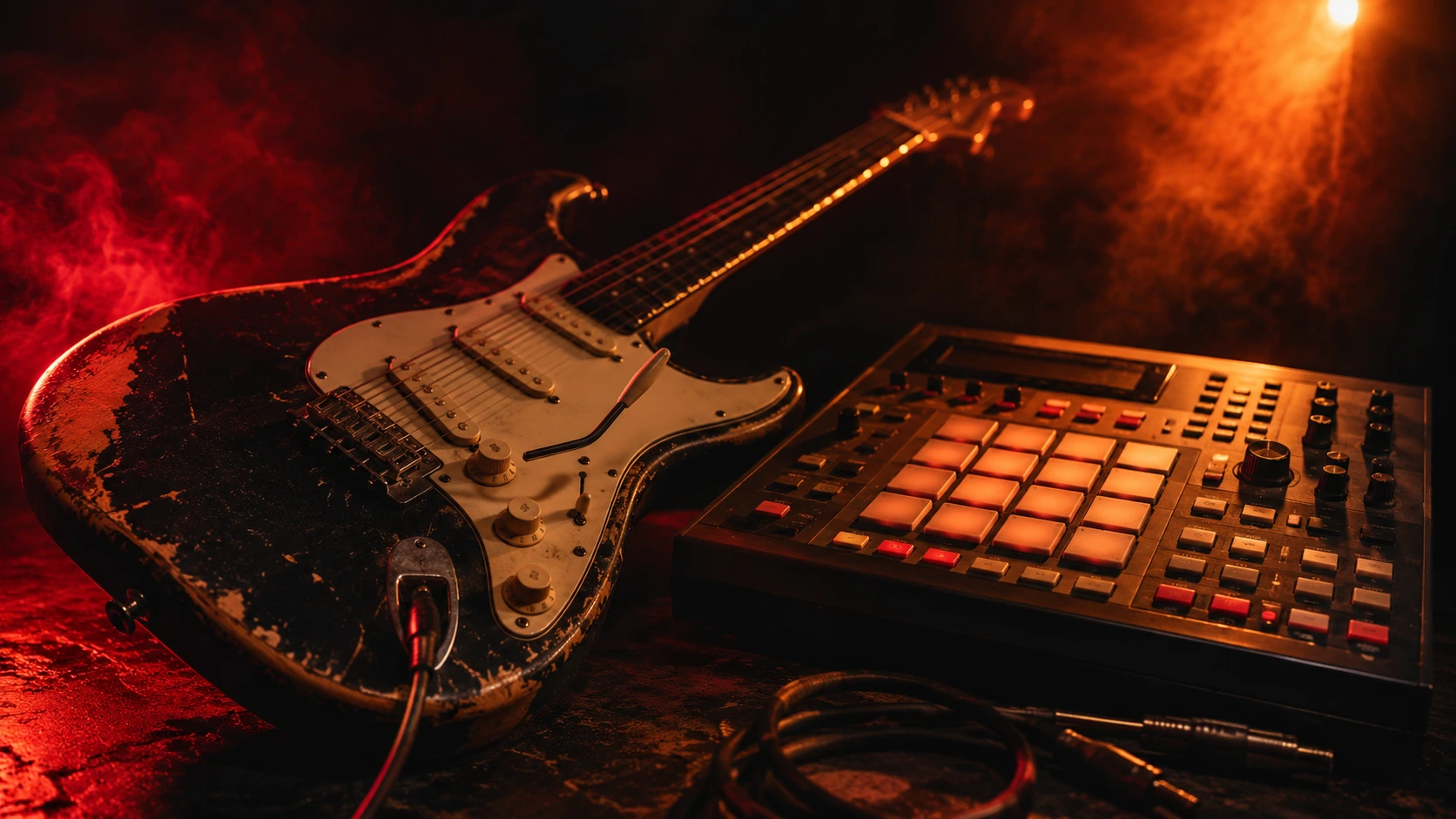
The Long Beach rapper built his new album entirely around live players, not loops. He is not an outlier. He is the front of a wave, and it stretches all the way back to the music's roots.
The first thing you notice about Vince Staples' new album is the guitar. Not a sample of a guitar, not a flip of some dusty soul record, an actual guitar, played by an actual person, distorted and urgent and alive. Cry Baby, out today via Loma Vista, was built track by track around live instrumentation, and that single production choice tells you more about where hip-hop is heading in 2026 than any chart placement could. The most interesting thing happening in rap right now is that it is reaching for a band.
The short version, if you only have a minute: Cry Baby is a ten-track, thirty-five-minute record that trades Staples' minimal, sample-driven palette for a confrontational, instrument-forward sound. It is also his first fully independent release after years on Def Jam, and it lands in the middle of a genuine movement of artists swapping the laptop for the live room. This is not a gimmick, and it is not new. It is a homecoming.
Cry Baby, Up Close
Staples has never been one for soft launches. He announced the project with a single line, "As the world burns, I have decided to release this album," and the music matches the bluntness. The album's press materials describe it as Staples processing "the endlessly repeating cycles of American tumult," and the sound is engineered to feel like exactly that, immediate, anxious, and impossible to ignore.
The rollout did its job. Lead single "Blackberry Marmalade" arrived as a breakneck, angular piece of guitar music, and its video, co-directed by Staples, sparked immediate debate for depicting a mass shooting from the shooter's point of view, a deliberately uncomfortable piece of commentary rather than spectacle. Follow-ups "White Flag" and "Cotton" kept the tension high heading into release week. When listeners rushed to slap the "punk rock" label on the sound, Staples pushed back fast, arguing that hearing a guitar and reaching for the nearest rock descriptor misses the point of what he is doing. He is right. This is a rap album. It just happens to breathe like a rock one.
The independence piece matters just as much as the instrumentation. Cry Baby is Staples' first release since leaving Def Jam, now putting it out through Loma Vista, the same home as Killer Mike. An artist with full creative control choosing to spend that freedom on live musicianship is its own kind of statement, and it slots neatly into the larger story we mapped in our Black Music Month 2026 kickoff, where ownership is the quiet through-line connecting nearly every major June drop.
Pull the lens back and Staples is standing in good, growing company. The clearest example is Doechii, who has spent the last two years turning live musicianship into her entire brand. Her Tiny Desk debut leaned on a nine-piece, all-female band stacked with horns, her tours run with a returning live band, DJ, and dancers, and she has been known to flip her own hits into rock and jazz arrangements on stage. She did not win a Best Rap Album Grammy by playing it safe with the beat. She won it by treating the song as something to be performed, not just streamed.
Below the radar, the lane is even busier. Acts like Paris Texas and Kenny Mason have been blending guitars and live textures into their rap for a minute now, and the entire underground rage scene, the one we broke down in our look at how Nettspend and OsamaSon are reshaping internet rap, is built on distorted, rock-adjacent production at its core. Strip the 808s off a rage track and you are often left with something that sounds a lot like punk. The instruments were always implied. Staples just made them literal.
Even the R&B world next door is moving the same direction, toward warmth, live players, and atmosphere over plug-in presets, a shift we traced in our piece on how Mariah the Scientist and Leon Thomas rebuilt modern R&B. Across the board, the most forward-thinking Black music of this moment sounds like it was made by hands in a room, not just a mouse on a grid.
Here is the part the trend pieces always miss. Live hip-hop is not an experiment, it is the original blueprint, dressed up in 2026 clothes. The Roots have been carrying live rap on their backs since the early nineties, proving night after night that a crew with a drummer and a bassist could outclass anyone running a track off a hard drive. Lauryn Hill's MTV Unplugged stripped the genre down to a guitar and a voice and dared you to call it any less than hip-hop. Kendrick Lamar built an entire era around jazz musicians like Thundercat, Kamasi Washington, and Terrace Martin, and Anderson .Paak made being a rapping drummer look effortless.
The lineage runs deeper than that, all the way back to the spirituals, the work songs, the jazz and the funk and the gospel that every one of these sounds is quoting whether the artist knows it or not. When Staples reaches for live instrumentation, he is not abandoning rap's roots. He is digging back down to them. That continuity, the idea that this is one unbroken soundtrack rather than a series of disconnected trends, is the exact thing institutions are racing to preserve right now during Black Music Month.
It also raises a question worth sitting with: where does the next generation of players come from? A live-music revival only sustains itself if young people are actually learning to hold an instrument, and access to that kind of arts education is wildly uneven, an equity issue our partners at The Standard NY have tracked across New York's school funding fights. The band cannot come back if the schools that build bands keep getting cut.
The timing is not an accident. For most of the last decade, the industry rewarded the single, the snippet, the fifteen-second hook engineered to loop on TikTok. Live instrumentation is the opposite of that. It is slower, more expensive, harder to fake, and nearly impossible to mass-produce. In an era when AI can spit out a passable trap beat in seconds, a real band is suddenly the most valuable thing in the room precisely because a machine cannot convincingly counterfeit it.
That is the deeper logic behind Cry Baby. Independence gave Staples the freedom to make a difficult, guitar-soaked, commercially inconvenient album, and the cultural moment rewarded the risk. The new music that matters most in 2026 is the music that sounds like it could fall apart at any second, because a human being is actually playing it. That fragility is the point.
So when Cry Baby hits your speakers today, do not just hear a rapper experimenting with rock. Hear a genre remembering what it has always been at its core: live, loud, played, and Black to the bone. Vince Staples did not invent this. He just turned the amp up loud enough that the rest of us finally have to listen. Stay with us all month as we track every chapter of it.
Comments (0)
No comments yet — be the first to share your thoughts.
Leave a comment