

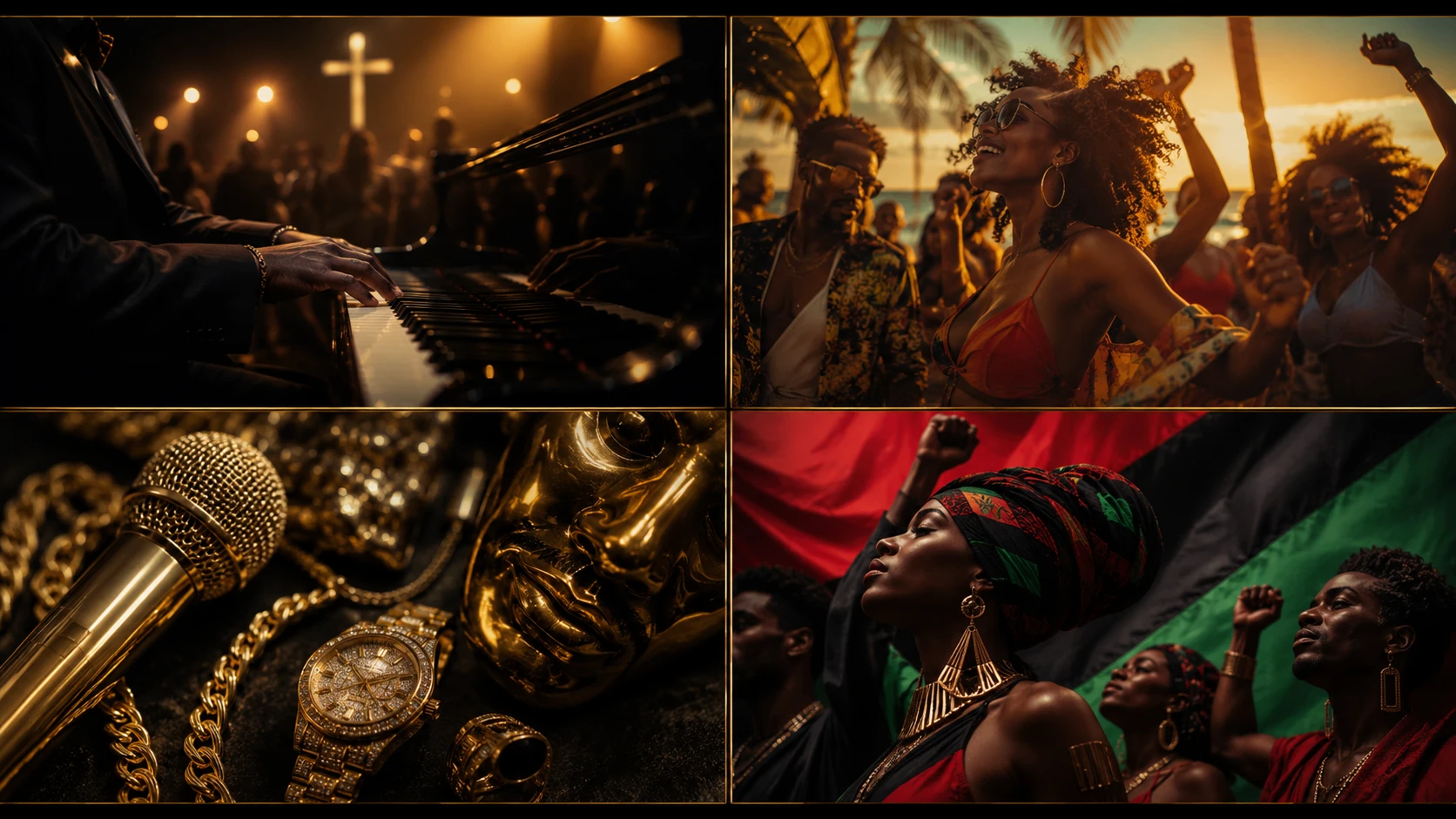
From the National Museum of African American Music's fifth anniversary to a New Music Friday slate stacked four albums deep, June 2026 is shaping up to be the most consequential month the culture has handed us in a long time. Here is the map.
Every June, the culture takes a breath and looks in the mirror. Black Music Month 2026 is no different, except this year the reflection is louder, denser, and more loaded than it has been in some time. Before the month is over we will have new full-lengths from Lizzo, Vince Staples, Rick Ross, Blxst, PJ Morton, and YG, a flagship museum turning five while the country turns 250, and a Juneteenth weekend that has quietly become one of the most important release windows on the calendar. If you only follow the algorithm's front page, you are going to miss most of it. So let us walk through what is actually happening.
The short version: this June pairs institutional celebration with a genuine wave of new music, and the throughline connecting all of it is ownership. Artists are releasing on their own terms, on their own dates, through their own labels, and the month's biggest cultural anchor is a museum whose entire mission is making sure that history gets told correctly. That combination is what makes Black Music Month 2026 worth paying close attention to.
The official kickoff belongs, as it should, to the National Museum of African American Music in Nashville. The museum launched Black Music Month under the theme "The Soundtrack Continues, 250 years in the making, five years in the telling, far from finished," a line that does a lot of work. It marks the museum's fifth anniversary, it nods to America's 250th year, and it frames Black music exactly the way it deserves to be framed: as a living historical record rather than a nostalgia exhibit.
The programming runs more than fifteen events across four genre-focused weeks, including artist talks, film screenings, live podcast recordings, a music and healing summit, and the inaugural Black Music Executive Toast on June 18. The summit alone is worth the trip, with the return of The Blackbyrds, the jazz-funk pioneers and Donald Byrd protégés whose catalog has been sampled by everyone from Tupac to Nas to De La Soul. This is the kind of legacy continuity that gets lost when coverage stays glued to first-week numbers, and it is the reason the NMAAM celebration matters beyond Nashville.
The institution is also leaning into access. Youth under eighteen get free admission every Tuesday in June through the museum's "Soundtrack for All" program, a reminder that protecting this music means handing it to the next generation, not just archiving it for the last one. The fight over whether young people get real exposure to the arts is a live one well beyond Tennessee, and it tracks closely with the kind of education and community reporting our partners at The Standard NY have done on school funding and access across New York. Preservation and education are two sides of the same coin, and NMAAM is spending both.
If the month has a face, it is PJ Morton. The New Orleans soul architect, a six-time Grammy winner and twenty-two-time nominee, was named the 2026 Grand Marshal of Black Music Month, and he is not treating the title as ceremonial. His exhibition, "Saturday Night, Sunday Morning," opens at NMAAM on June 18, followed by an exclusive listening session for the project of the same name.
That project is the headline. Morton's double album, also titled Saturday Night, Sunday Morning, arrives on Juneteenth, splitting the difference between the secular and the sacred in a way only someone raised in the church and seasoned on the road could pull off. For an artist whose reputation was built on being one of the best live performers in modern R&B, releasing a double album on a Black freedom holiday during the month he is officially leading is about as intentional as it gets. Morton is then taking it on the road with a Saturday Night, Sunday Morning tour in July.
While the institutions celebrate, the artists are stacking June album releases like it is a competition. The month opens hard on June 5, when Lizzo and Vince Staples drop on the same day from opposite ends of the spectrum.
Lizzo's Bitch is her first proper studio album in four years, a reclamation project she has described as a statement of confidence and control. The rollout has not been smooth, with the singer publicly airing frustration over what she sees as a lack of label support from Atlantic, which only adds to the underdog energy she clearly wants. On the other side of June 5 is Vince Staples and Cry Baby, a ten-track record built around live instrumentation and a confrontational, rock-leaning sonic shift teased by lead single "Blackberry Marmalade." It is also Staples' first fully independent release after leaving Def Jam, a detail that says as much about where the business is headed as the music does.
A week later, June 12 brings two more. Rick Ross returns with Set In Stone, his nineteen-track twelfth studio album and first solo LP in five years, dropping in the same stretch as a twentieth-anniversary tour for his debut Port of Miami. Ross arrives fresh off a high-profile Verzuz battle with longtime collaborator French Montana, a night that doubled as a reminder of how much catalog the man is sitting on. Sharing that Friday is Blxst with Labor of Love, a fully self-produced project about fatherhood, discipline, and the daily work of building something real. Two veterans, two very different definitions of luxury, same release date.
The single most interesting thing about this calendar is what happens on June 19. Juneteenth has evolved from a date most of the country ignored into a deliberate, loaded release window, and 2026 makes the case better than any year before it. PJ Morton's double album lands that day. So does YG's The Gentlemen's Club, reportedly the West Coast staple's most personal record to date, a turn inward from an artist best known for club anthems and gang-line bangers.
Then there is the live side. AFRAM, billed as the largest free African American festival on the East Coast, celebrates its fiftieth anniversary that same weekend in Baltimore, June 19 through 21, with Charlie Wilson headlining and a bill that includes Tamia, Normani, Chlöe, Mario, and Morton himself debuting the new album on stage. When the recorded music, the institutional spotlight, and the festival circuit all converge on a Black freedom holiday, that is not a coincidence. That is a culture deciding when its calendar begins.
Step back and the pattern is unmistakable. Vince Staples went independent. Blxst produced his entire album himself. Lizzo is at war with her own label in public. Ross runs his releases through his own imprint. The dominant story of Black Music Month 2026 is not a single blockbuster, it is a quiet, collective move toward control, and the timing around Juneteenth only sharpens the point.
That shift sits on top of an already historic year for the genre. The spring belonged to Drake's triple-album event, a release so dense that fans are still untangling it months later, and we broke down every layer of it in our full decode of the subliminals and hidden meanings buried across Iceman. R&B, meanwhile, is in the middle of a genuine renaissance, the kind we mapped through the rise of atmospheric, mood-driven voices in our look at how Mariah the Scientist and Leon Thomas rebuilt the sound of modern R&B. And the month closes with the BET Awards on June 28, a ceremony whose Album of the Year race we already broke down nominee by nominee. June is not arriving into a vacuum. It is arriving into the busiest, most contested year hip-hop and R&B have seen in a while.
So here is the takeaway as the month gets going. Do not let the front page decide what matters. The big commercial drops will take care of themselves, but the real story of this Black Music Month is happening in the spaces in between, in a museum turning five, in a double album timed to Juneteenth, in artists betting on themselves instead of the machine. The soundtrack continues, and this June, it is playing louder than usual. Stay with us all month, because we are covering every chapter of it.
Comments (0)
No comments yet — be the first to share your thoughts.
Leave a comment