

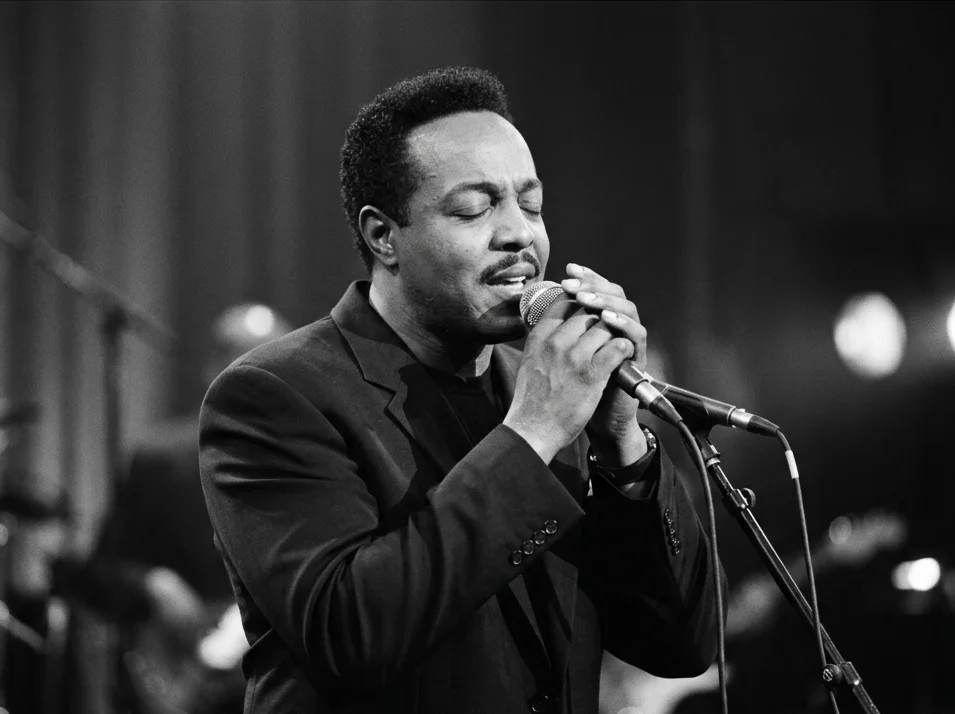
There is a specific kind of voice that does not chase the moment because it was built to outlast it. Peabo Bryson had that voice. The two-time Grammy winner, Disney soundtrack architect, and most reliable duet partner in the history of modern soul died on Tuesday, June 2, 2026, at his home outside Marietta, Georgia, days after suffering a stroke. He was 75. His family said he transitioned peacefully, surrounded by those closest to him.
The timing carries its own quiet pain. Bryson did not fade out. He died in the middle of a victory lap, near the tail end of his Golden Touch tour celebrating 50 years in the business, with a new album titled Grace already in motion under the production team of Jimmy Jam and Terry Lewis. The man was still working, still singing those impossible high notes clean and unhurried at 74, when a clip from a Las Vegas residency went viral in 2025 with one comment that said it all: he sounded absolutely amazing. That was the whole career in one line. He always sounded amazing.
He was born Robert Peapo Bryson on April 13, 1951, in Greenville, South Carolina, and spent much of his childhood on his grandfather's farm in nearby Mauldin. He was raised mostly by women, his mother and grandmother, and he always credited that for the emotional intelligence in his songwriting. He once told Essence that the sensitivity in his music came straight from a childhood spent watching women love with everything they had.
The name everyone knows was an accident of pronunciation. As a 14-year-old singing backup for a local Greenville group, Al Freeman and the Upsetters, his French West Indian given name, Peapo, kept getting mangled. Peabo stuck. Two years later he left home for good and toured the Chitlin' Circuit with Moses Dillard and the Tex-Town Display, the rite of passage that shaped nearly every great Black singer of his generation. By 16 he was already writing, arranging, and producing for Atlanta's Bang Records, where general manager Eddie Biscoe heard something nobody else was hearing yet and signed him as a creator, not just a singer.
His 1976 debut Peabo arrived with a young, unknown Luther Vandross singing in the background, a footnote that now reads like a passing of the torch between two of the most important male voices in R&B history. Capitol Records signed him the next year, and the gold-selling Reaching for the Sky announced him as a balladeer with operatic control and a baritone that could float without ever straining. The hits followed fast: "Feel the Fire," "I'm So Into You," and eventually the song that broke him through to the pop mainstream, 1984's "If Ever You're in My Arms Again," his first Top 10 single on the Billboard Hot 100.
Here is where Bryson did something almost no one else has matched. He built an entire second career as the greatest duet partner the genre ever produced, a singer so generous and so technically precise that he made everyone standing next to him sound better. He recorded We're the Best of Friends with Natalie Cole in 1979. He made Live & More and the gorgeous Born to Love with Roberta Flack, the latter giving the world "Tonight, I Celebrate My Love," a slow-burning standard that still gets played at weddings four decades later. He partnered with Regina Belle, with Minnie Riperton, with Kenny G on "By the Time This Night Is Over," with Melissa Manchester, with Deborah Gibson.
That instinct for blend, for listening rather than dominating, is exactly what made him the obvious choice when Disney went looking for a voice to anchor its early-90s soundtrack renaissance. The decision changed his life and the culture's idea of him forever. This is the same lineage of soul singers crossing into prestige spaces that HitsCulture has tracked in our reporting on the R&B-to-Broadway pipeline, where the church-trained voice keeps proving it belongs anywhere it wants to be.
In 1991, Bryson and Celine Dion recorded the pop version of "Beauty and the Beast" for the animated film, and it won the Grammy for Best Pop Performance by a Duo or Group with Vocals. The following year he reunited with Regina Belle for "A Whole New World," the love theme from Aladdin. That song did something no song from an animated film had ever done. It went to number one on the Billboard Hot 100, knocking Whitney Houston's "I Will Always Love You" off the top after its long reign, and it earned Bryson his second consecutive Grammy.
Two films, two duets, two golden men on the mantle. He became, improbably and permanently, the voice of childhood for an entire generation that may have never bought one of his solo albums but knew every word of those songs by heart. There is no higher form of cultural immortality than becoming the soundtrack to people's first idea of romance. That is what made him a two-time Grammy winner who transcended the R&B charts entirely.
To file Bryson under "Disney" or even "balladeer" undersells the instrument. He sang the lyrical theme for the soap opera One Life to Live, his voice a daily fixture in American homes for years. He stepped onto the stage as Sportin' Life in Porgy and Bess and appeared in productions of The Wiz and A Raisin in the Sun. He topped the pop, jazz, R&B, and adult contemporary charts across his catalog of roughly 20 solo albums, recorded between 1976 and 2018. His nine R&B Top 10 hits include the chart-topping "Show & Tell" and "Can You Stop the Rain." This was a complete musician, equally at home in a recording booth, an orchestra pit, and a Broadway house. That refusal to be boxed in is the through-line connecting him to the neo-soul tradition we explored in our Erykah Badu cover story, artists who treat genre as a starting point rather than a cage.
No honest celebration of a life skips the difficult chapters, and Bryson lived through real ones. In the early 2000s he faced serious tax debt that led the IRS to auction off many of his possessions, including, painfully, both of his Grammy trophies. He rebuilt. In 2019 he survived a major heart attack and recovered fully enough to return to the stage and the studio. The 2018 album Stand for Love, his Jam and Lewis collaboration, proved the voice had lost nothing with age. Each time the man got knocked down, he stood back up and sang. That resilience is its own kind of legacy, and it speaks to a generation of soul artists who weathered every industry shift the business could throw at them.
Bryson married British singer Tanya Boniface, a former member of the girl group The 411, in 2010. The couple welcomed a son in 2018, and a 2024 social media clip of the boy singing alongside his father became a small treasure for longtime fans. He is survived by Tanya, their son, his eldest daughter Linda Bryson, and three grandchildren. His family asked for grace in their statement, noting that for more than five decades his voice served as the soundtrack to life's most cherished moments, carrying generations through celebrations, love stories, and quiet moments of comfort.
In an era when so much of music is engineered for the scroll, Bryson's catalog is a standing argument for the opposite. He made songs built to be lived inside, played at the slow dance, the proposal, the anniversary, the funeral. He never needed a gimmick because the voice was the event. The current R&B resurgence led by a new generation of vocalists owes a structural debt to singers like him, the ones who proved that a male R&B singer could be tender without being soft, commercial without being hollow, and technically flawless without ever sounding cold. You can hear his DNA in every artist who picks restraint over runs, as we argued in our piece on the return of grown-folks R&B.
Peabo Bryson spent 60 years giving the world a voice that made people feel safe, loved, and seen. He went out doing exactly that, mid-celebration, with one more album still waiting in the wings. The body rests now. The voice does not. It is going to keep playing in kitchens and weddings and headphones for as long as people want to feel something true. A whole new world without him sounds quieter. We should all be grateful for the soundtrack he left.
Comments (0)
No comments yet — be the first to share your thoughts.
Leave a comment