

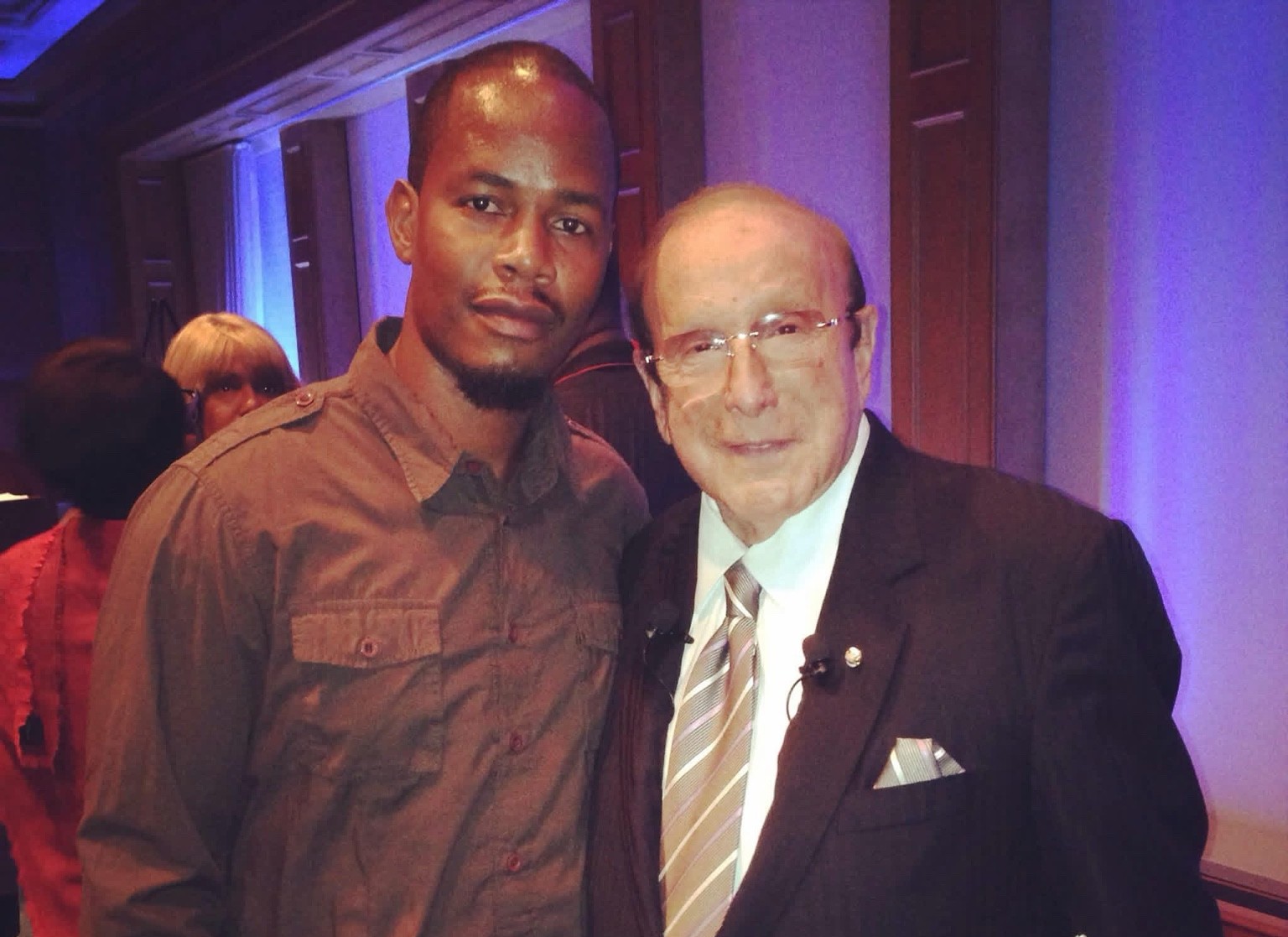
He turned a Harvard law degree into the most trusted ear in the record business and spent five decades aiming it at the artists who would define American sound. From Aretha to Whitney to the labels that built hip-hop's golden age, this is the real legacy of the man who kept being right.
Clive Davis died Monday, June 22, 2026, at his home in Manhattan. He was 94, and according to his family he passed peacefully from an age-related illness, surrounded by the people he loved. The headlines will call him a mogul, a hitmaker, the man with the golden ear. All true, and all slightly beside the point. What Davis actually was, across a fifty-year run that survived two public firings and outlasted nearly everyone who ever doubted him, was the rare executive whose instincts amounted to a thesis. He believed, earlier and louder than the boardrooms around him, that the voices at the center of American popular music were going to be Black voices, and he spent his career building the machinery to prove it.
For anyone new to his name: Davis was the music executive who ran Columbia Records, founded Arista, launched J Records, and finished his life as chief creative officer of Sony Music. He signed or steered an ridiculous span of talent, from Janis Joplin and Bruce Springsteen to Barry Manilow and Carrie Underwood. But the throughline that matters most here, the one HitsCulture is built to honor, runs from Aretha Franklin's reinvention to Whitney Houston's coronation to the corporate backing that let an entire generation of hip-hop and R&B take over the planet.
Davis did not start with an ear. He started with a contract. Born in Brooklyn's Crown Heights on April 4, 1932, he lost both parents before he was out of his teens and clawed his way through New York University and then Harvard Law on scholarship. He was a Manhattan attorney drafting agreements when a client called Columbia Records pulled him in-house, and the complex money flows of the record business became his real education. By 1967 he was running the label, and the kid who claimed no natural ear had developed one fast. As he put it years later, when you see a Joplin or a Springsteen, you simply know. He moved a steady, buttoned-up company into rock and never looked back, until 1973, when Columbia forced him out amid allegations he had misused corporate funds, and he later pleaded guilty to tax evasion. It should have been the end. It was the warm-up.
In 1974 he built Arista Records out of a pile of fading imprints, and the comeback became the defining act of his life. The clearest proof of his gift was not discovering a newcomer but reigniting a legend. When Davis brought Aretha Franklin to Arista, the Queen of Soul had drifted from the commercial center. He helped engineer a second imperial run, pairing her with contemporary producers and pop instincts that returned her to the charts and to the cultural conversation she had arguably invented. The respect ran both ways. Franklin, who did not hand out praise lightly, called him the greatest record man of all time. Coming from her, that is a coronation from the throne.
Then came the signing that would define them both. Davis saw a teenager performing in a New York nightclub alongside her mother, the gospel powerhouse Cissy Houston, and he understood instantly what he was looking at. He signed Whitney Houston to Arista, and under his guidance she became one of the best-selling artists in the history of recorded music. Their partnership was a masterclass in matching a generational instrument with material worthy of it, and it remains the cleanest example of what Davis did better than anyone: he did not just find the voice, he built the world around it. The relationship carried real grief too. He stood by Houston through her hardest years, and her death in 2012 on the eve of his pre-Grammy gala became one of the most wrenching chapters in modern music. He went forward with the party that night, which told you everything about how he understood his role: the show, and the legacy, had to continue.
Here is the part the mainstream obituaries will undersell, and the part that matters most to our audience. Davis was not only a discoverer of stars. He was a builder of the machinery that let Black music dominate, and his fingerprints are all over the architecture of nineties and two-thousands hip-hop and R&B. Through Arista's stake in labels like LaFace and Bad Boy, Davis helped fuel the rise of Usher, OutKast, Toni Braxton, the Notorious B.I.G. and Sean Combs. Read that roster again. That is not a footnote to a rock-and-roll career. That is the corporate backbone of an era, the distribution muscle and the major-label money that turned regional movements into global ones.
It is why a name like Davis still echoes through every conversation about who owns the sound today. The same Atlanta pipeline that LaFace opened gave the culture its most enduring institutions, and you can trace that lineage straight into the Rock Hall arc of a group like OutKast, who came up under that very LaFace and Arista umbrella. Davis did not make their records. He helped make sure their records could reach the world on equal footing. In an industry that spent decades treating Black music as a side genre rather than the main event, that structural bet was its own kind of radical.
By 2000 the cycle repeated. BMG, Arista's parent, decided Davis was too old and pushed him out in favor of L.A. Reid. Most men in their late sixties would have taken the gold watch. Davis instead launched J Records in what was described as the largest record-company startup ever assembled, and almost immediately he detonated again, this time with a piano-playing newcomer named Alicia Keys, whose debut turned J Records into a powerhouse out of the gate. Keys would later say he was the first executive who ever asked what she wanted for herself, a small line that explains the loyalty he inspired. He kept climbing. He took over RCA Music Group, then became chief creative officer of Sony Music Entertainment, a title he held to the end. Unlike the moguls whose relevance faded with age, Davis kept getting more powerful, steering everyone from Manilow to American Idol champions deep into his eighties.
You can't tell the story of a modern record label without telling the story of Davis's pre-Grammy gala, the most coveted ticket in music, where superstars performed inches from the people who signed them. As recently as this past January 31, the room at the Beverly Hilton held Jelly Roll, Joni Mitchell, Berry Gordy, Pharrell, Gladys Knight, Lana Del Rey and Shaboozey, plus a video tribute from Barack Obama, who said Davis always had a talent for seeing and hearing what other people don't. He built that talent into permanence, founding NYU's Clive Davis Institute of Recorded Music, winning five Grammys, and entering the Rock and Roll Hall of Fame in 2000 as a non-performer. He told the Los Angeles Times decades ago that there was no greater thrill than discovering a terrific song, and he chased that thrill for sixty years without ever appearing to tire of it.
What we take from his passing is not nostalgia. It is a standard. In an era when the discovery of music has been handed to recommendation engines and skip rates, Davis is the argument for the human ear, the curator who hears the future in a single performance and then has the nerve and the infrastructure to back it all the way. The algorithm can tell you what already works. It took a Brooklyn lawyer with a developed ear and an unbreakable will to keep betting on the voices that would change what works next. The game-changer is gone. The standard he set for hearing it first is the inheritance, and the culture would do well to keep it.


Comments (0)
No comments yet — be the first to share your thoughts.
Leave a comment