

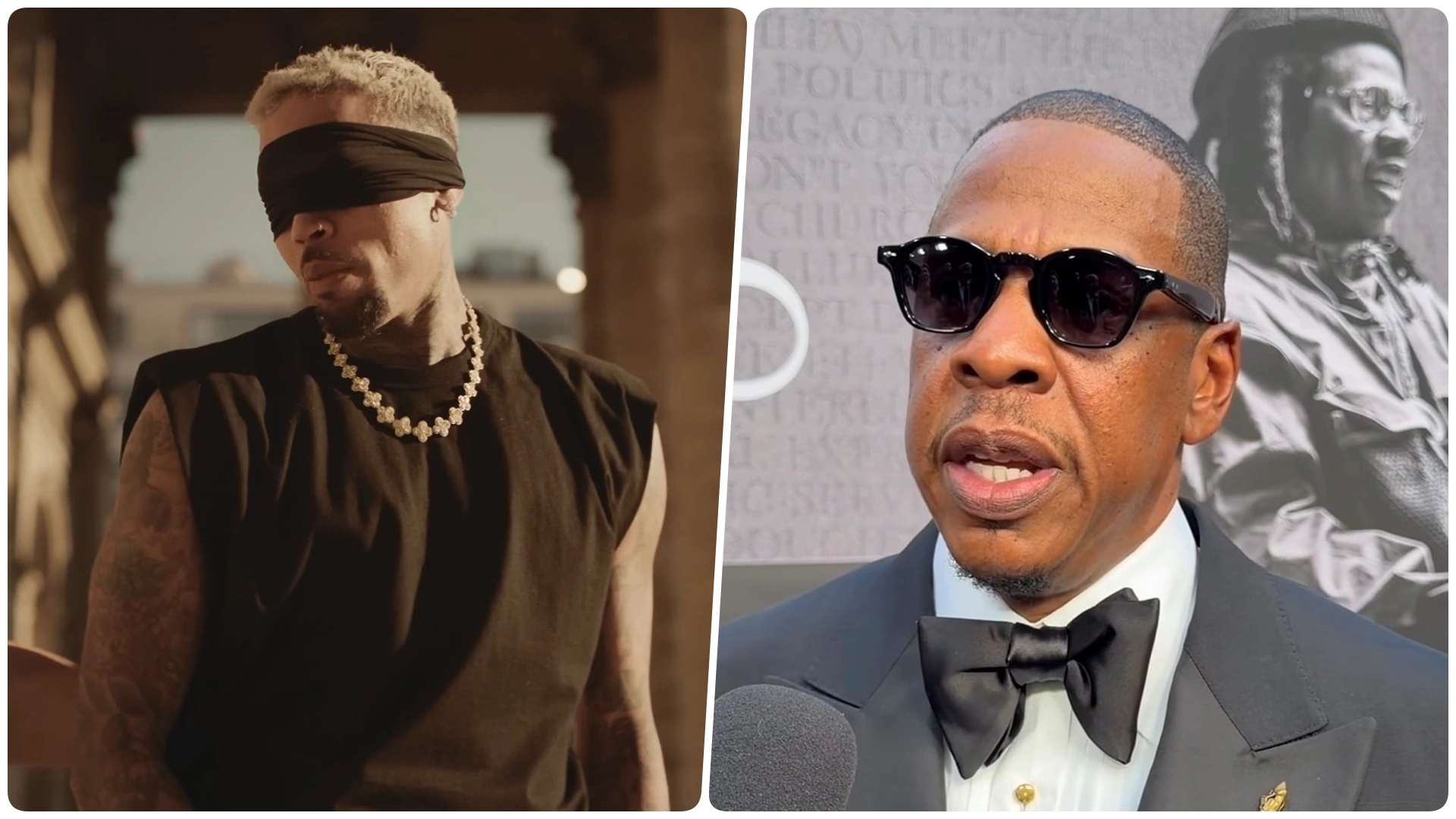
Maria Avila has a decision to make that a Los Angeles jury thought it had already made for her. In June, jurors awarded the former housekeeper $12.9 million over the December 2020 attack by Chris Brown's dog at his Tarzana home. On Tuesday (Sept 29), Los Angeles County Superior Court Judge Huey P. Cotton told her she can keep $9.5 million of it or argue the damages again in front of a new jury.
Her choice leads a week of filings that also reached Manhattan federal court, where the woman who accused Jay-Z of rape swore she had never met him. In another Los Angeles courtroom, a judge cleared Warner and Atlantic out of Sir Jinx's royalty suit. Outside any courtroom, Finesse2Tymes put a price on leaving Mob Ties, and his account of that demand shows how record deals tend to end.
Chris Brown's Dog-Attack Verdict Drops to $9.5 Million
Avila was working at the house when Hades, Brown's Caucasian shepherd, attacked her. She testified that the mauling left her with severe injuries and lasting facial disfigurement, while Brown's side argued that he had warned her not to go outside alone because of the dog.
Brown asked for a new trial after the June verdict, and Cotton's ruling gave him only part of what he wanted. The judge rejected the argument that jurors were improperly prejudiced by hearing a reference to Brown's 2009 assault of Rihanna, and he found that Brown had received a fair trial. His concern was the size of the award, since the trial evidence did not support the extent of permanent nerve damage Avila's side presented, though he still recognized her persistent pain and emotional distress.
California judges do this through remittitur, a procedure written into Section 662.5 of the state's Code of Civil Procedure. A judge who finds a jury's damages excessive can grant a new trial unless the winning party agrees to a smaller figure. The liability verdict stays in place, and the decision passes to the plaintiff. If Avila accepts, she holds a $9.5 million judgment. If she refuses, a new jury hears only what her injuries are worth, and that jury is free to land above or below Cotton's number.
The order leaves untouched the separate $855,000 award to Avila's sister, who was also working at the home when the attack happened. The collection fight keeps moving too, since a judge in August allowed money from Brown's tour earnings to be directed toward the judgment, and his attorneys have already taken steps toward an appeal. Avila's lawyer had not said publicly by Wednesday which option she will take.
In London, Brown is still awaiting sentencing on the affray plea he entered in July, a record HitsCulture set out in full in its Chris Brown ledger.
Jay-Z's Accuser Recants Under Oath
The anonymous woman who accused Jay-Z and Sean "Diddy" Combs of raping her when she was 13 filed a 12-page sworn declaration in Manhattan federal court on Thursday (Sept 24). "Shawn 'Jay-Z' Carter never raped me," she wrote, adding that she had never met or spoken to him.
She sued Combs in October 2024 and amended the complaint two months later to add Jay-Z, alleging an assault at a party after the 2000 MTV Video Music Awards. Both men denied the claims, and the case was dismissed in February 2025. In the new declaration she says nobody paid or promised her anything to recant, and she apologizes to Jay-Z and his family.
His lawyers moved at the same time to drop her as a defendant in his malicious prosecution suit in New York federal court. That case still names her former attorney, Tony Buzbee, and Buzbee's Texas law firm. Buzbee said he had not yet reviewed the declaration and pointed out that she had told the same story to several lawyers before his firm took her case.
The retraction arrived two weeks after Jay-Z lost on the other coast. On Sept. 9, California's Second Appellate District upheld the dismissal of his extortion and defamation suit against Buzbee. The panel agreed that the pre-suit demand letters were protected communications tied to a contemplated lawsuit and that Buzbee's investigation had led him to believe the accusations. Buzbee has said he will seek the fees he spent defending that case.
New York is now the only court where the fight continues, and Buzbee is expected to ask the judge there to dismiss it. The declaration was filed a day before HBO aired the third and fourth episodes of JAŸ-Z in 8, the Rick Rubin series in which Jay-Z walks back through his catalog.
Finesse2Tymes Names a Price for Leaving Mob Ties
Finesse2Tymes says J. Prince Jr. wants almost $1 million plus the Memphis rapper's royalties before he will release him from his Mob Ties deal, which runs through Atlantic Records. The claim surfaced through AllHipHop, and neither the contract nor any written buyout proposal has been made public, so for now the demand exists only in his telling.
He has argued about the deal in public all year. In January he asked Prince to let him go after roughly four years together, and by spring he was calling Mob Ties the worst deal he had ever signed. In May he said he had found a copy of his agreement and run it through ChatGPT after attorneys reviewed it.
He complained about how much of his wider career income the deal covered, about advances being recouped before royalties reached him and about paying for his own music videos. All of it, he has said, cost him the momentum that followed his 2022 release from federal prison, the stretch that produced "Back End" and 90 Days.
What a Record Deal Buyout Usually Costs
Most record contracts are built so that an artist never writes the label a check. Advances are recouped from the artist's share of royalties, and when a record never earns its advance back, the unrecouped balance stays on the label's books instead of becoming a personal debt. Leaving early changes that.
A buyout provision, when a contract has one, lets the artist end the deal by paying what the label has not recouped plus a premium. One entertainment law firm puts the total at about 120 percent of the unrecouped balance. Artists without that clause negotiate an exit from scratch, and labels rarely settle for cash alone.
The usual extra ask is an override royalty, a small percentage the old label keeps collecting on the artist's next records after the artist is gone. The label also keeps the masters it already owns from the deal. The royalties Finesse2Tymes says Prince wants would fit that model. A 360 deal adds another layer to the negotiation, because the label has been taking a share of touring, merch and other income for the length of the term.
Nobody outside the deal knows what balance sits on his account, so nobody outside it can say yet whether $1 million is a fair exit or a steep one. What the money would buy him is what he asked for in January, the right to decide when his next record comes out and who gets paid from it.
Sir Jinx Loses Warner and Atlantic in His Yo-Yo Royalty Suit
Anthony Wheaton, the producer and rapper known as Sir Jinx, says he is owed $62,090 for beats he contributed to Yo-Yo's 1991 debut, Make Way for the Motherlode. Wheaton, a 56-year-old Ice Cube collaborator and a cousin of Dr. Dre, sued in Los Angeles Superior Court in December 2024 for breach of contract, breach of good faith and unjust enrichment.
On Thursday (Sept 24), Judge Randolph M. Hammock dismissed Warner Music Group and Atlantic Recording Corp. as defendants. Hammock heard arguments Aug. 28 after allowing Wheaton to amend his complaint twice, and the companies argued that he still had not pinned down the deal he was suing over. "Simply put, plaintiff does not properly allege the existence of either an oral or implied agreement," their lawyers wrote.
Wheaton says he told the companies in September 2019 what he was owed and never received it, even though he paid income tax on the money. He dropped Universal Music Group from the case last November.

Comments (0)
No comments yet — be the first to share your thoughts.
Leave a comment