

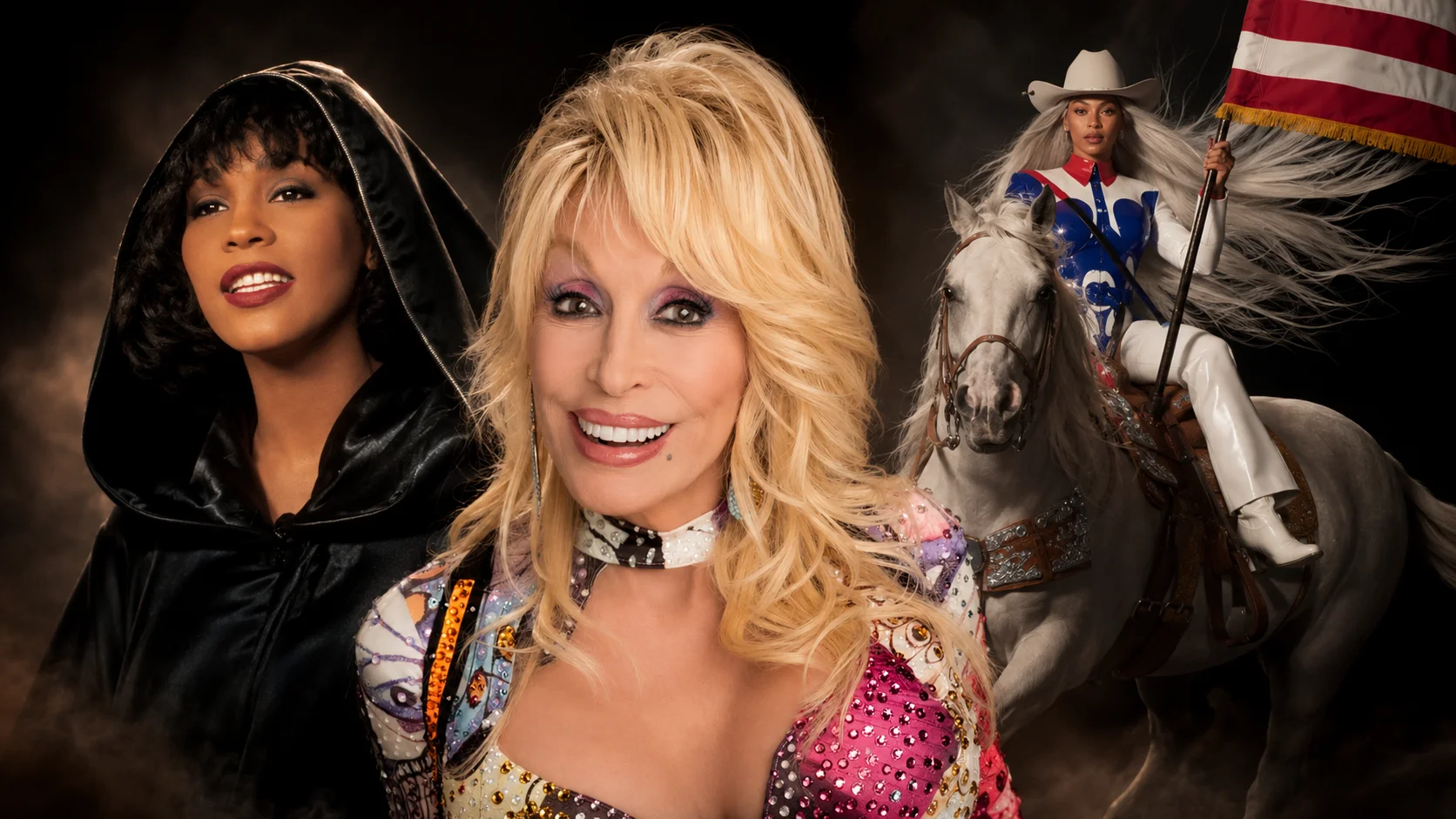
Four Black women have won Album of the Year at the Grammy Awards, and two of the winning records carry Dolly Parton's name in the credits. Whitney Houston took the trophy in 1994 for The Bodyguard. Parton had written its lead single two decades earlier, in a single afternoon, alongside "Jolene." Beyonce took the same award in February 2025 for Cowboy Carter, an album on which Parton speaks twice.
Parton died Tuesday (Aug 25) at 80, at the Vanderbilt-Ingram Cancer Center in Nashville, after what her family described as a brief battle with cancer. The announcement came from her nephew Brian Seaver, in a video she had asked him to record years earlier. By nightfall the Empire State Building had turned its tower lights pink at 9:25, a nod that needed no explaining.
Beyonce posted a statement to her website the same day. "You were the barometer. The north star," she wrote, before thanking Parton for the privilege of having worked with her. That work, two interludes and a "Jolene" rewritten from a plea into a warning, sits at one end of a fifty-year run through Black American music that Parton rarely narrated while it was happening.
The copyright she would not split
Parton wrote "I Will Always Love You" in 1973 as a goodbye to Porter Wagoner, the television host who had given her a national platform in 1967 and did not want her to go. It reached No. 1 on the country chart in 1974, then again in 1982 after she recut it for The Best Little Whorehouse in Texas. Somewhere between those two runs, Elvis Presley's organization built an arrangement and invited her to watch him record it.
The night before the session, Colonel Tom Parker called to explain that Presley cut nothing unless his side took at least half the publishing. Parton told him it was "the most important copyright in my whole publishing company," and said no. The recording was canceled. She has said since that she cried all night over it, and that Priscilla Presley later told her Elvis sang the song to her on the courthouse steps the day their divorce went through.
What she kept in 1974 is the asset that made everything after it possible. It is also the one hip-hop artists are still fighting to hold onto fifty years later, usually after the deal has already been signed.
The verse Whitney almost skipped
In 1992 Kevin Costner pushed the song on his The Bodyguard co-star, after a planned Jimmy Ruffin cover fell through. He played her Linda Ronstadt's 1975 recording as a reference. Ronstadt had dropped Parton's spoken final verse, the one where the singer wishes her departing lover joy and happiness instead of simply walking out. Word got back to Parton that the Ronstadt version was serving as the template, and she called producer David Foster to tell him a third verse existed and belonged on the record.
Houston recorded "I Will Always Love You" on April 22, 1992. She kept the verse, and she kept the a cappella opening her label did not want. The single spent 14 weeks at No. 1 on the Hot 100, a record at the time. It won Record of the Year and Best Pop Vocal Performance, Female at the 36th Grammy Awards, the same night the soundtrack itself took the top prize. The Library of Congress added the recording to the National Recording Registry in 2020, and the RIAA certified it Diamond in 2022.
The house that Whitney built
Forbes has estimated Parton's songwriting royalties from the Houston version at roughly $10 million in the 1990s alone. In 1997 she put part of it into a strip mall and office complex in 12 South, then a Black neighborhood sitting well off 16th Avenue and the Music Row corridor. The Washington Post has reported that other buyers were staying away from the area at the time.
Parton explained the purchase to Andy Cohen on Bravo in 2021. She had wanted to be down there with Houston's people, she said, and thought of the property as "the house that Whitney built." The complex still houses her business operation, which makes the biggest windfall of her writing career a permanent stake in a neighborhood Nashville money had spent decades declining to touch.
Before Cowboy Carter, there was Ghetto Supastar
Dolly Parton’s crossover into Black music also came through a song she did not write. Barry, Robin and Maurice Gibb originally developed “Islands in the Stream” as an R&B song for Marvin Gaye; Barry Gibb later told the BBC that Diana Ross was also considered. Kenny Rogers worked on the track for four days at his Los Angeles studio before telling Gibb he no longer liked it. Parton was brought in from downstairs, and the resulting duet reached No. 1 on the pop, country and adult contemporary charts in 1983.
The song found a second life in hip-hop when Pras Michel, Wyclef Jean, Jerry Duplessis and Che Pope built “Ghetto Supastar (That Is What You Are)” around its chorus for the Bulworth soundtrack. Mya performed the hook, while Ol’ Dirty Bastard reportedly recorded his verse in essentially one take. The production also samples James Brown’s “Get Up, Get Into It, Get Involved,” and the Gibb brothers received songwriting credit. In 2001, the Bee Gees returned the favor with a version of “Islands in the Stream” that adds the “Ghetto Supastar” chorus at the end.
Parton later moved into film and gospel music with Joyful Noise, which she filmed in 2011 alongside Queen Latifah and Keke Palmer. The small-town choir musical featured a score by Take 6’s Mervyn Warren, and Parton wrote three original songs for its soundtrack.
What she said out loud
In 2018, a year after Charlottesville, Parton pulled the word Dixie from the Civil War themed dinner attraction she had been running in Pigeon Forge, renaming it Dolly Parton's Stampede. Lady Antebellum and the Dixie Chicks arrived at comparable decisions two years after that.
In August 2020 she told Billboard, in a cover interview, "Of course Black lives matter." She described her earlier position on the Stampede name as innocent ignorance, the kind a person fixes once somebody explains the problem. The line ran during a summer in which most of country radio was working hard to say nothing at all.
Dolly P
Parton had been publicly asking Beyonce to record "Jolene" since at least 2022, when she told The Daily Show the idea would be killer. It arrived on Cowboy Carter in March 2024 with the begging stripped out and a threat installed in its place. Parton posted her approval the same day, and later told E! News that she had expected her own version and that the rewrite was "very bold of her."
She turns up twice on the album, opening "Tyrant" and delivering the spoken "Dolly P" interlude. There she links the auburn-haired rival of her own 1973 song to the woman Beyonce had sung about on "Sorry" in 2016. At the 67th Grammy Awards in February 2025, Cowboy Carter made Beyonce the first Black woman to win Best Country Album, an award handed to her by Taylor Swift. The album then took the night's top prize on Beyonce's fifth nomination, and she dedicated it to Linda Martell, the first Black woman to play the Grand Ole Opry, who appears on the record. Nothing has followed it, leaving a hole in the touring calendar that no other woman in the genre has managed to fill.
Houston died on February 11, 2012. Jennifer Hudson sang "I Will Always Love You" at the Grammys the following night. A week after that, the Houston recording played at the funeral in Newark, and Parton said hearing it pierced her like a knife. She had written it in an afternoon, for a man who did not want her to leave.
Comments (0)
No comments yet — be the first to share your thoughts.
Leave a comment