

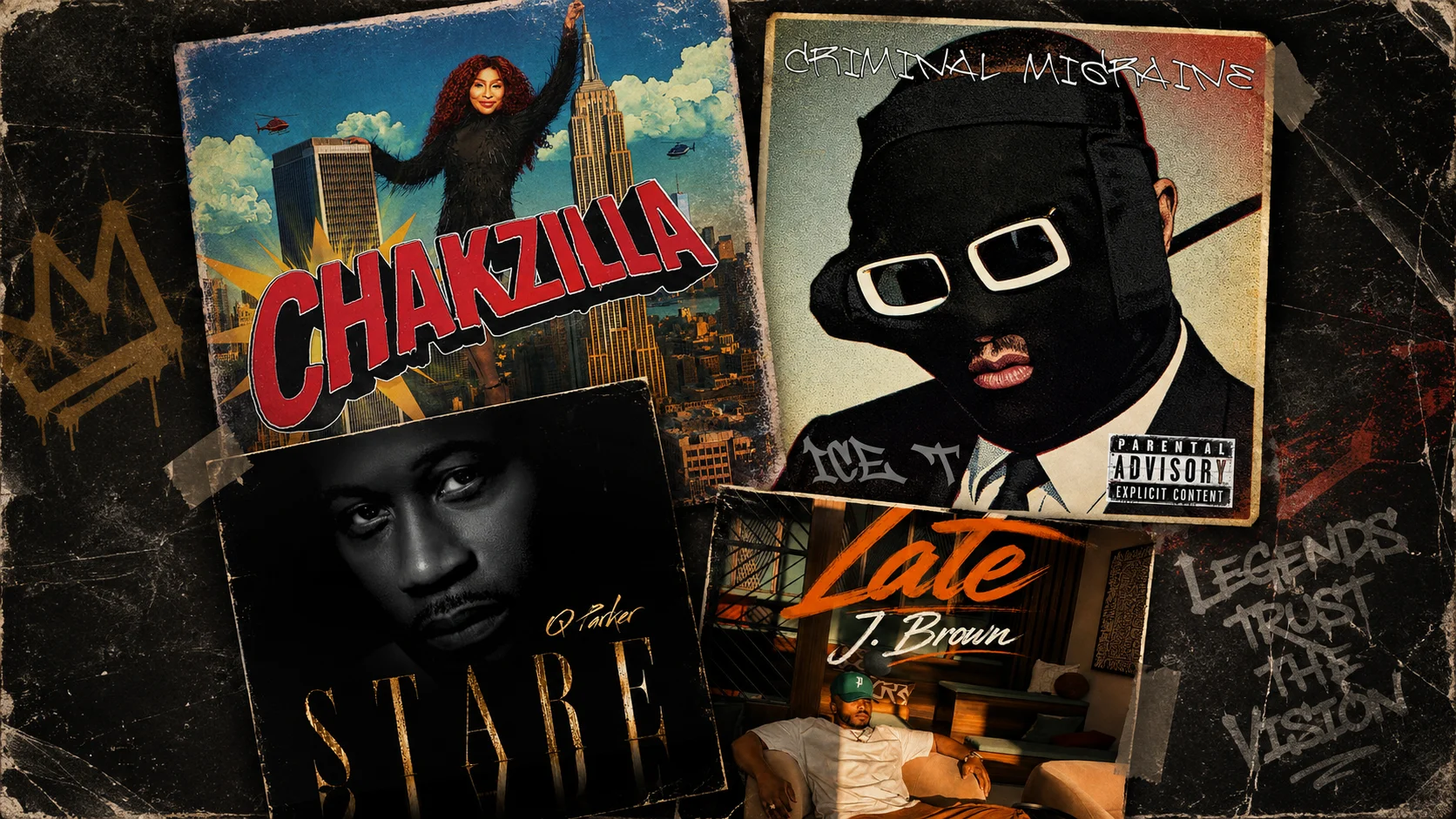
Ice-T made a rap album for the first time in more than twenty years and then decided you couldn't stream it. If you want Criminal Migraine, you have to go to his website and pay somewhere between five and nine dollars for a download, the way people bought music in 2004, back when the last Ice-T solo record came out.
That happened this week, and almost nobody noticed, because Friday was crowded.
We covered the front of the room already: Denzel Curry and Kenny Beats, Rapsody, Jorja Smith, Eric Bellinger in Friday's roundup, and Cleo Sol, Lucky Daye and the Erykah Badu date over in the R&B column. Underneath them sat a second Friday that got no oxygen at all, and it happens to be the more interesting one.
What this weekend gave us
August 21 buried a twenty-three-track Ice-T double record sold off his own website, two Mick Jenkins projects finally escaping a paywall, a ten-year anniversary edition of a PARTYNEXTDOOR classic with three unreleased songs on it, a Chaka Khan single written by Sia, a run of soul records on imprints with no major behind them, and a Detroit rapper quietly putting out nineteen tracks with no label attached. Then on Saturday the Roots announced their first album in over a decade. This new music catch up is where those records live.
Ice-T is running the math himself
The Ice-T Criminal Migraine rollout runs twenty-three tracks across a double album, and the thing to understand about it is the delivery, not the length. It reached the August 21 news cycle after going up direct on August 17, and it is a website purchase, full stop. No DSPs.
Treach appears on three tracks, alongside Smoothe Da Hustler, Ras Kass, and Bumpy Knuckles. Production is shared primarily by Charlemange, credited on seven songs, and P.A. Dre, credited on eight. DaeOne, Afrika Islam, Godfather, and Freddy Foxx handle the remaining production. The result is an intentionally unfashionable Ice-T record, made by an artist with no need to chase current trends. “You’ve heard the music. It’s Ice-T. It’s mature Ice-T,” he told AllHipHop.
Direct-to-fan music sales are often treated as an artist’s last resort, used when traditional industry support disappears. Ice-T’s release challenges that assumption. With a network television role and an established catalog, he does not need the visibility generated by streaming platforms. He wanted the nine-dollar purchase price, and more importantly, a larger share of it. For an artist at his level, selling music directly is not a retreat from the market. It is a deliberate test of pricing, ownership, and how much revenue a fan’s purchase can deliver.
Mick Jenkins finally let two records out of the vault
The other distribution story of the weekend is quieter and, for working artists, more useful. Mick Jenkins put two projects on streaming services Friday that had been living behind a direct-to-fan paywall.
BLACK ASS KUNG FU FLICK, made with greenSLLIME, first went out in February as an EVEN exclusive: ten tracks, a blaxploitation and kung-fu concept record that most of his audience never heard. Type Shit, five tracks and eleven minutes, had been sitting there since January of last year. Both hit DSPs on August 21.
This is what a Mick Jenkins streaming release pattern looks like in practice, and it is the version of the ownership argument that nobody puts on a panel. Sell it directly to the people who will pay, wait, then let the catalog go wide once the direct money is banked. You get both revenues. The order is the whole trick.
PARTYNEXTDOOR opened the drawer
The PARTYNEXTDOOR P3 anniversary edition arrived Friday on OVO Sound, ten years after the original, with three previously unreleased songs attached. Anniversary reissues are usually a catalog department's idea of a good time. This one is not, because PARTYNEXTDOOR 3 is the record where a fairly large amount of what R&B sounds like right now got its template, and hearing what he left off it in 2016 tells you something about how deliberate that record was. He was not throwing everything at the wall. He was cutting.
Chaka Khan, and the singles worth your Sunday
Chaka Khan released "Curious Subject," written by Sia and produced by Greg Kurstin, and premiered it as a COLORS performance, her second after "Through the Fire." It is the third single from the Chaka Khan CHAKZILLA album, due September 18, a record that also has Snoop Dogg and Lenny Kravitz on it. Do not let the guest list distract you. She is singing better at this stage than the last decade of her features suggested she still could, and the line she keeps returning to, the more I grow the less I know, is a strange thing to build a lead single around. It works.
Elsewhere in the singles pile: Blu and Sndtrak dropped "Jesus." ahead of their album LA, out September 4 on Nature Sounds. Tobe Nwigwe put out "Disguise" with Labrinth, Flavour and C.S. Armstrong, and no, the album is not this month, it is October 9. Jay Worthy and George Clinton made "P of the Week" with Leven Kali, which is the kind of pairing that either works immediately or not at all. Russ and A Boogie finally put out "Rider" after four years of it circulating unofficially. Nettspend's "sober" has his mother in the video.
The R&B that arrived without a major behind it
Three soul records came through this weekend on imprints you have to squint to see, and they make a quieter version of the same argument Ice-T made loudly.
J. BROWN LATE arrived through Mocha Music and UnitedMasters, and it is the most Detroit thing released all week. He is from there, he came up singing in his father's church choir, and the record is built on Motown bones: the walking bassline, the horn stabs sitting just behind the vocal, the refusal to hurry. What keeps it from being a costume piece is the subject. It is a song about being somebody's backup plan and deciding not to be.
You only love me when it's late, When there's nobody left to call / When your pride starts to fall, That's when you want me involved.
That is a harder sentiment than the arrangement lets on, and he sings it without raising his voice, which is the correct choice and a rare one. His camp reports early radio adds across New York, Los Angeles, Chicago, Atlanta, Washington, Miami, Charlotte, Buffalo and Toronto, and describes a run of three straight number ones and eight straight top tens on Billboard's R&B charts, most recently "TRUE LOVE" from Just a Matter of Time. Those chart figures come from his team rather than from us. Billboard does not open its pages to our newsroom, so take the streak as his label's accounting and the record as the thing you can judge yourself.
Q Parker's "Stare" was on Friday's slate and we left it out for space, which was a mistake. It is the lead single from Evolution of Romance, Volume Two, due this fall, and it continues a project he has been building in installments: grown R&B about adult attraction, made with obvious intent. He describes the idea behind it simply enough.
There is nothing like when two individuals make eye contact and read each other's soul through their stare.
The song does what the sentence promises. His runs are still the instrument, and the production stays out of their way.
Shazam Conner, a founding member of H-Town, put out a remix of "Back It Up For Love" that pushes the original toward Southern soul and country without sanding off the R&B underneath it. Patrick Postlewait, Twnty47, Jalen Thomas and Phillip Lynah Jr. handled production. Denise "Lady D" built a line dance for it, which explains a lot about where the song has been living.
The song means we will stay together no matter what, because everybody has problems.
Here is what makes it worth more than a listing. Conner's team reports the record has passed 13 million views on TikTok and around 164,000 streams on Spotify, and hit number two on the iTunes R&B and Soul chart. Sit with those first two numbers next to each other. That is roughly eighty TikTok views for every single stream. The song is plainly working: people are dancing to it, filming it, teaching it to each other. It is just that almost none of that activity happens where the money is, and the platform that pays is the one that barely registered it. Every conversation about independent R&B releases and streaming economics eventually arrives at that ratio, and this is the cleanest example of it anyone has handed us in months.
The independent shelf
Three rap records from Friday deserve better than the footnote they got.
Mike Shabb's Sewaside IV is roughly twenty tracks out of Montreal, self-produced, and openly built on Bomb Squad density: layered, abrasive, more sample collision than beat. MIKE, Obijuan and ANKHLEJOHN all show up. It is the most aggressive-sounding record of the weekend and it did not get a single mainstream write-up.
Yung Bleu's Bleu Vandross 4 ran nineteen tracks with Lil Baby and Fetty Wap on it, released independently through his own Vandross Music Group. And Victony's STARLIFE landed the same day, his second album, an Afrobeats record that will end up mattering more in six months than it did on Friday.
The Roots broke a decade of silence on a Saturday
The Roots ENDGAME is the headline nobody expected to write this weekend. The band announced their first studio album since 2014, described as nearly finished and built out of the kind of open-ended jam sessions that made their early records feel like documents of a room rather than a tracklist. No date. No label detail. No features.
One caution before you go repeating it: outlets are split on whether the title is styled Endgame or End Game, and the reporting traces back to a single interview, so treat the styling as unsettled. The announcement itself is solid.
Twelve years is a long time for a band that used to put out a record every eighteen months. Whatever Endgame ends up being, the fact that it came out of sessions rather than files is the detail worth holding on to. That is not nostalgia. It is a different method, and this year has not produced much of it.
What Friday was really telling you
Look at the buried half of August 21 together and a pattern shows up that the front page missed entirely. A rap veteran refused the platforms. Another rapper timed his catalog to hit direct first and streaming second. Three soul records came through small imprints and one of them is being danced to by millions of people who never once opened the app that pays for it. A band went back to a room. None of those are algorithm decisions. Every one of them is a person deciding what the record is for before deciding where it goes, and it is worth noticing that the week's most conventional releases were also its least surprising ones.

Comments (0)
No comments yet — be the first to share your thoughts.
Leave a comment