

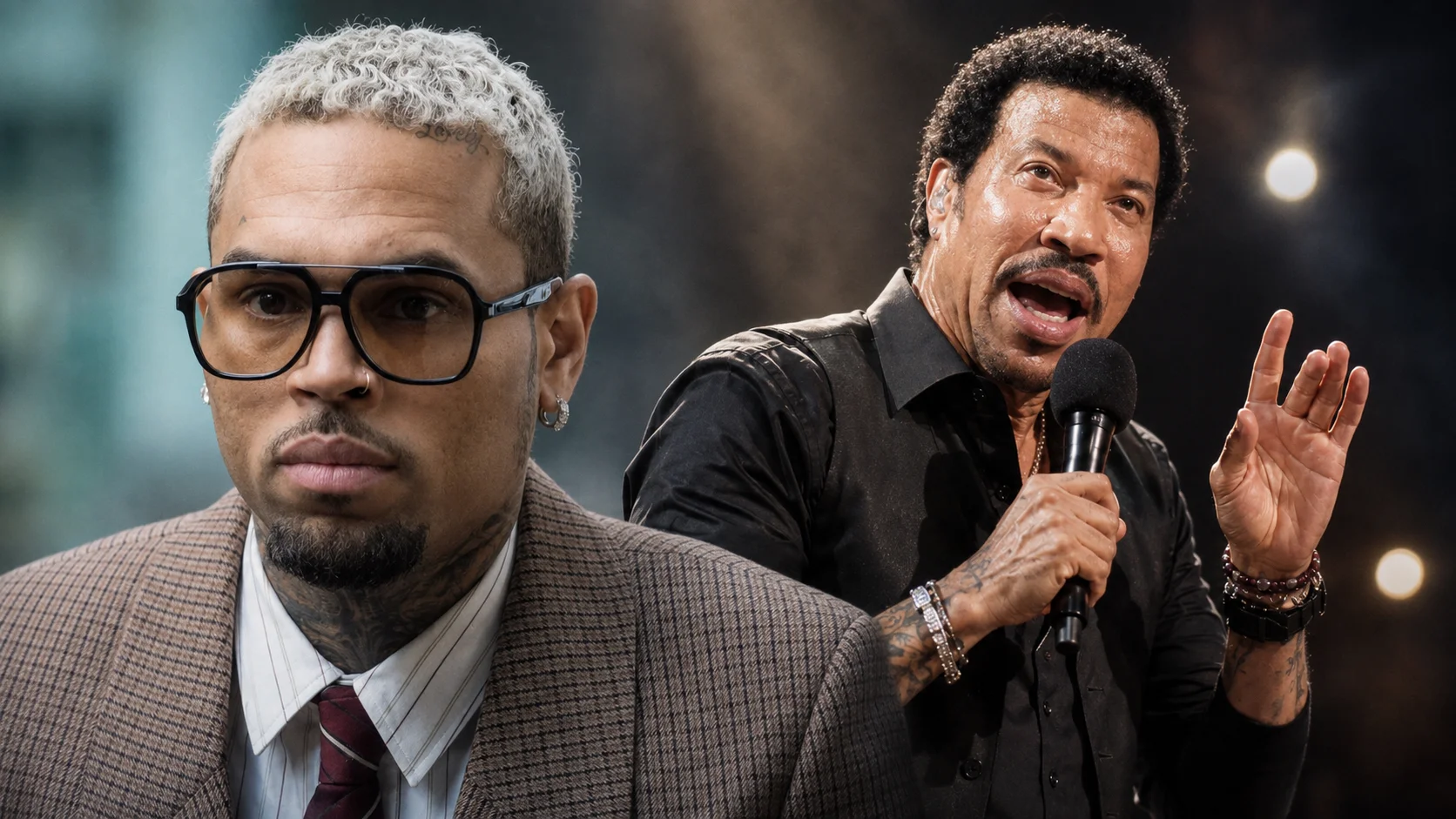
Four dates from the end of his summer tour, Lionel Richie stopped his show in Phoenix on Tuesday night (Aug 11) to talk about two artists who were not in the building. He was at Mortgage Matchup Center with Earth, Wind & Fire, the group he has co-headlined with since 2023. He wanted the crowd to understand that the Usher and Chris Brown stadium tour currently crossing the country was not the invention it had been sold as.
"Usher and Chris Brown, see, they trying to do something new," Richie told the room, according to fan video from the floor. "The Commodores with Earth, Wind & Fire, we were doing that back forty years ago." He continued, "Only difference is, between then and now, we didn't go to jail." The arena laughed. He smiled, said he was sorry, called himself and his peers "fine Christian men," and kept going.
By the next morning the clip was everywhere and Chris Brown had already found it, commenting under a repost with four laughing emojis and a line about loving his paw paw. Tank posted a defense on X, describing himself as an elder who uplifts the next generation. The cycle ran the way these cycles run, on one sentence, pulled out of a longer thought.
The part that got cut off
Richie did not stop at the punchline. In the full version of the clip, he explains the mechanism behind it. Back then, he tells the crowd, there was no Instagram and no TikTok, and nobody went out, told a lie, and posted it. That sentence did not travel. It is not funny, and it makes a claim about surveillance rather than a claim about character.
The controversy underneath it is that the behavior did not change, only the size of the audience watching it did. Forty years ago a man could do something in a hotel corridor at two in the morning, and the only record of it was the memory of whoever happened to be standing there. Now every person in the building is carrying a camera, and the same night becomes a permanent file.
Artist actually went to jail though...
Many of soul music’s most influential figures served prison sentences. Several were incarcerated for the very behavior Richie suggests differentiates generations, and two of the most prominent cases involved violence against women.
James Brown entered prison on December 15, 1988, after a PCP-fueled police pursuit across two states ended with law enforcement officers shooting out the tires of his truck. He served fifteen months at a state prison near Columbia, South Carolina, and another ten months in a work-release program in Aiken before being paroled on February 27, 1991. Fifteen years later, in 2003, South Carolina issued him a pardon.
Rick James, a fellow Motown recording artist, was convicted in 1993 for crimes arising from two separate incidents in which women were kidnapped and assaulted during cocaine-fueled binges. One victim was burned with a heated crack pipe. He served more than two years at Folsom State Prison before being paroled in 1996. In a related civil case, music executive Mary Sauger won a $2 million verdict after James subjected her to a twenty-hour beating at a West Hollywood hotel.
Neither man had a smartphone documenting his actions, and both nevertheless went to prison. That suggests the earlier era was not defined by an absence of consequences so much as by limited public circulation of information. Today, more people find out, they find out faster, and the record often becomes impossible to erase.
Every glitch in Chris Brown's record is a camera
Three incidents account for most of Brown's legal record, and a camera appears at the center of each one.
Around midnight on Feb. 8, 2009, Los Angeles police responded to a call on June Street. Officers photographed Rihanna's injuries, thirty-three images in all, and she asked that the investigation stay confidential. An officer named Rebecca Reyes, assigned to the team preparing to arrest Brown, saw one of those evidence photographs at her precinct and took a picture of it with her personal cell phone. The image reached TMZ. Reyes was fired in 2012, and a Superior Court judge upheld the firing in March 2014, finding she had participated in the release. Brown pleaded guilty and drew five years of probation. The image ran on television for weeks and became the reference point for a national argument about domestic violence.
In October 2013, outside a Washington hotel, Brown was taking a picture with two women near his tour bus when a twenty-year-old named Parker Adams tried to get into the frame. Adams was struck, and Brown's bodyguard was later convicted of assault over it. Brown admitted the incident violated his probation, and on May 9, 2014, Judge James R. Brandlin sentenced him to a year in county jail with credit for 234 days served, leaving 131 days. He served 108 of them. The fight that put him behind bars started over a photograph.
Then Feb. 19, 2023, at Tape London in Mayfair. Prosecutors said Brown struck producer Abraham Diaw over the head twice with a bottle in a crowded club, and that the attack was captured on the venue's surveillance camera. Brown left the country. A warrant sat for two years until he returned to play Manchester and was arrested on May 15, 2025. He pleaded guilty to affray at Southwark Crown Court on July 24, 2026, with the more serious counts dropped in exchange. The Crown Prosecution Service confirmed he will be sentenced on Oct. 26, 2026. The charge carries a maximum of three years. We laid out the full ledger of that case, the doctorate that preceded it, and everything else on the tab in our accounting of Brown's record.
The tour Lionel Richie was talking about is built for phones
The R&B Tour is a thirty-three-date Live Nation stadium run that opened June 26 at Empower Field at Mile High in Denver. It closes Dec. 11 at Raymond James Stadium in Tampa, with multi-night stands at SoFi, MetLife, Ford Field, Allegiant and Mercedes-Benz. Usher comes into it off a North American leg that moved more than 1.1 million tickets across sixty-two sold-out shows. Brown arrives from Breezy Bowl XX, which drew two million fans and grossed close to three hundred million dollars.
The tour’s defining moments have been less about the music than the clips it generates. The serenade segment, in which a woman is brought onstage from the audience, has become a recurring source of viral content. When Usher halted the routine at a Nashville show in July after recognizing a fan’s discomfort, the incident fueled days of debate about consent and audience expectations, which we took apart at the time. All of it was captured and circulated by paying customers holding up their phones.
Richie's own summer arrived the same way
On June 24, opening night at Grand Casino Arena in St. Paul, Richie sat down partially through "Dancing on the Ceiling" and told a crowd of roughly ten thousand he was dizzy. He got through "Three Times a Lady," called an unplanned intermission, and left. Forty minutes later saxophonist Dino Soldo returned to say he would not continue. The show ended at fifty-five minutes. Paramedics escorted the seventy-seven-year-old out and he went to a hospital. Live Nation postponed Chicago and Columbus on doctors' advice, and Earth, Wind & Fire drummer John Paris told the Minnesota Star Tribune that Richie had been a little dehydrated.
The country learned all of this from fan videos, which circulated within hours and were cited in nearly every account of the night. Richie's team never released a diagnosis. The record of what happened to him onstage was produced by the same devices he had just finished complaining about.
Mortgage Matchup Center posts a policy prohibiting professional cameras and video recording equipment, and nobody in the building on Tuesday needed any. The remark that put Richie in every music vertical in the country was captured on a phone by a paying customer standing in the dark. It reached Chris Brown's thumb before the house lights came up.
Forty years ago was also a double bill
The premise underneath the joke is sound, and Richie of all people would know it, because his career began on someone else's stacked bill. In 1971, Motown executive Suzanne de Passe needed an opening act for the Jackson 5. Manager Benny Ashburn pitched a college band out of Tuskegee. The Commodores went on the road with the brothers, signed to Motown's MoWest imprint that year, and took a full Motown contract in 1972. Two Black acts on one ticket, sold as an event, was the business model that produced Lionel Richie.
What the Commodores did not have was an audience that could publish. Motown controlled the photographs, the promoters controlled the venues, and the trade press decided which nights became stories. Richie played a full set in Phoenix on Tuesday. The fragment that left the arena was posted to Instagram by a local radio station, Sunny 104.3, and traveled from there.
Richie and Earth, Wind & Fire close the Sing a Song All Night Long tour Friday (Aug 14) at Moody Center in Austin. Brown and Usher have four months of stadiums left. Brown is due in Southwark Crown Court on Oct. 26.

Comments (0)
No comments yet — be the first to share your thoughts.
Leave a comment