

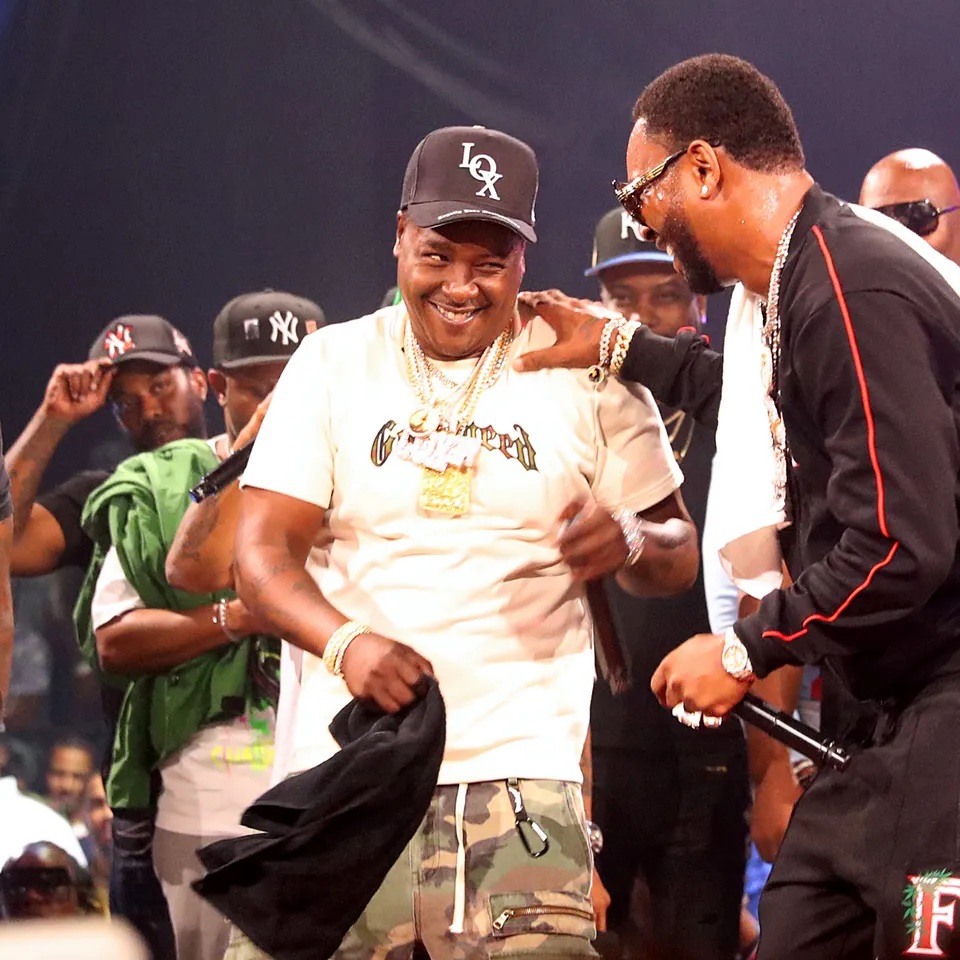
On Still 400, the podcast Mannie Fresh and Juvenile host together, Cam'ron was asked about a tour that never happened, and he answered with a sentence the live business should probably tape to a wall. "They beat us so bad on the Verzuz, that nobody wanted to see the tour afterwards," he said, according to The Source. The run had been assembled before either crew agreed to the event. "Originally, I had a tour set up with us and The L.O.X. before the Verzuz," he said, and the way he tells it now, the night at Madison Square Garden did not advertise that tour so much as retire it.
The short answer to what happened is that an evening of nostalgia settled the exact question the tour was selling, and once the answer was public, nobody needed to buy a ticket to find out. Cam'ron's regret is about sequencing rather than outcome, and he said so directly, wishing the crews had run the tour first and taken the Verzuz money afterward. Five years later, that sequencing problem has spread well past Dipset.
The Night the Argument Got Settled
Dipset and The L.O.X. met at Madison Square Garden on a Tuesday night (Aug 3, 2021), in a Verzuz that moved the format out of a studio and into an arena, and the Yonkers trio of Jadakiss, Styles P and Sheek Louch left with the room. Cam’ron is delivering the verdict, stating that the beating was so decisive it eliminated any commercial interest in a rematch he had already scheduled. Five years on, he still frames the night by what it cost rather than by what it was.
What the arena also did was convert a rivalry into a verdict. For two decades, the two catalogs were the subject of heated debates in barbershops, on message boards, and in the comment sections of blogs. The very argument that ensued became the product of their rivalry. A joint tour would have sold that argument city by city, letting every room render its own decision. The Garden rendered one decision for everybody, at once, on a livestream, for free.
A Black-Tie Orchestra and Two Dark Theaters
This weekend the same physics showed up in North Carolina. Rick Ross canceled the final two dates of the Port of Miami 20th Anniversary Black-Tie Experience Orchestra Tour, a Friday booking (Aug 28) at the Steven Tanger Center in Greensboro and a Saturday booking (Aug 29) at the Belk Theater in Charlotte, with automatic refunds issued and no explanation offered. The tour had been announced on March 11 as a seventeen-city run pairing Ross with the Renaissance Orchestra and the Sainted Trap Choir, and it opened in Miami on May 29 with a dress code.
The concept deserves credit for ambition. Ross took a 2006 street-rap debut, scored it for strings and a choir, moved it out of arenas and into performing arts centers, and asked an audience that grew up on "Hustlin'" to arrive in formalwear. That is a genuine reinvention rather than a victory lap, and it is exactly the kind of idea the veteran market is supposed to reward. Two rooms in the Carolinas went dark anyway, and 50 Cent, who has made a second career of this, posted a jab about it within hours, asking whether things were "not going well?"
Nobody outside the tour's accounting knows why those two nights came off the calendar, and it is worth saying plainly that cancellations happen for illness, for logistics and for reasons that never become public. A twenty-year anniversary, an orchestra, a choir, a pair of performing arts centers rather than arenas, and the run still did not finish the way it was drawn.
What the Mid-Year Ledger Says About the Middle
The touring economy is not shrinking, which is what makes this worth debating. Pollstar's mid-year business analysis, published June 22, put global grosses for the top one hundred tours at 3.16 billion dollars, up 12.3 percent over the same stretch of 2025, on 26,347,656 tickets sold, up 12.8 percent. Those are records. The average ticket price actually slipped slightly, to 119.92 dollars.
Then the same report turns over the card that explains Greensboro. The per-show average gross fell 5 percent to 1.63 million dollars, and average attendance per show fell 4.6 percent to 13,574. In North America the divergence is starker, with total grosses essentially flat at 1.923 billion dollars, up one tenth of a percent, while the per-show average gross dropped 7.8 percent. More shows, more total money, fewer people in each individual room. The market is expanding at the top and thinning underneath it, and a thinning middle is where anniversary tours live.
Look at who is actually carrying the aggregate. Bad Bunny led the mid-year list at 225.2 million dollars, followed by Lady Gaga at 209.4 million, BTS at 139.7 million, AC/DC at 120.3 million and Ed Sheeran at 105.2 million. Among the five biggest touring acts of the first half of 2026, exactly one raps, and he does it in Spanish.
The Scoreboard That Cannot Be Rented
Set that against the number that ran everywhere this weekend. Outlets reported Drake crossing 140 billion streams on Spotify across all credits, a total that is framed against roughly 130 billion for Taylor Swift and 128 billion for Bad Bunny. The figure comes from third-party aggregation rather than a Spotify disclosure, which is worth noting before anyone carves it into stone, and it measures something real: distribution, duration, catalog depth, and the sheer number of songs on which his name appears.
That distinction is the one this network keeps landing on, and it landed hardest three weeks ago, when J. Cole's streaming totals fell while his rooms did not. It shows up again in the other direction with Usher and Chris Brown stacking stadium dates into the high fifties, two R&B veterans with two decades of catalog who booked the largest rooms available and kept adding to the count. Nostalgia is not the variable that separates them from a canceled theater date in Charlotte. Unfinished business is.
That is the real lesson buried in Cam'ron's answer, and it is more useful than the loss itself. Usher and Chris Brown are selling a live proposition that has never been fully resolved on a screen, because their catalogs are built on performance that does not compress into a fifteen-round format. Dipset and The L.O.X. were selling an argument, and arguments can be settled in one night, in front of everyone, for nothing. The Verzuz era paid enormous cultural dividends and gave a generation of fans a reason to relitigate catalogs they had stopped playing, but it also spent down inventory that used to be sold city by city.
The veteran acts who are converting attention into gate receipts in 2026 have something in common, and it is not a bigger streaming number or a better anniversary. They have a reason for a specific room on a specific night that cannot be replicated on a phone. Ross understood that, which is why he hired an orchestra and a choir and asked people to dress for it. The idea was right. The market underneath it is where the trouble is, and the numbers in Pollstar's June ledger say that trouble is not going to resolve itself by autumn.
Cam'ron closed the subject with a shrug, saying the Verzuz "kind of messed the tour up" and leaving it there. Five years is long enough to be philosophical about lost money. It is also long enough for the rest of the business to notice that the one-night event and the twenty-city tour are competing for the same finite thing, and that the event usually wins because it is free.
Comments (0)
No comments yet — be the first to share your thoughts.
Leave a comment