

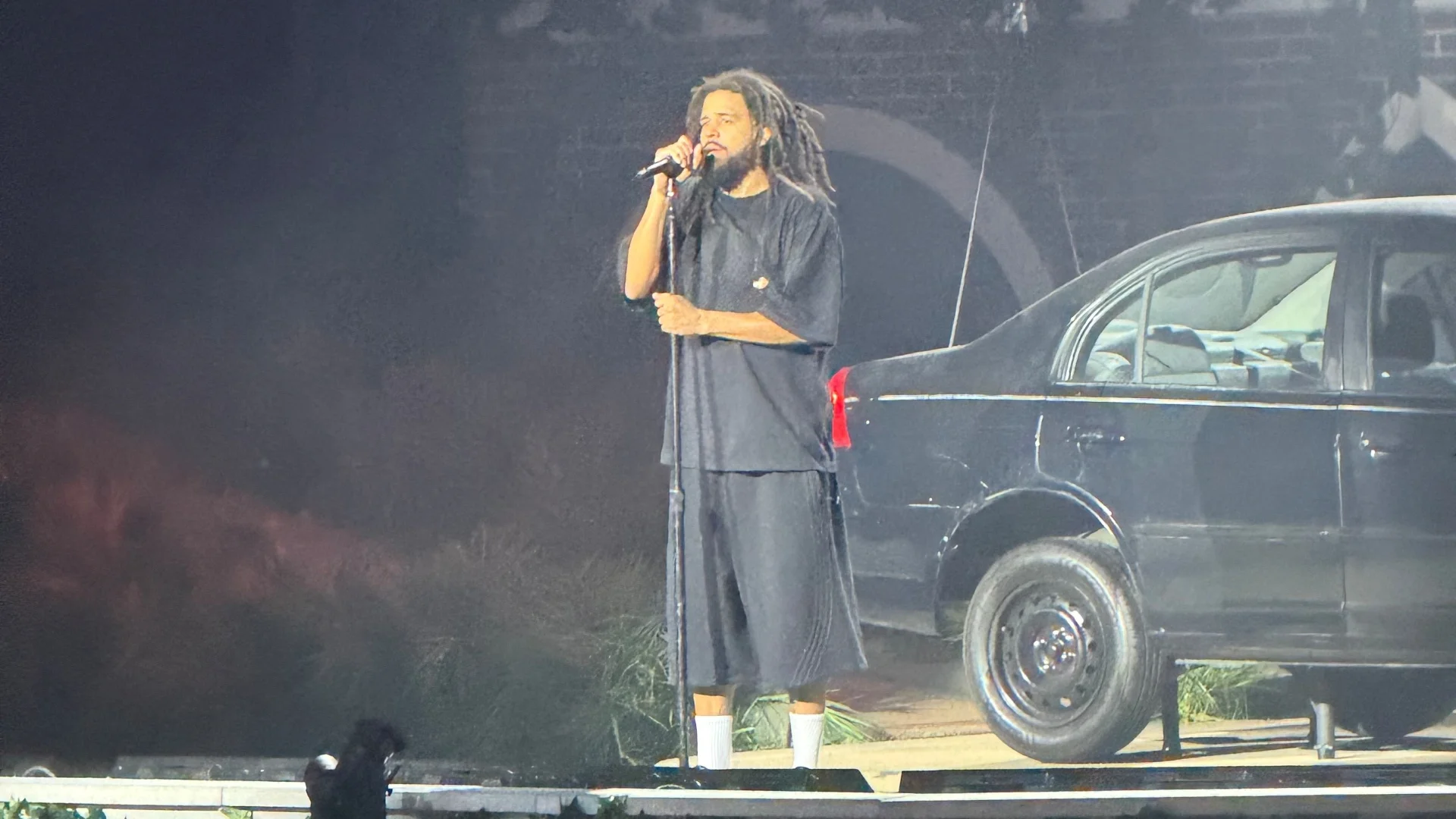
The stage at UBS Arena was set ablaze a little after nine on Wednesday night (Aug 5). From the opening song, it felt like everyone in the room was a hypeman, a backup singer and a collaborator to the man onstage. That is an ordinary tale for hit singles, but much less ordinary for album cuts, the tracks that never received a video or radio push. Songs from Cole World: The Sideline Story, a project that turns fifteen this year, came back word for word from people who were in middle school when it was released. For the majority of the night, J. Cole delivered a lyrical arsenal of songs from his catalog and the crowd was right there with him, riding the beat word for word.
Wednesday was the fifth New York-area date in six nights, following two shows at Barclays Center on July 31 and August 1 and two at Madison Square Garden on August 2 and August 4. J. Cole live at UBS Arena closed the metro run of The Fall-Off Tour, which includes more than 50 dates across North America, Europe, Australia and South Africa. The trek ends December 12 at FNB Stadium in Johannesburg. It is his first solo headline run since 2021 and his first global tour since 2017.
The First Week
The Fall-Off arrived February 6 as a double album split into Disc 29 and Disc 39. Each side includes eleven tracks and a bonus cut, bringing the full project to 101 minutes. Future, Tems and Burna Boy are among the guests, and the two-disc CD sold for $26.26 on Cole's website. By the Saturday morning after its release, he held eight of the top ten songs on Apple Music in the United States. "Two Six" sat at number one, with only Bad Bunny interrupting the run.
The album landed at number one on the Billboard 200 chart, giving Cole his seventh chart-topper in seven tries. The Fall-Off earned 280,000 equivalent album units, the largest week for any R&B or hip-hop album in nearly a year. Of that total, 166,500 came from streaming equivalent album units generated by 169.5 million on-demand plays across 24 tracks. By comparison, The Off-Season in 2021 had pulled 243,000 streaming units out of 325 million streams with only 12 songs. The tracklist doubled while the number of plays roughly halved.
Pure album sales moved in the opposite direction. The Fall-Off sold 113,000 copies, compared with the 37,000 moved by The Off-Season. Roughly 80,000 of those were vinyl sales, representing about 71 percent of all copies sold and the largest vinyl week of Cole's career. It was also the first time one of his albums shipped on vinyl the same day it reached streaming platforms, so the figure is not directly comparable with the rest of his catalog.
The record runs about 101 minutes with long verses. There are few obvious singles, and almost nothing is cut to the length of a social media clip. That puts the album at odds with a system we have written about before, one in which sixty seconds of video and a curator's nod decide what breaks in hip-hop and R&B. Those levers are built for frequency and repetition. A 41-year-old rapper releasing a double album about returning home to Fayetteville does not trip many of them.
A Honda Civic With a New Engine
The day after the album's release, Cole posted a photograph of his old Honda Civic with the trunk open and boxes of CDs stacked inside. He announced the Trunk Sale Tour after installing a new engine and speakers in the car. Cole and his manager, Ib Hamad, started at Crabtree Valley Mall in Raleigh, moved on to UNC-Chapel Hill ahead of a Duke game, then visited North Carolina A&T in Greensboro, where Cole had sold CDs while coming up.
From there, the route continued through Charlotte, Greenville, Atlanta, Hampton, Howard and Silver Spring before reaching New York. At Hampton, a student named Kelo Soul walked up to the car and freestyled for Cole, who shouted him out afterward. In late February, the Civic broke down, and a crowd formed around it while it waited to be repaired. Cole announced the entire route in three words: "catch me outside."
He explained the impulse in the same post, returning to the years when he was a teenager in Fayetteville selling copies of a local group's record at gas stations. He opened every pitch by asking strangers whether they liked hip-hop.
What He Said Onstage
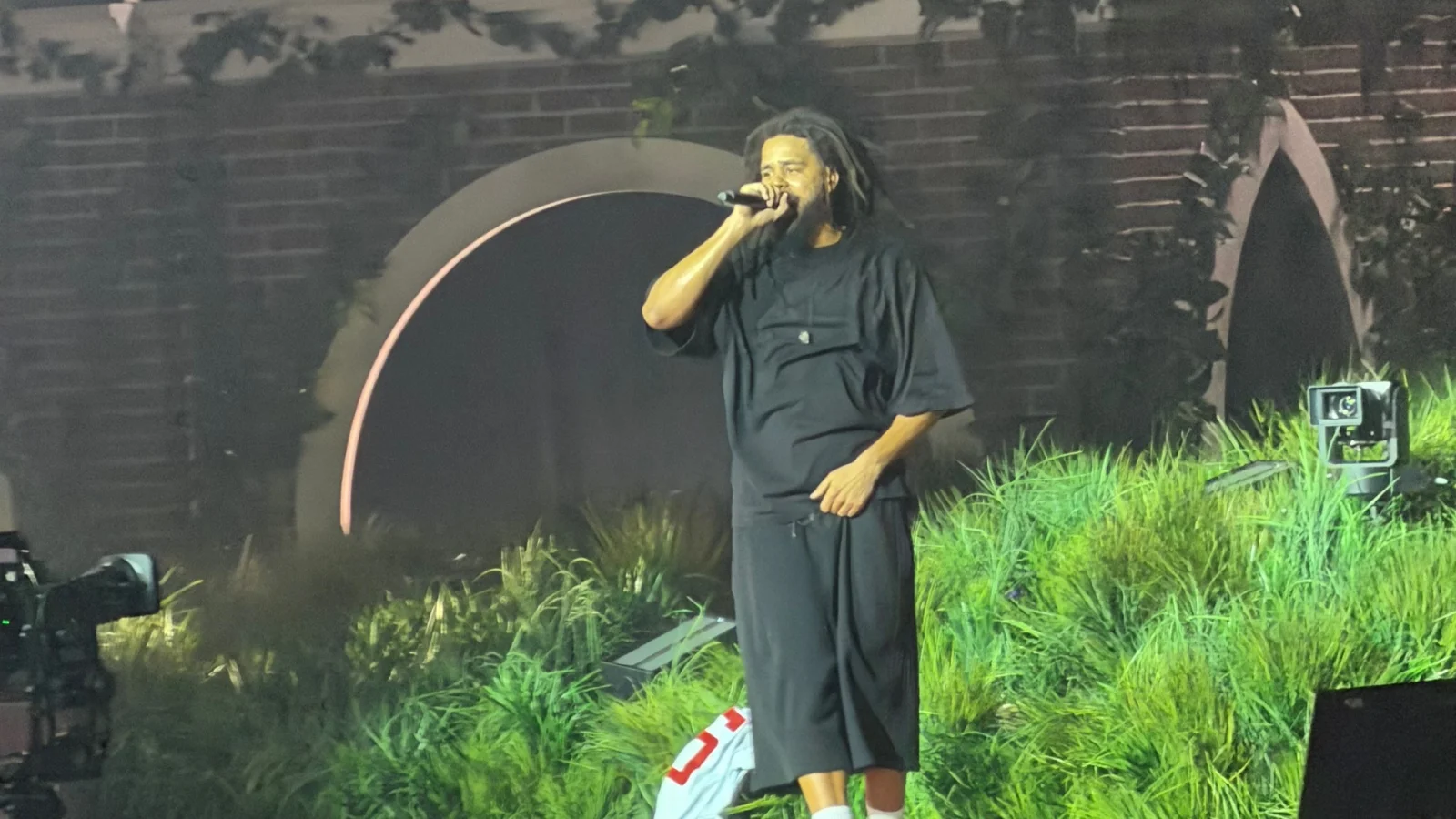
Cole stopped the UBS Arena show to discuss where the album came from, describing a period when he did not feel welcome in the city he had spent his life putting on the map. He also named what went into the writing: hate, love that turned out to be performance and a sadness sitting underneath both.
In his release note, Cole framed the first disc as a return home at 29, when he was at a crossroads with his woman, his craft and his city. The second disc follows the same journey a decade later through the perspective of a man "older and a little closer to peace."
That second disc exists because of 2024. Cole released "7 Minute Drill," removed it from streaming and apologized to Kendrick Lamar onstage at Dreamville Festival. He has since said the period that followed left him re-inspired. The project grew from a single album into a double, expanding far enough for him to commission a separate cover to mark the change.
No Dancers, No Screens
The arena rap show he is running has no dancers, costume changes or video interludes. There is only a live band, a catalog spanning seven albums and roughly two hours to move through it. He regularly drops out of songs and lets the crowd carry the choruses. In Elmont, the audience responded without hesitation, even on tracks that were never released as singles. Across the five area dates, fans spent the following days comparing setlists and arguing about everything he had been forced to leave out.
A Ticket and a Stream
A ticket is a dollar collected. A stream is a fraction of a cent divided several ways before it reaches anyone who made the song. That is the formula we examined in our look at why millions of plays still are not paying most artists' bills. Live performance revenue remains the most direct money in the business. An artist like J. Cole who owns his masters and controls his Dreamville imprint keeps considerably more of whatever comes through the door.
Cole sold 113,000 copies of an album to listeners who wanted the physical object. He then booked more than 50 dates across four continents, with a stadium finale in Johannesburg scheduled for December. None of that changes the fact that 24 tracks is a great deal to ask of an audience, or that parts of the album wander. None of it mattered in Elmont. The crowd moved through the album cuts the same way it moved through the singles, and when Cole stopped rapping, the room kept going without him.
Comments (0)
No comments yet — be the first to share your thoughts.
Leave a comment