

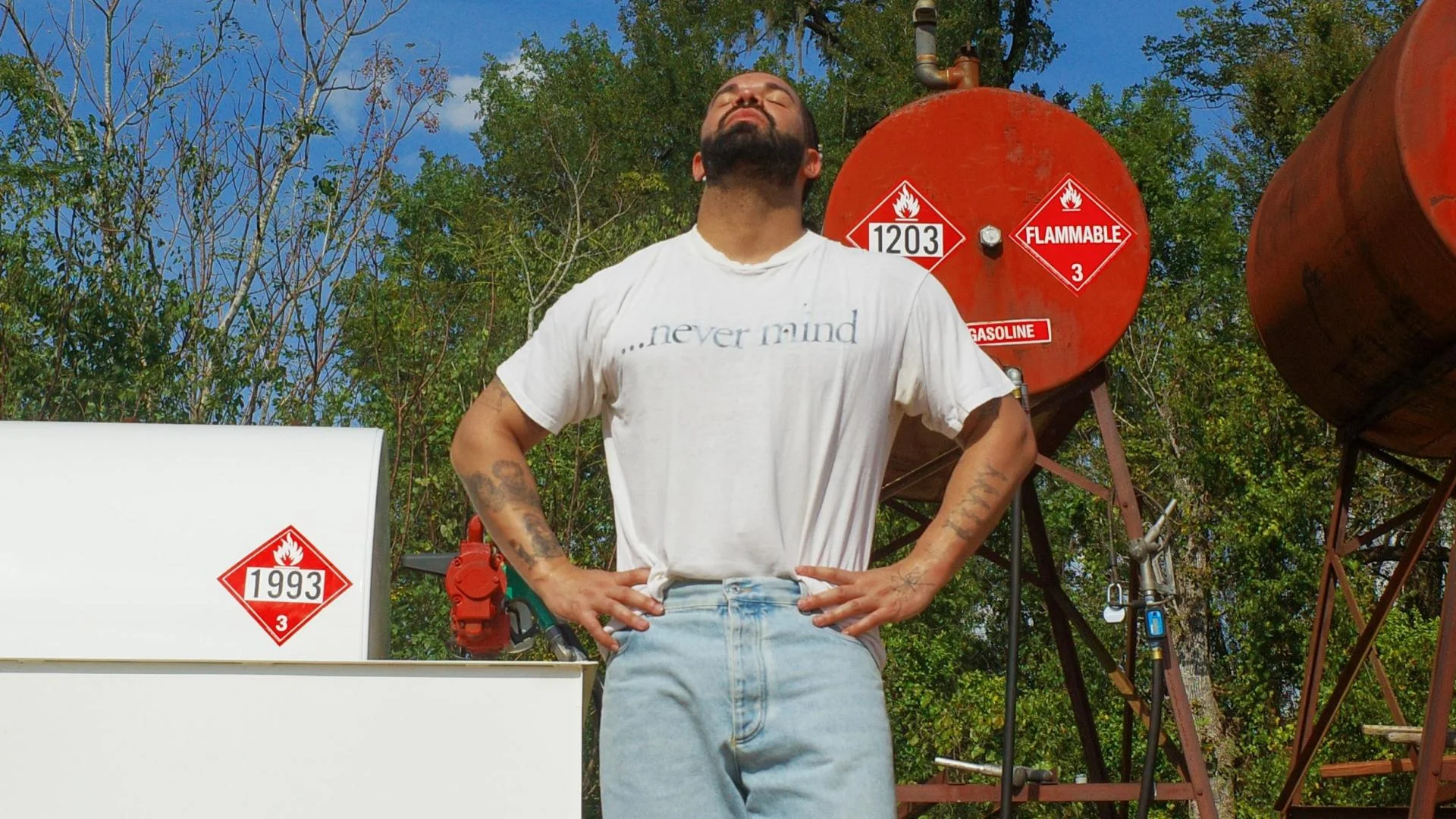
Aviel Calev Hirschfield, a Portland songwriter who records as GoodbyeCalev, says he spent December 2025 and January 2026 writing an eight-line chorus over an instrumental by the production duo FnZ, finished the recording around January 25, and then sent it to FnZ and other producers in Drake's circle. On May 15, Drake released "Janice STFU" on Iceman, with FnZ credited as producers and Drake listed as the only artist. Last Friday (Oct 16), Hirschfield sued Drake, OVO Sound, UMG Recordings and Universal Music Publishing in federal court in Los Angeles, claiming the chorus is his.
According to the complaint as described by Music Business Worldwide, the taking was so literal that Hirschfield "assumed he was of course receiving co-writing credit." A Drake representative answered that "there is not one iota of truth to these accusations" and that "Drake wrote this song and has no connection or knowledge of this person full stop." A court will take months to sort out who wrote what, but the paper trail on Hirschfield's side can be read today, and it is short: no split sheet, no co-writer registration with a performing rights organization, and a copyright registration that took effect on July 21, more than two months after the song was on every streaming service.
For working artists, the fix starts in the room. A split sheet is a signed, dated record of who wrote what percentage of a song, and it belongs in the session, before anything is pitched or released. Each writer then registers that same share with a performing rights organization, ASCAP or BMI for most independents, while copyright registration runs on its own separate clock that decides which remedies survive if a dispute ever reaches court.
The same week brought a second credit fight at the far end of a career. In Los Angeles, lawyers for Chad Hugo answered Pharrell Williams's motion to dismiss the suit over Neptunes credits and royalties, a case HitsCulture laid out on Oct 8. One case involves a demo emailed to strangers and the other involves a partnership that lasted three decades, and both turn on the same missing document.
What a Split Sheet Records, and When to Sign It
The distributor Symphonic's free split sheet template asks for the song title, the date, each contributor's legal and stage name, contact details, role, performing rights organization, IPI or CAE number, publisher, and a percentage, with the percentages adding up to 100. Its guidance on timing is blunt: "The best time is during the writing session or immediately after the song is finished." The same guide adds that, at the latest, splits should be settled "before the song is released or pitched for sync."
One line on that template trips up rap sessions more than any other. "Composition ownership and master recording ownership are separate," the guide notes, and it warns writers not to assume the same percentages apply to both. The person who owns the recording is not automatically a writer, and the producer who built the beat often is. Ari Herstand, the musician and author who runs Ari's Take, writes that in hip-hop the producer "who makes the beat will demand 50%" of the song, and he tells every writer that "each songwriter must register their own splits with their publishing entities." His own sample split sheet carries a disclaimer worth repeating to any session: "This is NOT a legal document and I do recommend getting a lawyer to draw up a formal agreement."
The sheet itself does not need to be elaborate. A PDF with every name signed, sent by email to everyone in the session along with a bounce of the reference track, creates a dated record that no one has to reconstruct from memory three years later, when a placement or a lawsuit makes the song worth arguing about.
The Two Halves of a Performance Royalty
Performing rights organizations pay for public performances: radio, streaming, television, venues. BMI's royalty policy manual describes the math in one sentence: "BMI considers payments to songwriters or composers and to publishers as a single unit equal to 200%." Writers split their 100 percent among themselves, and "the total publishers' shares may not exceed 100%." That second half is the publisher share, and it is the half independent writers most often leave on the table or misunderstand.
Here the BMI manual is reassuring for artists without a publisher. Where no performing rights have been assigned to a publisher, it says, "the songwriters or composers will receive the entire 200%," divided in the same ratio as their writer shares. BMI's own joining FAQ goes further: "If you are just getting started, you will not need to set up a publishing company," and "Creating a publishing company will not mean that you receive more royalties." A self-published imprint mostly matters once you are collecting from multiple sources or signing administration paperwork, a subject our deep dive on The MLC's unclaimed royalties covers from the mechanical side, where unregistered shares end up flowing to the biggest catalogs.
ASCAP or BMI
Writer affiliation with BMI is free, while publisher affiliation carries a one-time fee of $175 for an individual and $250 for a corporation or LLC. ASCAP charges "a one-time, $50 fee for each application submission," and says it "does not charge annual dues or fees," with writer and publisher memberships filed as separate applications. SESAC, Symphonic notes, "does not accept unsolicited submissions," so most independent writers begin with ASCAP or BMI, and "as a writer, you typically affiliate with one U.S. PRO at a time." Co-writers do not need to share an organization; each registers their own share with their own society.
The registration is what moves money. ASCAP says plainly that it "is advised of the correct shares to be paid when members submit Title Registrations," which means a split sheet that never becomes a registration pays nobody. The cleanest practice is to register the song, with every co-writer listed at the agreed percentage, before the release date, so the first statement that includes it already reflects the sheet.
Copyright Registration Runs on a Different Clock
A PRO registration and a copyright registration are separate filings with separate purposes. The first tells a society how to divide performance money. The second, filed with the U.S. Copyright Office, decides what a writer can recover in court. Under Section 412 of the Copyright Act, statutory damages and attorney's fees are generally unavailable for infringement of an unpublished work that began before the work was registered, and for published works the registration must come within three months of first publication to preserve them.
That is the detail in the Drake case a working artist should study. Hirschfield's demo was registered as an unpublished work, and the registration took effect on July 21, 2026, roughly nine weeks after "Janice STFU" came out on May 15. The complaint asks for actual damages and profits, and for statutory damages in the alternative; statutory damages can reach $150,000 per work where willfulness is found, and attorney's fees often decide whether an independent writer can afford to keep litigating. It specifies no damages figure and, according to Music Business Worldwide, does not ask the court to order a songwriting credit. The demo was also sent out with its stems and metadata intact, and the complaint says his manager gave those files to Drake's representatives as proof of when the chorus was written. Drake's camp, the complaint says, answered with a cease-and-desist demanding he stop publicly claiming authorship.
A demo that is about to circulate to producers outside your circle is worth registering first, and the files that prove its date are worth keeping exactly as the software saved them.
What Happens to the Money When a Split Is Disputed
Societies do not referee authorship, but they do have rules for conflicts. When a later registration for the same work conflicts with an earlier one, BMI's manual says, "we will notify the party submitting the later registration" and request documentation or written confirmation. The writer who filed first, with paperwork behind the filing, starts the dispute in a far stronger position than the writer who shows up after the first royalty statement.
Once lawyers are involved, the money can stop moving altogether. "If BMI is named as a party to a lawsuit, BMI may withhold royalties relating to that dispute," the BMI royalty policy manual reads, and the organization can also hold royalties on a work in litigation once it receives the complaint and a court directive. Held funds can move to an interest-bearing account "when accumulated royalties exceed $1,000," and the parties can instead direct payments to a third-party escrow agent until the case is settled or decided. For a song in heavy rotation, that freeze can sit on years of income for every listed writer, including the ones nobody is suing.
The Neptunes and the Handshake That Covered Everything Except the Songs
Hugo's filings describe a partnership in which he and Williams agreed, over more than 30 years, to divide all Neptunes assets equally. What the filings do not include is a song-by-song record of who wrote what, and the motion to dismiss went straight at that gap. Hugo's first amended complaint named eight songs, among them Rosalía's "La Combi Versace," Latto's "Real One" and Nigo and Tyler, the Creator's "Lost and Found," while the second amended complaint names only EarthGang's "U Gotta."
Williams's lawyers argued in the Oct 6 motion that "after years of dispute, three years of tolling, and three successive pleadings, those basic facts remain unidentified," and that "it appears that Hugo has no idea which compositions or sound recordings he supposedly authored." Hugo's opposition, filed through attorney Brent Lehman and reported Oct 17, says he was removed from the "U Gotta" credits even though the artists acknowledged his involvement, and it points to nearly 50 studio sessions from 2019 to 2021. "Defendants ask the court to write Chad Hugo out of The Neptunes on the pleadings, before a single document has been produced," his lawyers wrote. "This case is about Williams' effort to rewrite history and turn The Neptunes' success into the work of only one person."
The band side of the partnership, by contrast, was papered. Hugo's filings say N.E.R.D. Music, LLC, formed in 2014, pays Williams 50 percent of touring and certain other income and Hugo and Shay Haley 25 percent each, with merchandise and trademark income split in thirds. Hugo estimates he is owed up to $1 million tied to No One Ever Really Dies, a number he can at least measure against a written formula.
A Working Order for the Next Session
Agree on the splits out loud before the session ends, then fill out a sheet with every contributor's legal name, PRO, IPI number, publisher and percentage, and have everyone sign it the same day. Email the signed sheet with a reference bounce to the whole room, and keep the project files untouched. Register the song with your PRO, listing every co-writer at the agreed shares, before the release date, and file the copyright before a demo travels beyond people you know.
Producers sending beat packs and writers pitching hooks into a camp should treat the first email as the moment a song begins to need protection. Hirschfield's chorus left his hard drive around January 25, and his copyright registration arrived on July 21. His case will be argued over everything that happened in the six months between those two dates.
Comments (0)
No comments yet — be the first to share your thoughts.
Leave a comment