

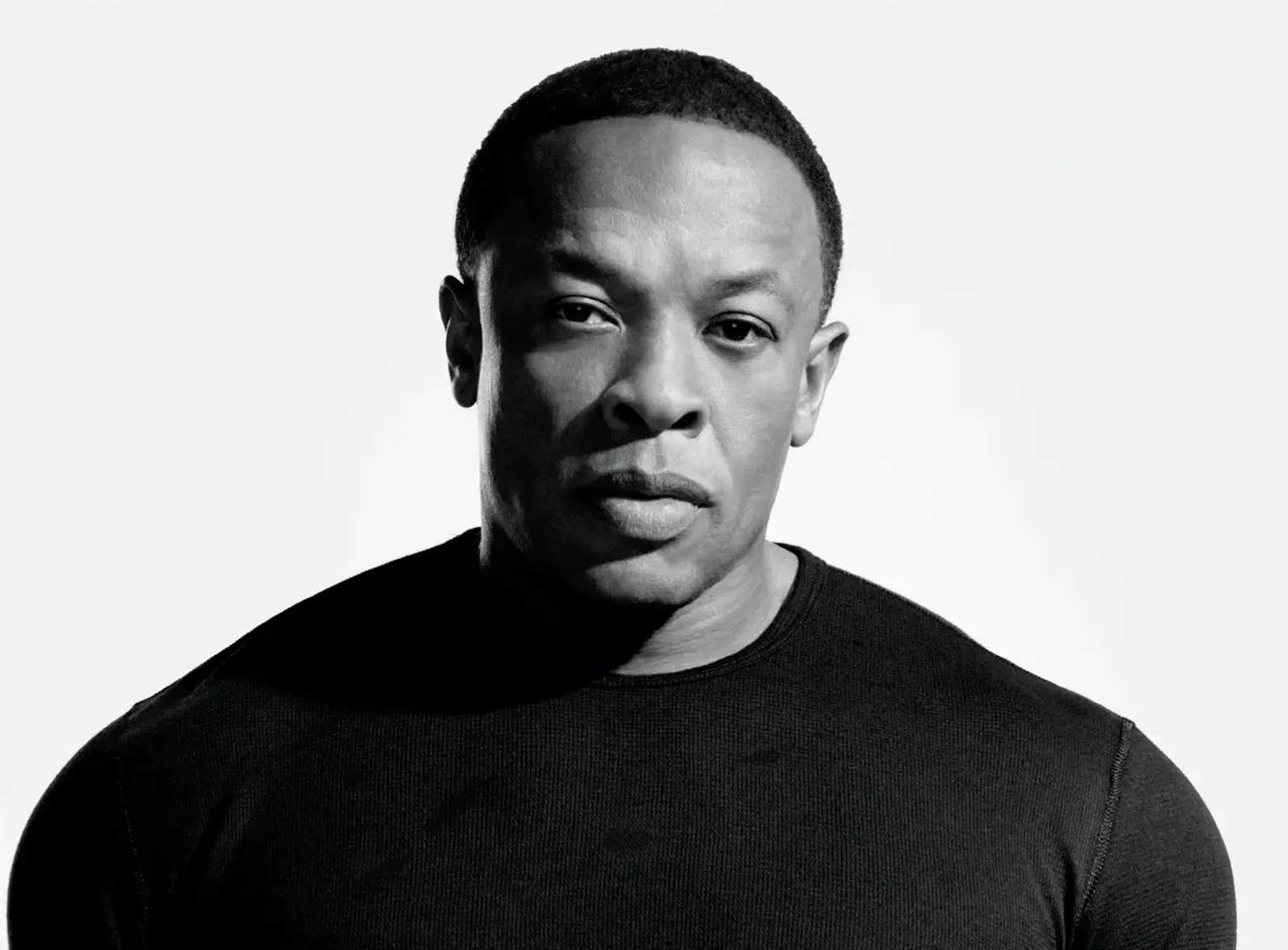
The interview posted on Sunday, and by Monday afternoon, a generation of producers who capitalized on the sound Dr. Dre is credited for inventing were calling him a tourist in his own house.
Speaking to The New York Times, Dre and Jimmy Iovine, his partner at Beats and the executive who turned Interscope into rap's most consequential record label, came out for artificial intelligence in the studio and did not bother hedging. Dre said he does not see it as a threat. He said the people who do are the people who struggle to make things. Then he compared the objection to being scared of a drum machine.
"OK, you sound like the person that would have been against the drum machine when it came out. Or synthesizers. It's a new tool for creativity."
Iovine went further. "I'm very pro-AI in music creation. I don't see the downside at all. There will be some crappy music. There's crappy music now," he told the paper, and added that gifted people with AI in the room will make better records. The remarks were reported across the music stratosphere within hours. He also said the AI companies have the worst public relations in the history of the world, which is the one line in the interview almost nobody has disputed.
DJ Quik, whose influence on Compton rivals Dr. Dre’s, rejected the drum-machine analogy. In an interview with The Shade Room, he described it as cultural violation and appropriation, arguing that creators cannot be recreated while they are alive and actively working. His point highlights the dispute over AI music: a drum machine once replaced a session drummer’s labor, while a model trained on Quik’s catalog could replicate his recognizable identity, voice, and style without replacing the artist himself or securing his consent.
Brian Zisook, who co-founded Audiomack, was blunter about the interview itself, posting on X that "They're all reading from the EXACT SAME SCRIPT." Writer Austin McCoy called the whole thing ill-informed and contradictory. The hip-hop producers and AI fight has been simmering for two years in comment sections and group chats. This week it got names attached on both sides, which is different.
Our read: the drum machine comparison fails on ownership, not on craft. When the 808 arrived, nobody's voice was inside it. Roland did not train the TR-808 on Rick James. The tools Dre is describing were built by ingesting recorded music, most of it Black, most of it uncleared at the time of training, and the producers objecting are not objecting to automation. They are objecting to being raw material. Dre is answering a question about workflow. Quik is asking a question about consent. Those are not the same question, and the interview never separates them.
On August 20, Apple told the distributors that supply music to Apple Music that its AI Transparency Tags will soon become mandatory. The tags were optional since March. Under the new policy, any release in which generative AI created a “material portion” of the work must be identified. That includes music primarily generated by services such as Suno or Udio, as well as AI involvement in compositions, cover art and music videos. Listener-facing labels are expected to appear later this year. Apple said the goal is to provide as much transparency as possible. The change was first detailed on August 20.
The policy's central problem is its lack of a clear threshold. Apple has not said what qualifies as a “material portion,” and it has provided no percentage, formal test or practical examples. Instead, labels and distributors will decide how to report AI use. That creates room for inconsistent outcomes across music catalogs. One distributor might classify an AI vocal-comping tool as reportable, while another might not label a track featuring a fully synthetic guest verse. Artists and labels should therefore document how AI tools were used during production and ask distributors for written guidance before submitting releases.
The AI Transparency Tags system is a disclosure policy, not a ban. It does not prevent a synthetic recording from being uploaded, monetized or considered for playlists. The impact will depend on how listeners respond to the label. More broadly, the change shows how music industry AI policy is increasingly being set by platforms rather than courts or lawmakers. Apple has already faced the challenge of sorting an enormous volume of uploads. With roughly 90,000 tracks arriving each day, human curation cannot handle every decision manually. We examined that upload flood when the problem was still emerging. Apple’s mandatory tags now make clear that platforms are turning to uploaders for help identifying AI-generated content.
A disclosure regime answers one question: was a machine involved. It does not answer the two questions artists keep asking. Whose work trained the machine, and does that person get paid. That is the gap rapper AZ has been building into. He staked a piece of his own legacy on infrastructure for AI music labels for artists and creator-side rights rather than on a lawsuit, which we covered when he announced it, and it reads differently this week. Dre says the tool is neutral. AZ's bet is that the tool is neutral and the plumbing is not, and that whoever owns the plumbing owns the outcome. One of those positions requires you to build something.
Generative AI music tools are cheap, fast and already inside sessions that nobody discusses. Iovine said as much, claiming there are producers using AI who will not admit it, and while outlets have rendered that line inconsistently enough that we will not pin it to a speaker, the underlying claim is not controversial in any studio we know. The tagging requirement will force some of those conversations into the open, one distributor form at a time. That is probably its most useful effect and it was almost certainly not the point.
Authorship is being argued in a second room
While the timeline was busy with Dre, opening statements began Monday in Los Angeles federal court in the murder-for-hire case against Durk Banks. Judge Michael Fitzgerald is presiding. The government has signaled it will put his lyrics in front of the jury; the defense has already framed his catalog as art and as his profession. He faces mandatory life if convicted on all counts, and the trial is expected to run at least three weeks.
Set the two stories side by side and the symmetry is uncomfortable. In one room, an artist argues that the words in his songs are authored performance and not confession. In the other, a platform is building a system to declare which words were authored by a person at all. Neither conversation is being had by the same people, and both come down to the same premise: that it matters who actually made the thing.
What this changes for an artist this week
If you release music through a distributor, expect a new required field and expect it to arrive without much guidance. Ask your distributor now, in writing, how it defines material portion, because that definition is the one that will be applied to your catalog and you did not get a vote on it. If you used a model anywhere in the chain, including for stems, mastering assistance or a demo vocal you later replaced, decide your own disclosure posture before a form forces a rushed answer. Vague answers age badly on a platform that is about to start showing labels to listeners.
And keep the two arguments apart, because the industry benefits when they blur. Whether AI belongs in a session is a taste question, and Dre is entitled to his taste. Whether the training data was licensed and whether the money moves back is a contract question, and taste has never once settled a contract.
Quik's line is the one worth carrying out of this week. You cannot recreate somebody that's still here doing what they do. The people being recreated are still in the building. Most of them are still owed.

Comments (0)
No comments yet — be the first to share your thoughts.
Leave a comment